Anyone researching CBD in Pakistan will quickly notice how difficult it is to find clear and reliable answers. Questions around legality, THC content, hemp classification, and product compliance create uncertainty for first-time buyers and even regular users. Through this guide, CBDOILS.PK aims to provide straightforward, well-structured information so readers can better understand the legal position of CBD in Pakistan and approach the market with greater clarity and caution.
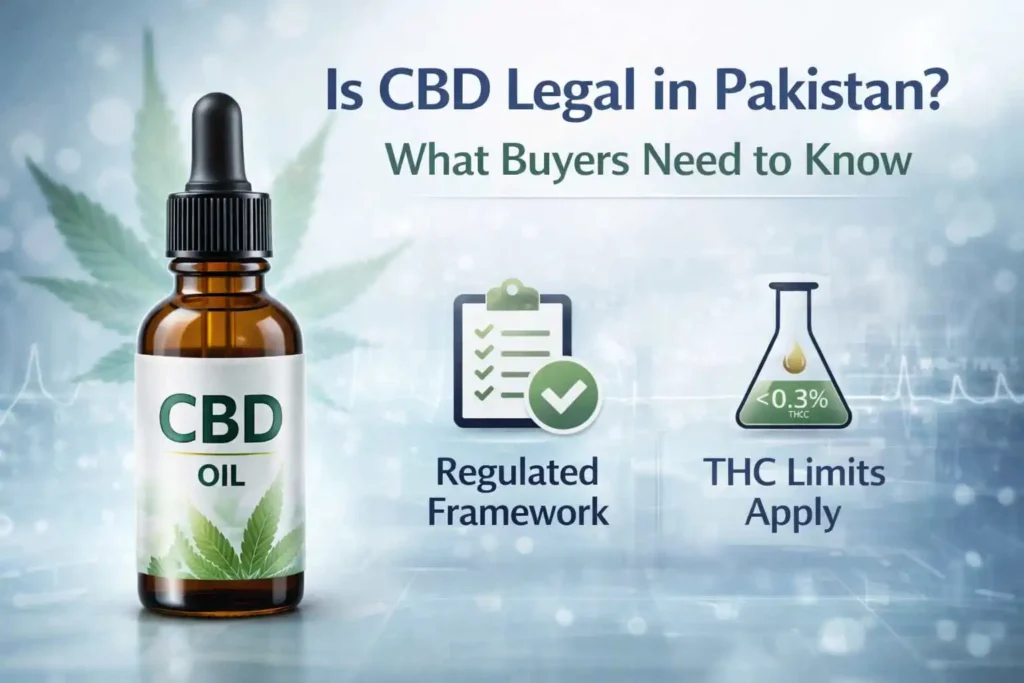
Here’s the short answer: CBD in Pakistan sits inside a regulated cannabis and hemp framework, not a free-for-all market. Pakistan has enacted the Cannabis Control and Regulatory Authority Act, 2024, and official policy defines industrial cannabis/hemp as below 0.3% THC. But buyers should not assume that every CBD product on a website, Instagram page, or marketplace is automatically compliant just because it is labeled “CBD.”
Is CBD Legal in Pakistan?
The honest answer
CBD may be legal in Pakistan when it falls within the country’s regulated hemp and cannabis framework, especially where THC limits, licensing, and compliance requirements are met. That is very different from saying all CBD products are openly legal in the same way ordinary supplements are sold. Pakistan’s federal framework now regulates cannabis-related activity for industrial and medicinal purposes, and the official licensing structure covers cultivation, processing, manufacturing, research, and related activities.
That matters because readers are not really asking a theory question. They are asking: Can I buy CBD in Pakistan without getting misled or buying something non-compliant? That answer depends on the product’s THC content, sourcing, testing, and whether it fits the legal structure Pakistan is building.
Why There Is So Much Confusion Around CBD in Pakistan
Let’s be real—most of the confusion comes from three places.
1. People mix up hemp, cannabis, and CBD
These are related terms, but they are not interchangeable. Hemp is generally treated as low-THC cannabis in the regulatory context, while CBD is one compound that can be derived from cannabis or hemp plants. If a reader does not understand that difference, they will misunderstand the law too.
For readers who need the basics first, see What Is Hemp?.
2. Pakistan’s legal position is more regulated than most blog posts admit
A lot of content online copies U.S. or generic global CBD wording. That is lazy. Pakistan’s framework is not simply “CBD is legal” or “CBD is illegal.” The country has moved toward a controlled industrial and medicinal model, with a dedicated federal regulator and defined license categories.
3. Retail sellers often speak with more confidence than the law deserves
This is where buyers get burned. In cities like Islamabad, Lahore, or Karachi, you may see imported oils, repackaged drops, or vague “hemp wellness” products sold online with little proof behind them. A label alone means nothing if there is no batch testing, no clear THC disclosure, and no compliance trail.
What Is the THC Limit for Hemp in Pakistan?
Pakistan’s official National Cannabis Control and Regulatory Policy – 2025 describes industrial cannabis/hemp as less than 0.3% THC. That threshold is central because it separates regulated low-THC hemp from higher-THC cannabis categories in the policy framework.
That does not mean every product under 0.3% THC is automatically legal in every retail context. It means the low-THC threshold is part of the policy and compliance structure. Buyers still need to look at the full picture: product origin, testing, labeling, and whether the product fits a lawful supply chain.
Is Hemp Legal in Pakistan?
Pakistan has already moved past the old “all hemp is banned” assumption. The federal government approved industrial and medical use of hemp years ago, and since then the legal framework has become more formal through the CCRA Act, 2024 and subsequent policy and licensing rollout. Official sources now describe a national system to regulate industrial and medicinal cannabis activities.
That is why understanding the plant categories matters. If your audience is still unclear on terminology, direct them to Hemp vs Cannabis vs CBD.
What Is CCRA Pakistan?
CCRA stands for the Cannabis Control & Regulatory Authority. It is the federal body created to regulate and oversee cannabis-related activity within the industrial and medicinal framework in Pakistan. Official CCRA materials describe its role as regulating, supervising, and controlling cultivation, processing, research, export, licensing, and monitoring.
Pakistan’s Senate records show the Cannabis Control and Regulatory Authority Act, 2024 was passed in September 2024. That is not a rumor or a blog claim. It is part of the formal legislative record.
If the term still sounds abstract, this page should be linked naturally here: What Is CCRA Pakistan?
Can You Buy CBD Oil Online in Pakistan?
You can find CBD products online in Pakistan, but availability is not the same thing as legal clarity or compliance. That distinction is where many buyers go wrong.
Too many people assume:
- if a product is being shipped, it must be legal
- if it says hemp, it must be compliant
- if the label says “non-psychoactive,” it must be safe
None of that is enough.
A compliant-minded buyer should check:
- THC disclosure
- batch-specific lab testing
- ingredient transparency
- seller credibility
- whether the product is clearly positioned within a lawful, low-THC framework
If a seller cannot explain what is in the bottle, where it came from, and how THC is controlled, the product is not trustworthy. That is the blunt truth.
Is Recreational Cannabis Legal in Pakistan?
No. Pakistan’s current reforms are aimed at industrial and medicinal cannabis and hemp regulation, not open recreational legalization. The legal movement is toward controlled licensing and regulation, not a retail recreational market.
This point matters because some buyers hear “cannabis law changed” and assume all cannabis-derived products are now broadly legal. That is false. The law is evolving, but it is still structured around control, licensing, and low-THC compliance.
How to Check If a CBD Product in Pakistan Looks Compliant
Here’s the practical part readers actually need.
Ask for a lab report
A serious CBD product should have third-party testing that shows cannabinoid content, including THC.
Check the THC level
If the product does not clearly disclose THC content, you are guessing. That is reckless.
Look at the seller’s language
If the seller makes wild cure-all claims, hides the source, or cannot explain whether the product is hemp-derived, walk away.
Be careful with imported or repackaged products
This happens a lot in Pakistan. A product may arrive with flashy packaging and still tell you almost nothing useful.
Do not confuse “available” with “regulated”
A bottle being sold online is not proof of lawful status.
At CBDOILS.PK, we believe buyers deserve straight answers, not vague wellness talk or copied foreign claims. If the legal side feels confusing, start with documented product information and compliance-minded education before you buy.
What This Means for Buyers in Pakistan
The safest way to answer the headline question is this:
CBD in Pakistan appears to be viable within the country’s regulated industrial and medicinal cannabis framework, especially for low-THC hemp-derived products, but buyers should not treat the market as universally clear or unrestricted. Pakistan now has a federal law, a regulator, a policy framework, and license categories. But for everyday consumers, caution still matters because product compliance and retail enforcement are not the same thing as a simple “yes, everything is legal.”
Final Word
If you came here hoping for a one-line answer, here it is: CBD is not best understood in Pakistan as fully banned or fully open. It is best understood as regulated.