For consumers in Pakistan who are exploring CBD oil for the first time, product quality is often the biggest concern. Many buyers struggle to tell the difference between a properly tested CBD product and one that only looks convincing on the label, especially when online listings, reseller claims, and imported packaging can hide important details. At CBDOILS.PK, we take an educational approach to this issue by helping readers understand what quality really means, what warning signs to watch for, and which checks matter before purchasing any CBD product.
Here is the problem in plain language: not every CBD product on the market deserves trust. Quality does not come from branding, attractive packaging, or broad wellness claims. It comes from evidence. That includes clear labeling, accurate CBD strength, THC disclosure, third-party testing, and basic safety checks for contaminants. Pakistan’s current policy direction also makes testing and certification especially relevant, with the national cannabis policy stating that certification and testing clearance issued by the CCRA laboratory is mandatory for regulated products.
Why CBD Product Quality Matters So Much in Pakistan
In a tightly regulated and still-developing market, poor product quality creates two problems at once.
First, the buyer may not get what they think they are paying for. A bottle may claim a certain CBD strength, but the actual concentration may be lower, inconsistent, or unclear. Healthline notes that many CBD products are not accurately labeled, which is exactly why buyers are told to rely on third-party testing and careful label review.
Second, the buyer may take on avoidable risk. If a product does not clearly show THC content, ingredient details, or contamination screening, the consumer is left guessing. In Pakistan, that uncertainty matters even more because buyers often purchase through websites, social media sellers, or repackaged imports rather than a tightly controlled retail system.
Let’s be real—too many people assume that if a CBD oil is being sold online, it must already be safe and compliant. That is weak thinking. Availability is not proof of quality.
What Makes a High-Quality CBD Product?
A high-quality CBD product should be easy to verify. The seller should not force the customer to rely on vague promises.
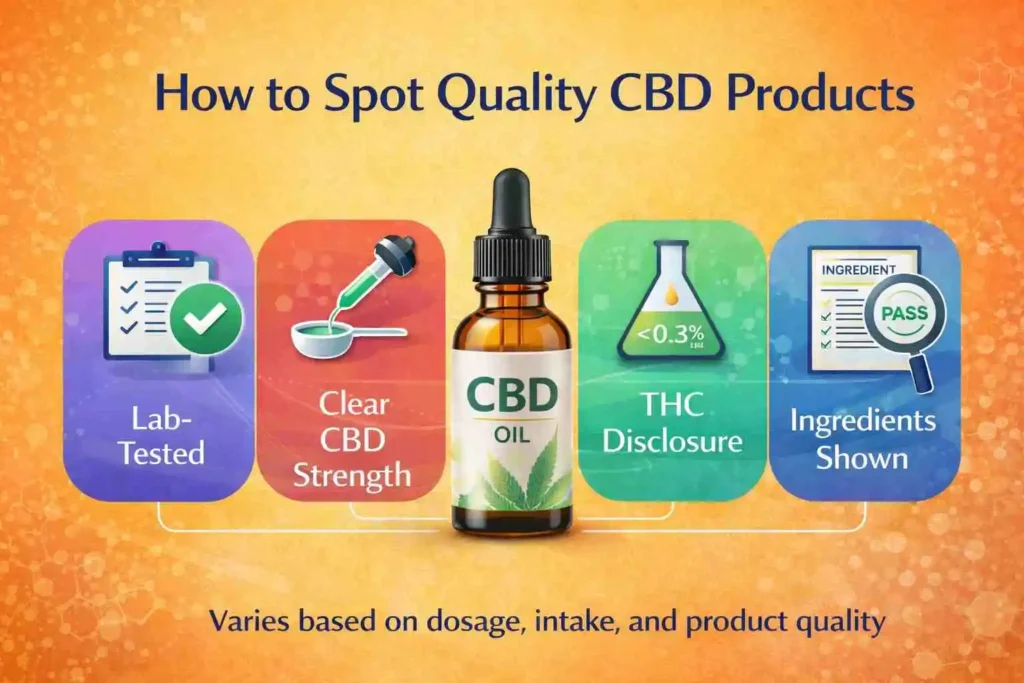
1. Third-party lab testing
This is the first filter. If a product does not have a Certificate of Analysis, or COA, the buyer has no serious way to confirm what is inside. Healthline explains that third-party testing helps verify the contents of a CBD product, while Medical News Today also points to COAs as a way to confirm CBD content and check for contaminants.
For a deeper explanation, readers can review our guide on third-party lab testing for CBD.
2. Clear CBD strength
A good label should not just show a big number on the front of the bottle. It should tell the buyer how much CBD is in the product per serving or per milliliter. Healthline notes that the most useful figure on CBD oil labels is often mg per mL, because that shows the actual concentration.
3. THC disclosure
Buyers need to know whether the product is:
- full-spectrum
- broad-spectrum
- isolate
That matters because THC content affects compliance, user expectations, and product feel. Pakistan’s national cannabis policy uses 0.3% THC as the threshold for industrial hemp/cannabis in the regulatory framework.
4. Ingredient transparency
A trustworthy CBD product should list all active and inactive ingredients clearly. If the label hides key details behind vague phrases like “proprietary hemp blend” or “natural extract formula,” the product is not earning trust.
5. Contaminant screening
A good COA should not stop at cannabinoids. Healthline specifically advises buyers to look for heavy metal and pesticide analysis and to check whether the results show “pass.”
How to Read a CBD Label Without Getting Misled
This is where many buyers lose money.
A product can look polished and still tell you almost nothing useful. When checking a CBD label, look for these points:
- product name and type
- CBD amount per serving or per mL
- THC disclosure
- ingredient list
- batch or lot number
- manufacturer or distributor details
- link, QR code, or access to a current COA
One of the most common mistakes is focusing only on the large number on the front label. A bottle may say “2000 mg CBD,” but that may refer to the entire bottle, not each serving. Healthline warns consumers about this exact confusion and recommends checking the concentration carefully.
For readers who want a fuller buyer checklist, link naturally here: How to Choose High-Quality CBD Oil.
What Should a CBD Certificate of Analysis Show?
A proper COA should match the product you are holding. That means the batch number on the COA should match the batch number on the product. If it does not, the report may be irrelevant.
A useful COA should show:
- CBD potency
- THC level
- cannabinoid profile
- heavy metals
- pesticides
- residual solvents
- microbial screening where relevant
The point is simple: the report should prove both potency and purity. If a seller says “lab tested” but cannot provide a current, readable report tied to the actual product batch, that claim is weak.
Common Quality Problems Buyers Should Watch For
Mislabeled strength
Some products claim a CBD strength that sounds impressive but do not explain the dose clearly. That can leave first-time users confused about how much they are actually taking.
No proof of testing
If there is no accessible COA, the product should not be trusted.
Vague source claims
Saying “organic hemp” or “premium extract” is not enough. Buyers need details, not slogans.
Unrealistic health claims
The FDA continues to note that there are significant regulatory and safety issues around cannabis-derived products, and it has taken action against unlawful marketing in this area. Overblown medical promises are a red flag, not a mark of quality.
Poor seller transparency
If the seller avoids basic questions about source, testing, THC, or ingredients, walk away. A serious business should be able to answer basic product-quality questions without hiding behind sales language.
How Pakistani Consumers Can Shop More Carefully
This is the part readers actually need.
Ask for the lab report before you buy
Do not wait until after delivery. Ask before payment.
Match the batch number
Make sure the COA belongs to the exact product batch being sold.
Check the THC result
In Pakistan, THC disclosure matters for both safety and regulatory reasons.
Review the label like a buyer, not a fan
Do not let design or buzzwords do the thinking for you.
Be extra careful with repackaged or imported products
In local markets, some products may arrive through informal channels with attractive packaging but limited documentation. That is where quality confusion gets worse.
Start with sellers who educate, not just sell
At CBDOILS.PK, we believe consumers deserve clear information before they place an order. That means helping buyers understand what to check, what to compare, and what should raise concern.
Readers who still have basic questions can also be directed to our FAQs.
Does High Quality Mean the Product Will Work Better?
Not automatically. Quality and effectiveness are related, but they are not identical.
A high-quality CBD product means the buyer has a better chance of getting:
- the labeled amount of CBD
- the stated THC level
- a cleaner ingredient profile
- fewer unknowns
That does not mean every person will feel the same effects. Individual response still varies. But without product quality, even the starting point is unreliable.
Why Lab Testing Matters More in a Regulated Pakistan Market
Pakistan’s regulatory framework is moving toward a more structured cannabis and hemp system, and official policy has already emphasized mandatory certification and testing clearance in the regulated environment. That means testing is not just a nice extra. It is central to how product credibility should be understood in this market.
There is also growing institutional capacity around testing and research in Pakistan. PCSIR Laboratories Islamabad states that it will house a National Industrial Hemp and Medicinal Cannabis Analytical Laboratory, alongside broader analytical and advisory services. That matters because buyers and businesses alike need real testing infrastructure, not just marketing claims.
Final Thoughts
Consumers in Pakistan should approach CBD product quality with caution, not fear. The goal is not to avoid every CBD product. The goal is to avoid buying blindly.