
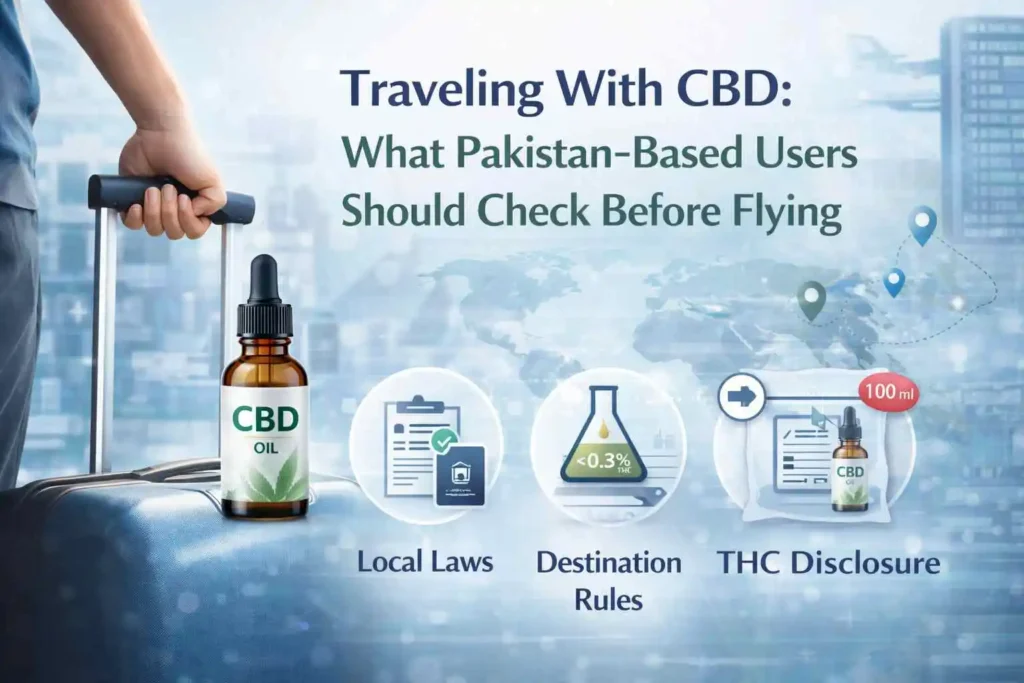
For travelers in Pakistan who use CBD oil and are planning to fly, this guide is built for you. Many passengers worry about carrying a product that seems harmless at home but could create delays, confiscation, or legal trouble at the airport, during transit, or after landing—especially when CBD, hemp, cannabis, and THC are often treated differently across countries. At CBDOILS.PK, we focus on helping readers understand these differences clearly so they can check the right documents, product details, and country-specific rules before they travel.
Here’s the part people get wrong: a CBD product being legal or available in one place does not make it safe to fly with everywhere. Pakistan’s cannabis policy framework uses a 0.3% THC threshold for industrial hemp, but international travel adds more layers: the destination country’s law, the transit country’s law, airport liquid restrictions, and whether your product is clearly documented and labeled.
Can You Fly With CBD From Pakistan?
Sometimes yes. Sometimes absolutely not. That is the honest answer. The safer rule is this: do not travel with CBD unless you have checked the law in every country on your route—departure country, transit country, and destination country. Even countries that allow some CBD domestically may still restrict cross-border carriage or require special permissions. Canada is a good example: the CBSA says not to bring cannabis into or out of Canada, and that includes cannabis products like CBD oil and CBD gummies unless a permit or exemption applies.
For the Pakistan legal side, Is CBD Legal in Pakistan?.
Why Flying With CBD Is Riskier Than Buying CBD
Buying CBD and flying with CBD are not the same issue. A buyer is dealing with product quality and local legality. A traveler is dealing with:
- border law
- customs checks
- airline and airport security rules
- liquid restrictions
- country-specific cannabis rules
- transit-country exposure
That is where people get careless. Someone packs a CBD dropper in Lahore, connects through Doha or Istanbul, and lands in a country with a stricter view of cannabis-derived products. Now the problem is no longer “wellness.” It is border compliance.
What Pakistan-Based Travelers Should Check Before Flying With CBD
1. Check the destination country’s CBD law first
This is the biggest filter. If the destination country bans cannabis-derived products, or only allows very narrow forms of CBD, do not take chances. Japan is a good example of why this matters. Japan’s Ministry of Health has an official process for confirming whether CBD-related products are considered outside narcotics control, and Tokyo Customs states that products considered regulated require import permission from the Ministry of Health, Labour and Welfare.
If Japan is on your route or destination list, Is CBD Legal in Japan?
2. Check every transit country, not just the final destination
This is where sloppy travelers get trapped. A country you only connect through can still create problems if your baggage is screened, re-checked, or inspected under local law. Canada’s border guidance is blunt: cannabis in any form, including CBD oil, is not something travelers should bring into or out of Canada without the proper permit or exemption.
That matters even if the final stop is elsewhere.
3. Check the THC content on your product
A vague “hemp extract” label is not enough. Pakistan’s 2025 cannabis policy uses less than 0.3% THC as the industrial hemp threshold. If your CBD product does not clearly disclose THC content, you are carrying a product you cannot properly explain at a checkpoint. That is amateur behavior.
You should know:
- whether it is full-spectrum, broad-spectrum, or isolate
- the THC level
- the CBD amount per serving or per mL
- whether you can show a current lab report
4. Carry the product in original packaging
Do not travel with CBD in an unmarked bottle, a random dropper, or a pill box. Original packaging helps show:
- product identity
- ingredient information
- seller or manufacturer details
- batch or lot number
- CBD and THC disclosure
It does not guarantee acceptance, but it gives you a better chance of showing what the product actually is.
5. Keep the Certificate of Analysis with you
A current Certificate of Analysis is one of the few documents that can help prove the product’s cannabinoid content and THC level. If a border or security officer looks at the label and sees “cannabis extract” or “hemp oil,” you need better proof than a sales page screenshot.
At CBDOILS.PK, we push this point because it is practical, not trendy: if a product cannot be explained on paper, it should not be packed for international travel.
6. Check airport liquid rules
CBD oil is usually treated as a liquid in cabin baggage. On many international routes, standard aviation security rules limit hand-luggage liquids to containers of 100 mL or less, packed in a transparent re-sealable bag. The European Commission’s air-travel guidance states this clearly, and similar screening logic applies widely across international travel. TSA also notes that medically necessary liquids can be treated differently, but CBD-specific legality still depends on the underlying law.
So no, you cannot assume a large CBD bottle in hand luggage will slide through just because it is “wellness oil.”
7. Check whether the airline has stricter rules
Airlines may point back to local law, airport security law, or dangerous goods screening rules. That means you should review the airline’s prohibited or restricted items guidance before departure, especially on international routes with strict hubs. General aviation rules focus on security and prohibited items, and undeclared restricted goods can trigger extra screening or confiscation.
8. Think twice before traveling with CBD edibles or gummies
Edibles often create more confusion than oils because they look like food but may still be treated as cannabis products under border rules. Canada’s border messaging explicitly includes CBD gummies and CBD oil in its warning not to bring cannabis products across the border.
That is why destination-specific airport buying questions also matter. If someone is wondering about availability after arrival rather than carrying a product from Pakistan, this internal link works well: Is There a Place to Buy CBD in Toronto Airport?
What Documents Should You Keep With Your CBD While Traveling?
A careful traveler should keep:
- the original product box or bottle
- a current Certificate of Analysis
- proof of purchase
- a doctor’s note if the product is being used for a health reason
- any country-specific permission, where required
This will not override local law, but it may reduce confusion if the product is lawful and properly documented.
Countries Where You Should Be Extra Careful
Some countries take a very strict approach to cannabis-derived products, even where the traveler believes the product is low-THC or “just CBD.” Japan is a strong example of a jurisdiction where travelers should not improvise. Official Japanese sources make clear that regulated cannabis products require import permission, and there is a formal confirmation process around CBD-related products.
Canada is another example people misunderstand. Domestic legality inside Canada does not mean travelers can cross the border with CBD. The CBSA says the opposite.
When Is It Smarter Not to Fly With CBD at All?
Sometimes the smart move is not to pack it.
Do not fly with CBD if:
- the destination law is unclear
- the transit country is strict
- your product has no COA
- the THC level is not clearly shown
- the packaging is incomplete
- you are carrying gummies or edibles into a country with strict cannabis controls
- you are relying on “but it’s just hemp” as your legal strategy
That last one is not a strategy. It is wishful thinking.
A Simple Pre-Flight CBD Checklist
Before flying from Pakistan with CBD, check these points:
- Is CBD allowed at my destination?
- Is it allowed in every transit country?
- Does my product clearly show THC content?
- Do I have a current lab report?
- Is the product in original packaging?
- Does it meet cabin liquid rules if it is in hand luggage?
- Have I checked the airline’s baggage and restricted-items guidance?
- Would buying a legal product after arrival be safer than carrying one from Pakistan?
If any answer is weak or unclear, reconsider taking it.
Final Word
Traveling with CBD is not mainly about whether CBD gets you high. It is about whether your specific product, your route, and your paperwork hold up under airport and border scrutiny. Pakistan-based users should treat CBD travel like a compliance question, not a lifestyle question.