The phrase “0.3% THC” gets repeated so often in Pakistan’s CBD and hemp space that many people assume they already understand it. They do not. For buyers, growers, and businesses, that number can shape how a product is classified, regulated, and trusted. CBD Pakistan explains what the threshold actually means, how products below and above it are treated, and why that distinction matters before anyone relies on labels or market noise.
What is the THC limit under CCRA in Pakistan?
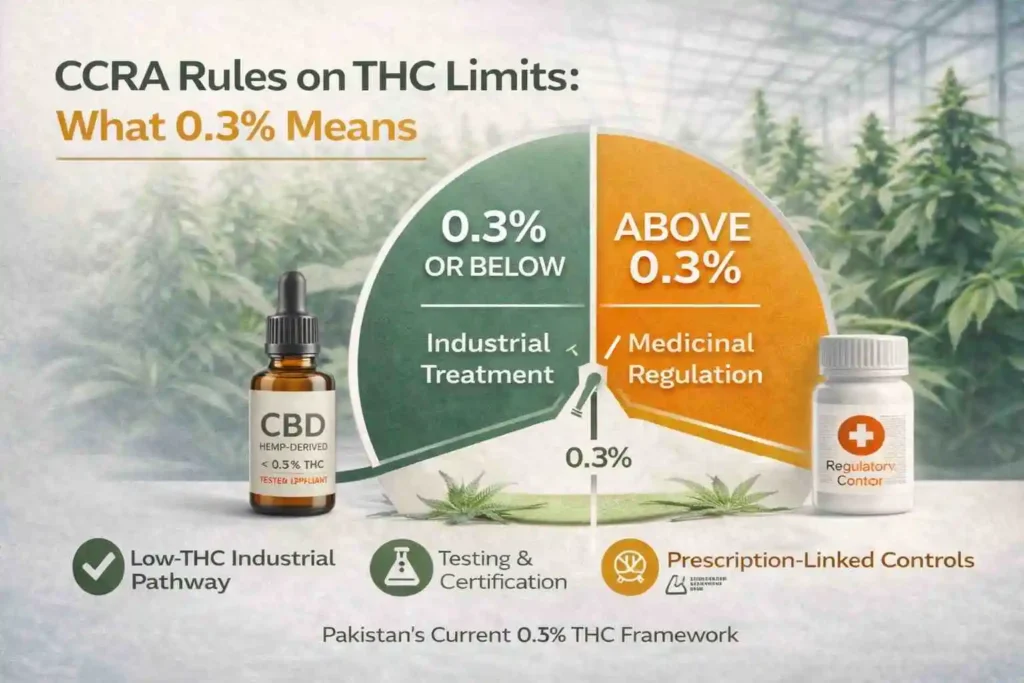
Under Pakistan’s current cannabis policy framework, the critical threshold is 0.3% THC. The official National Cannabis Control and Regulatory Policy, 2025 states that routine testing of industrial cannabis crops is conducted to verify THC levels against the permissible threshold of less than 0.3%, and the same policy says that medicinal cannabis with THC above 0.3% is treated differently in distribution and sale. The earlier legal text surfaced through official ordinance and Senate records also distinguishes cultivation of cannabis with THC less than 0.3% from cultivation with THC more than 0.3%.
So the number is not decorative. It is a dividing line inside the regulatory framework.
What does 0.3% THC actually mean?
It means the product or crop is being classified based on how much tetrahydrocannabinol (THC) it contains. In Pakistan’s policy structure, less than 0.3% THC is used as the key threshold for industrial cannabis or hemp-style treatment, while above 0.3% THC moves the product into a more tightly controlled medicinal cannabis category. That distinction is reflected both in the official policy PDF and in reporting on Pakistan’s cannabis rules.
Here’s the thing: 0.3% does not mean “no THC.” It means THC is present at a level the framework treats as the cut-off for low-THC industrial handling rather than higher-THC medicinal control.
Why did Pakistan choose 0.3%?
Pakistan’s current framework presents 0.3% THC as the level used to prevent abuse of medicinal products and avoid recreational misuse, while still allowing a regulated industrial hemp pathway. Al Jazeera’s reporting on the framework says the regulatory model specifies the maximum THC level in the cannabis derivative as 0.3 percent to avoid abuse of medicinal products and recreational use. Another industry report on Pakistan’s 2025 provincial regulation says the limit was set at 0.3% in line with international norms.
So the choice was not random. It was tied to control, classification, and international-style hemp regulation.
How CCRA treats cannabis below and above 0.3% THC
This is the part most articles blur badly.
Industrial hemp and low-THC cannabis
The official policy states that routine testing of industrial cannabis crop is used to verify that THC levels stay under the permissible threshold of less than 0.3%. The earlier legal framework also specifically refers to the manner in which a licensee cultivating cannabis with THC less than 0.3 percent is required to undertake licensed activities.
In practical terms, this is the side of the framework associated with industrial hemp and regulated low-THC activity. For readers who need the category differences first, place one natural internal link here to Hemp vs Cannabis vs CBD.
Medicinal cannabis above 0.3% THC
The policy also makes clear that medicinal cannabis with THC above 0.3% is treated more strictly. The official policy snippet says that the distribution and sale of medicinal cannabis (THC > 0.3%) and its derivatives must take place through outlets and with prescriptions from registered health professionals. The earlier official legal text likewise separates licensed activity for cannabis with THC more than 0.3 percent from lower-THC cultivation.
That means Pakistan’s framework is not saying all cannabis is handled the same way. It is dividing the market by THC threshold and use case.
For readers comparing the two branches, place one natural internal link here to Industrial Hemp vs Medicinal Cannabis in Pakistan.
Why the 0.3% rule matters for CBD oil in Pakistan
This rule matters for CBD because CBD products are not judged only by the word “CBD” on the label. Their THC content and product classification matter too. Pakistan’s policy makes THC verification part of the compliance structure, and the framework also says certification and testing clearance issued by the CCRA Laboratory shall be mandatory for cannabis, hemp, and cannabinoid-based products in Pakistan.
That means a CBD oil seller cannot just claim “hemp-derived” and assume that settles the issue. If THC levels, testing, or product classification are wrong, the product may sit in a very different regulatory category than the buyer expects. For readers focused on the downstream impact, place one natural internal link here to CCRA and CBD Oil in Pakistan.
How THC limits are checked under the policy
Pakistan’s policy does not leave THC control to guesswork. The official policy states that routine testing of industrial cannabis crops shall be conducted by CCRA to verify THC levels, and it also says certification and testing clearance from the CCRA Laboratory is mandatory for cannabis, hemp, and cannabinoid-based products. The licensing process described in the policy includes verification of compliance with the stipulated THC limits.
So the 0.3% rule matters in three places:
- crop testing
- product certification
- licensing and compliance review.
Common mistakes people make about the 0.3% rule
Let’s be blunt. Most confusion comes from people wanting a simple answer where the law gives a conditional one.
Mistake 1: Thinking 0.3% means zero THC
It does not. It means less than 0.3% THC is the relevant threshold for low-THC industrial handling under Pakistan’s framework.
Mistake 2: Thinking anything under 0.3% is automatically approved
Wrong. Pakistan’s policy also requires testing, certification, and licensing-related compliance, so the number alone does not equal blanket approval.
Mistake 3: Thinking CBD and hemp are automatically the same thing
They overlap, but they are not identical. Hemp is a regulatory crop classification tied to THC levels, while CBD is a cannabinoid that may appear in products whose treatment still depends on sourcing, processing, testing, and THC profile. That is exactly why the 0.3% threshold matters.
Mistake 4: Thinking above 0.3% means open retail sale
It does not. The policy explicitly says medicinal cannabis above 0.3% THC is tied to controlled outlets and prescriptions from registered health professionals.
Final takeaway
Under CCRA’s current policy framework, 0.3% THC is the line that helps separate low-THC industrial hemp-style regulation from more tightly controlled medicinal cannabis treatment in Pakistan. Cannabis or derivatives below 0.3% THC are handled within the industrial cannabis framework, while products above 0.3% THC move into a stricter medicinal category tied to prescription-based distribution and closer control. The policy also makes THC verification, laboratory testing, and certification central to compliance, which is why the 0.3% rule matters for growers, manufacturers, CBD businesses, and buyers alike.