The moment people hear “cannabis policy” in Pakistan, the conversation usually goes off the rails. One side assumes full legalization. The other assumes it is all meaningless. The truth sits in the middle, and that is where most readers get lost. CBD Pakistan breaks the policy down in simple terms, showing what changed, what did not, and why the details matter more than the noise around them.
What is the National Cannabis Control and Regulatory Policy 2025?
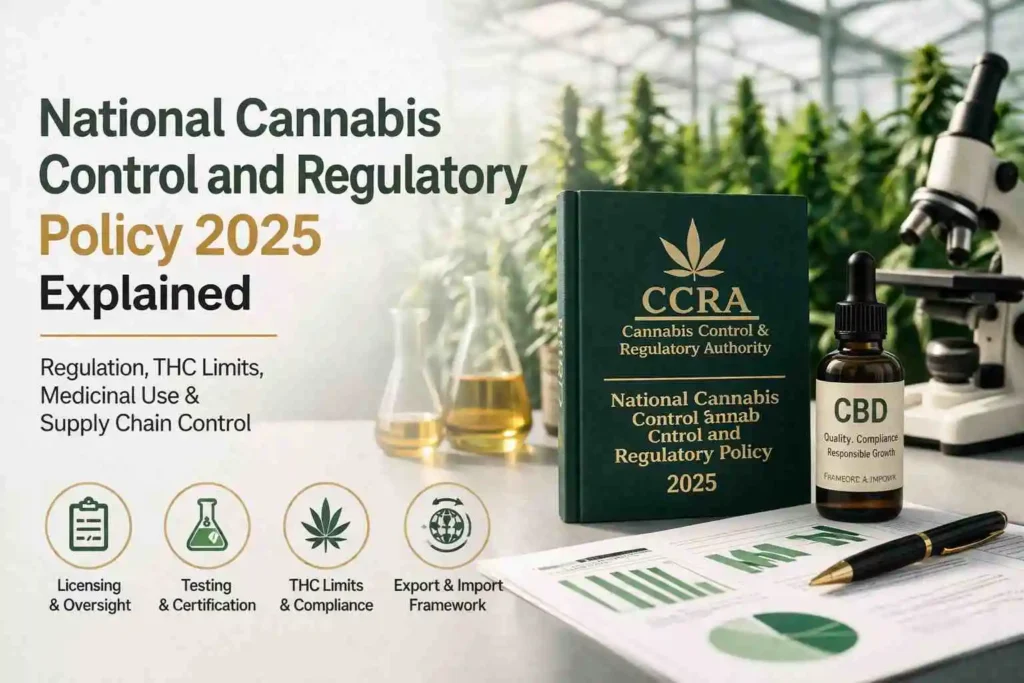
The National Cannabis Control and Regulatory Policy, 2025 is Pakistan’s national policy framework for controlling and regularising the cannabis sector. According to recent reporting on the cabinet decision, the federal cabinet approved the policy on 20 January 2026 under Section 13 of the Cannabis Control and Regulatory Authority Act, 2024, after committee review meetings held on 5 August 2025 and 13 October 2025. The policy is described as Pakistan’s first comprehensive national roadmap covering cultivation, production, sale, and the wider cannabis value chain for medicinal and industrial use.
That matters because this is not just another press release. It is the policy layer sitting above licensing, testing, THC control, and supply-chain oversight.
Why did Pakistan introduce this policy?
Pakistan introduced the policy to do three things at once: reduce misuse, prevent market manipulation, and create a structured framework for regulated cannabis activity. Cabinet-approval coverage says the policy was designed to reap economic benefits from regulated cultivation and the manufacturing and sale of cannabis derivatives for medicinal and industrial purposes, while also building safeguards across the supply chain.
Here’s the thing: governments do not build national policy around a controversial plant unless the old situation has become worse than the controlled alternative. Pakistan clearly decided that vague, fragmented handling of cannabis was no longer good enough.
If the reader wants the institutional background first, place one natural internal link here to What Is CCRA in Pakistan?.
What does the policy actually cover?
The policy covers the cannabis sector from cultivation to sale and production, and it also contemplates export and import of cannabis and its derivatives under a nationally governed framework. Reporting on the cabinet approval says the federal government will prescribe national policy from time to time governing all aspects of the market and may seek input from CCRA and provincial governments.
In practical terms, the big policy themes are clear.
Industrial hemp and THC limits
The policy sets a compliance structure around industrial cannabis / hemp and THC control. Search excerpts from the official policy PDF state that routine testing of industrial cannabis crop shall be conducted by CCRA to verify THC levels, and that compliance must remain under the permissible threshold of less than 0.3%. That is a core rule, not a side detail.
That means businesses cannot treat THC as marketing language. It is a regulatory threshold tied to crop testing and product classification.
Medical cannabis and prescription-only sales
The policy also separates medicinal cannabis from low-THC industrial hemp. An official policy snippet states that the distribution and sale of medicinal cannabis with THC above 0.3% and its derivatives shall take place through outlets, with prescriptions from registered health professionals. That tells you the framework is not an open retail model. It is controlled, medically framed, and prescription-linked for higher-THC products.
For a reader focused on that branch of the topic, add one natural internal link here to Medical Cannabis in Pakistan.
Testing, certification, and CCRA oversight
The policy places strong emphasis on testing and institutional control. Public excerpts tied to the policy state that certification and testing clearance issued by the CCRA Laboratory shall be mandatory for cannabis, hemp, and cannabinoid-based products, and that the licensing process includes background checks and verification of compliance with THC thresholds. Recent policy reporting also frames the system as one meant to curb misuse and bring order to the market.
That matters because the market can no longer pretend that a nice label or imported-looking bottle equals credibility. Under this framework, testing and clearance matter more.
Licensing, traceability, and supply-chain controls
The policy is also built around supply-chain discipline. Cabinet reporting says the review process specifically examined safeguards to prevent misuse of cannabis plants, products, or derivatives along the supply chain, and the official policy snippets indicate a system built around tracking and tracing, THC checks, and regulated movement from cultivation into manufacturing and sale.
Let’s be real—this is exactly the part weak operators hate. A traceable market is harder to bluff your way through.
What does this policy mean for businesses in Pakistan?
For hemp, cannabis, and CBD-related businesses, the policy means the market is moving toward a more structured model built on:
- category-specific activity
- THC threshold control
- testing and certification
- licensing and background checks
- tighter oversight of cultivation, manufacturing, and derivatives.
That creates opportunity for serious businesses and pressure for sloppy ones. A brand that understands sourcing, product type, regulatory limits, and testing discipline is far better positioned than one still operating on vague claims and copied product descriptions.
If the reader needs the policy motive behind all this, add one natural internal link here to Why Pakistan Created CCRA.
What does this policy mean for CBD buyers and the public?
For buyers, the policy matters because it makes one thing clearer: not every cannabis-derived product should be treated the same. The policy distinguishes higher-THC medicinal cannabis from low-THC industrial cannabis, ties medical distribution to prescriptions, and reinforces the role of testing and verification.
In plain language, buyers should care more about:
- what category a product falls into
- how much THC it contains
- whether the seller sounds informed or evasive
- whether the product sits inside a more credible supply chain
This is where CBD Pakistan can position itself intelligently: not by overselling certainty, but by helping people understand the difference between low-THC hemp-derived products, regulated medical cannabis, and the compliance questions that now matter more than before.
What the policy does not mean
This is where lazy content usually falls apart.
The policy does not mean Pakistan has opened a free-for-all recreational cannabis market. It also does not mean every CBD or cannabis product currently being sold online is automatically approved, tested, or compliant. What it does mean is that Pakistan has approved a formal policy framework for regulated medicinal and industrial use, with THC thresholds, prescription controls for medicinal cannabis, and a stronger emphasis on laboratory testing and structured oversight.
That distinction matters. Ignore it, and the whole article becomes fluff.
Final takeaway
Pakistan’s National Cannabis Control and Regulatory Policy 2025 is the country’s first broad national framework for regulating cannabis for medicinal and industrial purposes. It was approved by the federal cabinet on 20 January 2026 after review meetings in August and October 2025, and it points toward a regulated system built on THC thresholds, crop testing, prescription-based access for medicinal cannabis above 0.3% THC, supply-chain safeguards, and stronger CCRA oversight.