The biggest mistake people make with CCRA is assuming it covers everything in the same way. It does not. In Pakistan, confusion around cannabis law, CBD products, and regulatory control keeps leading to bad assumptions and weak business judgment. CBD Pakistan helps readers make sense of that framework with simple, practical explanation of what sits under CCRA’s mandate and why that should matter before anyone places trust in a product or operator.
What is CCRA’s mandate in Pakistan?
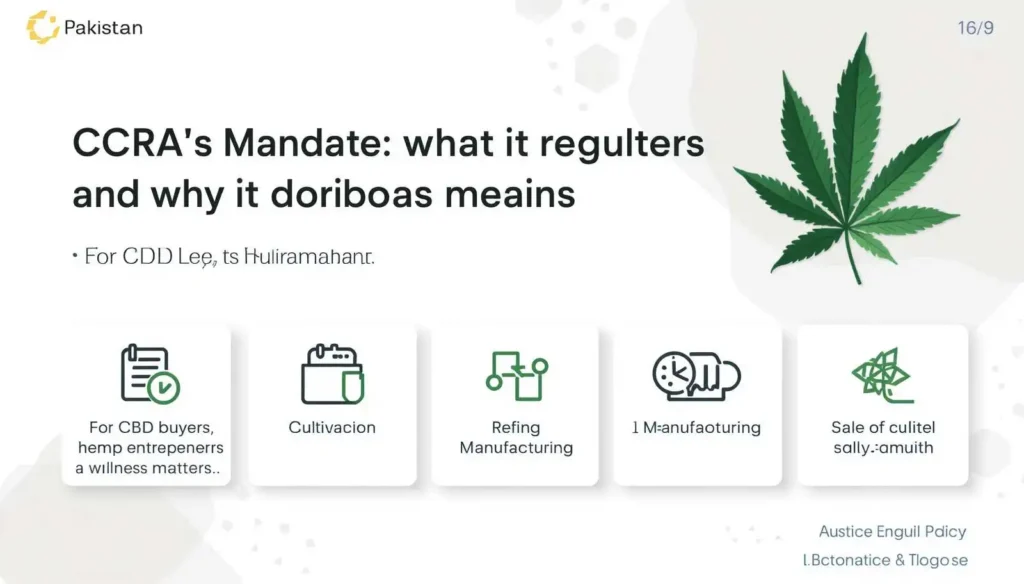
CCRA’s mandate is to regulate the cultivation of the cannabis plant, extraction, refining, manufacturing, and sale of derivatives for medicinal and industrial purposes in Pakistan. That language appears directly in current CCRA materials and aligns with the legal framework established under the Cannabis Control and Regulatory Authority Act, 2024.
That matters because “cannabis regulation” is not one thing. It covers farming, processing, product development, licensing, oversight, and commercial control. Too many people reduce it to one lazy question: “Is it legal or not?” That is not how regulated sectors work.
What does CCRA regulate?
At its core, CCRA regulates the lawful chain of activity around cannabis for industrial and medicinal purposes. Public CCRA sources and licensing materials show that this includes cultivation categories, processing, derivatives, and licensing pathways, not just raw plant growth.
Cannabis cultivation for industrial and medicinal purposes
CCRA regulates cultivation in at least these publicly listed categories:
- Industrial Hemp Cultivation
- Medicinal Cannabis Cultivation (Controlled)
- Medicinal Cannabis Cultivation (Open Field)
That alone kills one common misunderstanding. CCRA is not limited to hemp only, and it is not limited to end products only. It reaches upstream, right to cultivation. If you want a fuller foundation first, add a natural internal link here to What Is CCRA in Pakistan?.
Extraction, refining, and manufacturing
CCRA’s own mandate states that it regulates extraction, refining, and manufacturing tied to cannabis and its derivatives for medicinal and industrial purposes. That means the authority’s role extends beyond farms into labs, processors, and production systems.
This is where people in Karachi, Lahore, and Islamabad often get it wrong. They assume regulation starts and ends with the crop. It does not. Once extraction and manufacturing are in scope, the conversation becomes about process control, inputs, output quality, and traceability.
Sale of cannabis derivatives
CCRA’s public mandate also covers the sale of derivatives of the cannabis plant for medicinal and industrial purposes. That is highly relevant for CBD-related businesses because derivatives are where many consumer-facing products sit.
In other words, if someone is bottling, marketing, or selling cannabis-derived products and pretending regulation only applies to growers, they either do not understand the framework or they are hoping you do not.
What licenses fit within CCRA’s mandate?
The public license list reinforces the scope of CCRA’s mandate. The authority has already published cultivation-focused license types, including A-1 Industrial Hemp Cultivation, A-2 Medicinal Cannabis Cultivation (Controlled), and A-3 Medicinal Cannabis Cultivation (Open Field), while its licensing portal indicates future or broader licensing coverage for medicinal cannabis, industrial hemp, and synthetic/bio-synthetic areas.
That means licensing is not decorative. It is how the mandate becomes enforceable in practice. For a separate breakdown of these categories, insert one natural internal link here to Types of Licences Under CCRA.
What does CCRA not regulate?
This is where bluntness helps.
CCRA’s public mandate is framed around medicinal and industrial purposes. The official language does not present CCRA as a blanket regulator for open recreational cannabis use. Its mandate, policy materials, and licensing structure point toward controlled, purpose-specific regulation, not an unrestricted retail market.
So if someone tells you Pakistan has “fully legalized cannabis,” they are compressing a regulated framework into a lazy slogan. That is not legal understanding. That is social media brain rot.
Why CCRA’s mandate matters for Pakistan
CCRA’s mandate matters because it tries to solve three real problems at once: public health risk, market confusion, and lack of accountability. Official CCRA objectives say the authority exists to address the negative social and health impact of unregulated cannabis, including addiction and unsafe use of plant products.
Public health and safer market controls
One reason the mandate matters is that unregulated cannabis markets tend to produce bad outcomes: unclear sourcing, unsafe products, and weak oversight. CCRA’s policy and objectives directly tie regulation to reducing unsafe use and improving control.
For ordinary buyers, this is not abstract. It is the difference between a product that sits inside a monitored framework and one that exists on vibes and marketing.
Legal clarity for hemp and CBD businesses
The authority’s mandate gives businesses a more structured framework for lawful participation in industrial hemp and medicinal cannabis-related activity. The 2025 policy describes controlled and regulated cultivation for medicinal and industrial purposes as a key feature of Pakistan’s cannabis roadmap.
That is critical for brands trying to build something real. Without a regulator, everyone claims legitimacy. With one, serious operators have a standard to align with.
Better traceability, accountability, and oversight
CCRA-linked institutional materials describe the emerging regulatory ecosystem as one grounded in traceability, accountability, and scientific validation. That is exactly what this sector needs. Without traceability, compliance becomes theater. Without accountability, quality claims are just packaging.
How CCRA’s mandate affects CBD buyers and businesses
For buyers, CCRA’s mandate matters because it changes how you should judge a product. A clean label or polished website is not enough. You should care about where the product sits in the broader legal and regulatory chain, how transparent the seller is, and whether the business sounds educated or evasive.
For businesses, the message is tougher. You cannot keep selling into a developing regulated market with vague claims, mystery sourcing, and zero educational depth. CCRA’s mandate reaches into cultivation, extraction, manufacturing, and derivatives. That means the whole pipeline matters, not just the final sales page.
This is where CBD Pakistan can separate itself: by educating customers clearly, answering real questions, and acting like a serious operator in a sector that still attracts too many shortcuts.
What to check before trusting a cannabis or CBD product in Pakistan
Here’s the practical part. Readers do not just want law summaries. They want to know how this affects their next decision.
Check these points before trusting a product or seller:
- Does the brand explain what category of product it offers?
- Does it speak clearly about sourcing, product type, and quality controls?
- Does it avoid sloppy claims that ignore Pakistan’s regulated environment?
- Does it help you understand the difference between hemp, CBD, THC, and medicinal cannabis?
And if you need a related regulatory detail that often gets misunderstood, add one natural internal link here to THC Limit for Hemp in Pakistan.
Final takeaway
CCRA’s mandate in Pakistan covers the cultivation of cannabis, extraction, refining, manufacturing, and sale of derivatives for medicinal and industrial purposes. That mandate matters because it creates legal structure in a sector that used to be dominated by confusion, poor oversight, and unregulated risk. It also matters because CCRA is not just about crops. It is about the whole controlled chain, from cultivation to processing to sale.