If you are using CBD for wellness support, considering it for the first time, or worried about workplace screening, this article is written for you. Many people are not actually afraid of CBD itself—they are afraid of losing a job opportunity, failing a routine drug screen, or trusting a product label that turns out to be incomplete or misleading. At CBDOILS.PK, we approach this topic with practical, evidence-based guidance so readers can understand where the real testing risk comes from, how to reduce it, and what to check before using any CBD product.
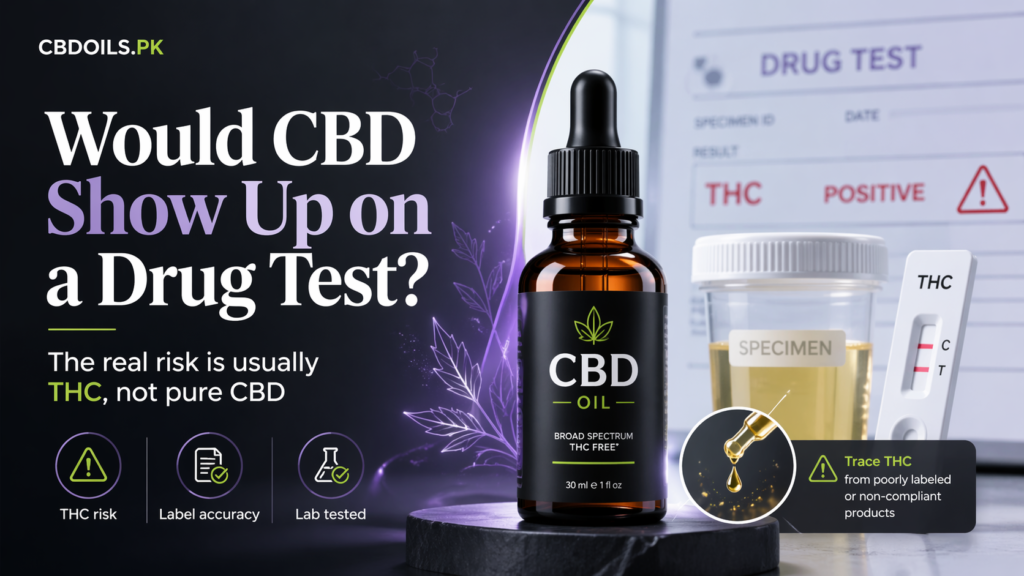
Here is the direct answer: CBD itself is usually not the main reason people fail a standard drug test. THC is. Most routine workplace tests are designed to detect THC or its metabolites, not cannabidiol. The real problem is that some CBD products contain THC, are mislabeled, or are marketed as “THC-free” without strong proof. A controlled study found that pure CBD was unlikely to trigger a positive urine drug screen, but hemp products containing even low amounts of THC could.
Short Answer: Would CBD Show Up on a Drug Test?
In most cases, pure CBD should not cause a positive result on a standard drug test. Standard urine drug screens usually target THC-COOH, a metabolite linked to THC exposure, not CBD itself. But that does not mean CBD users are fully protected. If the product contains THC, even in small or undeclared amounts, that can create a real risk. SAMHSA’s federal workplace guidance also makes clear that a donor’s CBD use can be consistent with a marijuana-positive test result and is not accepted as a legitimate medical explanation for that positive result.
Why People Fail Drug Tests After Using “CBD”
This is where most articles get lazy. They say “CBD won’t show up” and stop there. That is incomplete.
The more accurate answer is that people usually fail after using a CBD product that also contains THC, whether they realized it or not. This can happen because:
- the product is full-spectrum
- the label is inaccurate
- the product is contaminated during manufacturing
- the buyer assumed “hemp” means “zero THC”
A 2024 analysis found that the majority of commercially available CBD products studied were inaccurately labeled. That is not a small problem. That is the whole problem.
Do Drug Tests Look for CBD or THC?
Most standard workplace drug tests are looking for THC-related markers, not CBD. That is why the testing risk usually comes from the THC side of the formula, not the CBD side.
SAMHSA’s federal workplace testing materials focus on marijuana metabolite results, and its case materials specifically note that CBD use does not excuse a positive marijuana test. So if someone says, “But I only used CBD oil,” that may explain how the exposure happened, but it does not automatically protect them from the result.
Can Full-Spectrum CBD Make You Fail a Drug Test?
Yes, it can.
Full-spectrum CBD products may contain small amounts of THC. That may sound harmless on paper, but repeated use, larger servings, or inaccurate labeling can increase exposure enough to matter. This is especially relevant for people taking CBD daily for stress, sleep, recovery, or general wellness.
Let’s be real—someone using full-spectrum oil every night and then acting shocked about a positive test is ignoring the obvious risk. If THC is in the product, it can become a testing issue. The controlled urine pharmacokinetic study found that hemp-derived products with low levels of THC may produce cannabis-positive urine tests, while pure CBD did not.
If readers are also worried about intoxication, this internal page fits naturally here: Will CBD Oil Get You High?
Can THC-Free CBD Still Cause a Positive Drug Test?
Sometimes, yes. That is the uncomfortable truth.
A product labeled THC-free or broad-spectrum is only as trustworthy as its testing and manufacturing controls. Some products marketed as THC-free have still been found to contain measurable cannabinoids that should not have been there. The bigger issue is label accuracy. If the label is weak and the lab testing is missing or outdated, the buyer is taking a blind risk.
This is why third-party verification matters more than marketing language. For readers who want to understand that process better, Third-Party Lab Testing for CBD
What Type of CBD Product Carries the Lowest Drug-Test Risk?
Among common product types, CBD isolate generally carries the lowest testing risk because it is intended to contain CBD only, without the wider cannabinoid profile found in full-spectrum formulas. But lower risk does not mean zero risk. A bad manufacturer can still ruin that with contamination, poor quality control, or inaccurate labeling.
A safer buying approach includes:
- checking for a current Certificate of Analysis
- matching the batch number on the report to the product
- confirming THC content clearly
- avoiding vague “hemp extract” labels with no detail
For a wider buyer checklist, How to Choose High-Quality CBD Oil
How Much THC Is Too Much for a Drug Test Risk?
There is no universal consumer-safe shortcut here. Even low amounts of THC may become relevant depending on:
- frequency of use
- dose size
- metabolism
- product accuracy
- test type and cutoff
Pakistan’s regulated hemp framework uses a less than 0.3% THC threshold in policy language for industrial hemp, but buyers should not confuse that legal-style threshold with a promise of zero workplace drug-test risk. Those are different issues. A product may sit within a low-THC category and still create testing concerns under repeated use.
THC Limit for Hemp in Pakistan
How Long After Using CBD Could THC Still Matter on a Drug Test?
This depends less on CBD itself and more on whether THC was present, how much of it was there, and how often the product was used. Someone who takes a mislabeled or full-spectrum product once is dealing with a different risk profile than someone using it every day for weeks.
That is why the better question is not just “Would CBD show up?” It is:
- Did the product contain THC?
- Was the THC disclosed accurately?
- Was the product used once or repeatedly?
- Was there reliable third-party testing?
A study highlighted by Johns Hopkins found no positive urine test results in sessions using pure CBD capsules or pure CBD vape, but products with detectable THC created different outcomes.
What Users in Pakistan Should Be Extra Careful About
In Pakistan, the product-quality issue can be worse than the biology issue.
A buyer in Islamabad, Lahore, Karachi, or Rawalpindi may order a CBD oil online that looks polished, says “premium hemp,” and still offers weak THC disclosure, no batch-specific lab report, and no meaningful compliance detail. That is exactly how people end up guessing about drug-test risk after they have already started using the product.
Here’s the thing: if the product documentation is poor, the answer to “Will I fail a drug test?” becomes much harder to predict. A serious CBD seller should be able to explain:
- whether the product is isolate, broad-spectrum, or full-spectrum
- whether THC is present
- how much THC is present
- whether a current COA exists
- whether the batch on the report matches the item being sold
How to Lower Your Risk Before a Drug Test
If a job screening, workplace check, or compliance test matters to you, take the cautious route.
1. Avoid full-spectrum products
They carry the clearest THC-related risk.
2. Choose products with a current COA
A seller should provide a readable, batch-specific report.
3. Check the batch number
If the report does not match the product, the report is not useful.
4. Do not trust “THC-free” claims blindly
Read the evidence behind the claim.
5. Stop guessing about low-quality products
If the label is vague, move on.
6. Be more careful with daily use
Repeated exposure can matter more than one-off use.
Common Questions Users Ask
Can CBD oil make you feel stoned?
Pure CBD is generally described as non-intoxicating, but a product containing THC may feel different. That is another reason labeling matters.
How does CBD oil make you feel the first time?
That varies by dose, formulation, and body chemistry. Some people report calm or drowsiness, while others feel very little. The FDA also notes that CBD can affect alertness and may interact with other substances.
What happens if you take CBD with other medicines?
CBD can affect how other drugs work and may increase or decrease their effects. The FDA has specifically warned about drug interactions and liver-related concerns.
Final Thoughts
Would CBD show up on a drug test? Usually, the real answer is that THC shows up—not CBD itself. But because many commercial CBD products are inaccurately labeled, contain trace THC, or are poorly documented, users should not treat every bottle as equally safe from a testing perspective.