For job applicants, employees facing workplace screening, athletes, and first-time CBD buyers who cannot afford a mistake, this guide is built for you. The biggest fear is not usually CBD itself. It is the possibility of using a product that seems safe, then facing a failed drug test because the label was incomplete, the formula contained THC, or the product quality was poor. At CBDOILS.PK, we help readers understand these risks clearly so they can evaluate CBD products more carefully and avoid careless decisions.
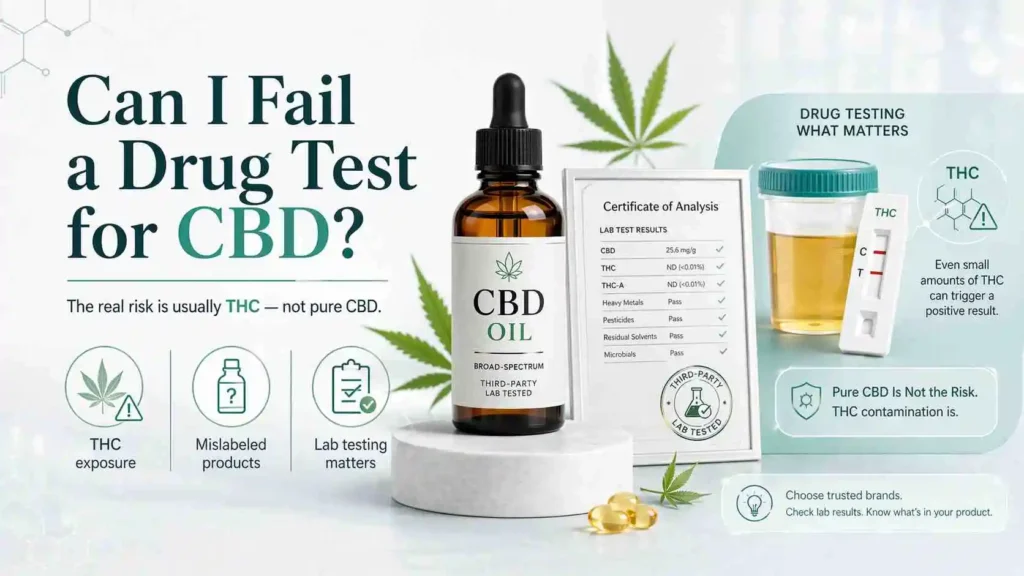
The blunt answer is yes, you can fail a drug test after using a CBD product—but usually not because of pure CBD alone. Most standard drug tests are designed to detect THC or THC metabolites, not cannabidiol. The real risk comes from full-spectrum products, mislabeled products, contamination, or weak quality control that exposes the user to THC without making that risk obvious. Controlled research found that pure CBD was unlikely to trigger a positive urine test, while hemp-derived products containing low amounts of THC could produce cannabis-positive results.
Short Answer: Can I Fail a Drug Test for CBD?
Yes, you can fail a drug test after using CBD if the product contains THC. That is the core issue. Routine workplace testing generally targets marijuana-related markers, especially THC metabolites, not CBD itself. SAMHSA’s 2024 Medical Review Officer guidance also makes clear that a person’s report of using CBD does not erase or justify a verified marijuana-positive result in federal workplace drug testing.
Why This Happens More Often Than People Think
A lot of users assume “hemp-derived” means “safe from drug testing.” That assumption is weak. Product quality in the CBD market is inconsistent, and inaccurate labeling is common enough to be a real problem. A 2024 peer-reviewed analysis found that the majority of commercially available CBD products tested were inaccurately labeled, which means consumers may be taking more CBD, less CBD, or more THC than the packaging suggests.
This is exactly how people get caught off guard. Someone orders a bottle in Lahore, Islamabad, Karachi, or Rawalpindi, sees phrases like “premium hemp extract” or “THC-free,” and assumes the risk is gone. Then the product either contains trace THC or does not have trustworthy testing behind it. The problem is not optimism. The problem is buying without proof.
Do Drug Tests Check for CBD or THC?
Most routine drug tests are looking for THC exposure, not CBD. That is why people who fail after using a CBD product usually run into trouble because the product contained THC, not because the test was targeting cannabidiol. The controlled urinary pharmacokinetic study on CBD and THC formulations supports this distinction: pure CBD did not produce cannabis-positive urine tests under current federal workplace testing methods, but products with THC exposure could.
Can Full-Spectrum CBD Make You Fail a Drug Test?
Yes. Full-spectrum CBD carries the clearest risk because it may contain measurable THC. Even if the THC amount is low, repeated use, higher doses, or inaccurate labeling can make that exposure more meaningful over time. That is why “legal hemp” and “drug-test safe” are not the same thing. The research is very consistent on this point: hemp-derived products with low levels of THC may still produce a positive cannabis urine test.
If readers need the foundational difference first, CBD vs THC.
What About Broad-Spectrum or THC-Free CBD?
These options may lower the risk, but they do not eliminate it automatically. A label that says “THC-free” is only as trustworthy as the testing behind it. If the brand does not provide a current, batch-specific Certificate of Analysis, the buyer is relying on marketing language, not evidence. Studies of commercial CBD products have repeatedly shown labeling problems and contamination concerns, which is why buyers should treat undocumented “THC-free” claims with caution.
For readers who need a deeper explanation of proof and product verification, Third-Party Lab Testing for CBD
Can Pure CBD Cause a Positive Drug Test?
Current controlled evidence suggests that pure CBD by itself is unlikely to cause a positive standard urine drug test for marijuana. In one controlled study, acute dosing with pure CBD did not result in positive urine tests under current federal workplace testing procedures. Another study found that oral CBD did not produce false-positive tests for THC on common screening devices. That is the good news. The bad news is that many commercial products are not truly “pure” in the real-world retail sense.
How Do People Fail If the Product Only Has “Trace THC”?
Because trace amounts add up faster than careless buyers think. The testing risk depends on several factors:
- how much THC is actually in the product
- how often the product is used
- whether the product is taken daily
- whether the label is accurate
- the cutoff and method used in the drug test
Here’s the thing: a low-THC product can still be a bad choice for someone who is facing screening. A legal-style threshold is not the same as a workplace-safe threshold. In Pakistan’s regulatory framework, industrial hemp is described using a less than 0.3% THC benchmark, but that does not guarantee zero testing risk for repeated consumer use.
What Type of CBD Product Carries the Lowest Risk?
In general, CBD isolate carries the lowest testing risk because it is intended to contain cannabidiol without the wider cannabinoid profile found in full-spectrum products. But lower risk is still not zero risk. A sloppy manufacturer can contaminate an isolate product or mislabel it. So the real standard is not just product type. It is product type plus verified testing plus clear documentation.
For a broader buyer framework, How to Choose High-Quality CBD Oil
What If I Have an Upcoming Drug Test?
If your job, visa process, sports clearance, or employment screening matters, the safest advice is simple: do not gamble on uncertain CBD products.
Before using any CBD product, ask:
- Is it isolate, broad-spectrum, or full-spectrum?
- Is THC clearly disclosed?
- Is there a current COA?
- Does the COA match the batch number on the product?
- Is the seller transparent or just persuasive?
If any of those answers are weak, the product is not trustworthy enough for someone facing a test.
This is also a good place to reference your related article: Would CBD Show Up on a Drug Test?
Common Buyer Mistakes That Increase Drug-Test Risk
Trusting the front label too quickly
A polished bottle proves nothing. The real evidence is in the lab report.
Assuming “hemp” means no THC
That is one of the most common and expensive misunderstandings in the CBD market.
Using full-spectrum CBD daily without checking the COA
Daily use increases the chance that small THC exposure becomes relevant.
Buying from sellers who cannot explain the product
If the seller cannot answer basic questions about THC, formulation, and testing, that is a warning sign, not a minor issue.
Ignoring federal guidance
SAMHSA’s workplace testing materials make the point clearly: CBD use is not a clean defense for a marijuana-positive result.
What Users in Pakistan Should Watch More Closely
Pakistan-based buyers often face a quality-control problem before they face a biology problem. In local online markets, some products are sold with imported-style packaging, big claims, and very little real documentation. That is risky for any buyer, but especially risky for someone with an employer screening coming up.
At CBDOILS.PK, we believe people should not have to guess what is in the bottle. Clear THC disclosure, third-party lab reports, and honest product education matter more than slick branding. If a product does not come with proof, it should not be trusted for anyone concerned about drug testing.
Quick Checklist to Reduce Your Risk
If passing a drug test matters to you, this is the practical checklist:
- avoid full-spectrum CBD
- prefer verified isolate products
- ask for a current batch-specific COA
- match the batch number on the report to the product
- do not rely on “THC-free” claims without proof
- avoid vague labels like “hemp extract” with no cannabinoid breakdown
- be extra cautious with daily or heavy use
That is not paranoia. That is basic risk management.
Final Thoughts
Yes, you can fail a drug test after using CBD—not because standard tests are usually hunting for CBD, but because many CBD products expose users to THC through formulation choice, contamination, or inaccurate labeling. Pure CBD is much less likely to be the problem. Real-world products are the problem.
The smart move is not to argue with the test after the fact. The smart move is to choose carefully before you ever use the product. That means checking THC content, reviewing third-party lab reports, and refusing to trust products that hide behind vague claims.