CBD oil gets most of the attention, yet many first-time users are actually more comfortable starting with a cream they can apply to one specific area. The problem is that topical CBD is often poorly explained, so buyers are left guessing what it does, how it works, and whether the label can be trusted. CBDOils.pk helps close that gap with straightforward education, quality-focused products, and practical support for customers who want clarity before they buy.
Quick Answer
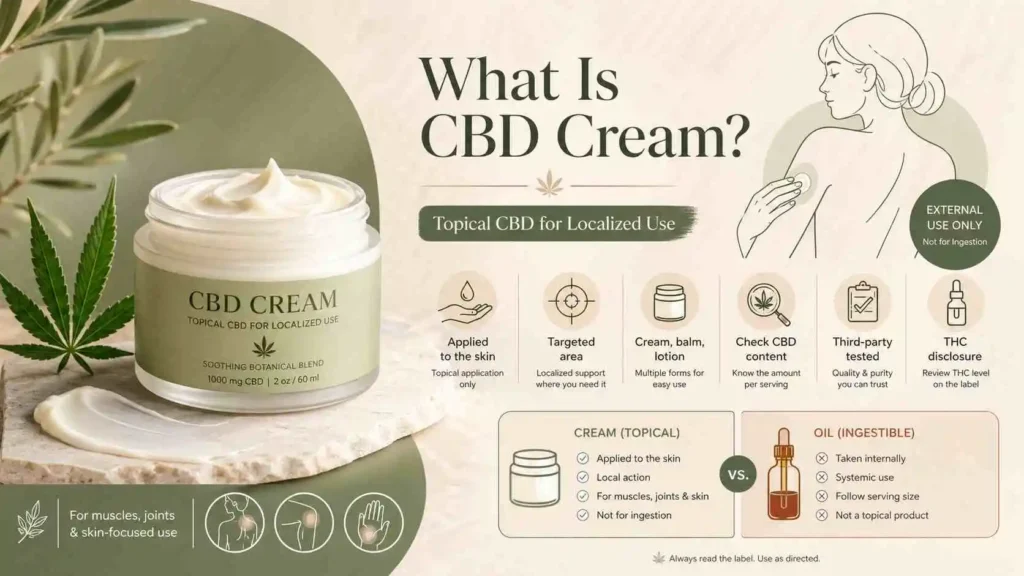
CBD cream is a topical product infused with cannabidiol (CBD) that is applied directly to the skin rather than swallowed like oil or gummies. Public health-style sources describe CBD creams, lotions, balms, ointments, and salves as topical formats commonly used for localized application, especially around muscles, joints, or certain skin concerns.
That is the simple definition. But the useful question is not just what it is. It is how it differs from other CBD products and whether it is worth using for your goal. Those are the questions searchers actually care about.
Why CBD Cream Is Different From CBD Oil
CBD cream and CBD oil are not interchangeable. CBD oil is usually taken under the tongue or swallowed, while CBD cream is meant for external use on a specific area of skin. Topical products are generally chosen when someone wants a more targeted approach rather than a product taken internally.
Benefits of CBD Oil and How CBD Oil Works in the Body. People searching “what is CBD cream” are often comparing product types, not just asking for a dictionary definition.
How CBD Cream Works on the Skin
CBD cream is rubbed onto the skin, where it works as a topical cannabinoid product rather than an oral one. Reviews in the medical literature describe the skin as having a cannabinoid-responsive system, and they note growing interest in topical CBD for anti-inflammatory, anti-itch, pain-related, and skin-supporting effects. The key point is local use. This is not the same route as oils, capsules, or gummies.
That does not mean every CBD cream on the market is equally effective. It means the mechanism and use case are different. Too many brands skip that distinction because vague claims sell faster than careful explanations.
What CBD Cream Is Commonly Used For
Muscles and joints
Topical CBD products are commonly marketed and used for targeted muscle and joint discomfort. Healthline says people use topical CBD for targeted pain relief in muscles and joints, and the Arthritis Foundation says animal studies and some small human studies suggest CBD may have pain-relieving and anti-inflammatory properties, though larger, high-quality human studies are still needed.
That is the honest framing: interest is real, early evidence exists, but the research is not settled.
Dry or irritated skin
CBD cream is also discussed in relation to skin-focused use, including dry, irritated, or problem-prone skin. Healthline notes that topical CBD may soothe symptoms of conditions such as eczema and psoriasis, while recent dermatology reviews describe CBD as a promising candidate in skin health research because of anti-inflammatory and skin-supporting properties.
Again, promising is not the same as proven. If a brand talks like the science is finished, it is overselling.
Targeted daily use
A lot of users are not thinking in clinical terms at all. They want something they can apply to one area after a long commute, after gym soreness, or during dry winter weather. That local-use appeal is a big part of why creams feel less intimidating than ingestible products. This is especially true in real-life routines where someone in Lahore, Karachi, or Islamabad may want a simple topical step instead of learning how to dose oils or gummies.
Does CBD Cream Get You High?
CBD itself is generally described as non-intoxicating, and topical CBD products are not typically used in a way that would be expected to produce the classic “high” associated with THC. Healthline explicitly describes CBD as non-intoxicating, and its comparison of THC lotion vs CBD lotion says CBD lotion is unlikely to cause intoxication.
But this is where buyers get careless. “CBD cream won’t get you high” is a useful general rule, not a permission slip to ignore formulation. If a product contains THC, is mislabeled, or comes from a weak-quality source, that changes the risk profile. The FDA warns that many CBD products are of unknown quality and are marketed with unproven claims.
That is why product quality belongs in this article, not as an afterthought but as a core part of the answer.
How to Use CBD Cream
CBD cream is usually applied directly to the area you want to target. In practical terms, that means cleaning and drying the skin first, applying a small amount, and rubbing it in evenly according to the product’s instructions. Because over-the-counter CBD products are not standardized, it makes more sense to start cautiously and follow the label than to guess based on what someone online said worked for them. The Arthritis Foundation advises people trying CBD to buy from a reputable company and start conservatively.
Let’s be real—this is where many buyers sabotage themselves. They order a random cream online, never check the ingredient list, use it once in a rushed way, and then declare that “CBD does nothing.” That is not analysis. That is impatience.
What to Look for Before Buying CBD Cream
This is the part most fluffy articles dodge because it forces them to talk about quality instead of hype.
Before buying CBD cream, check:
- how much CBD is in the jar or tube
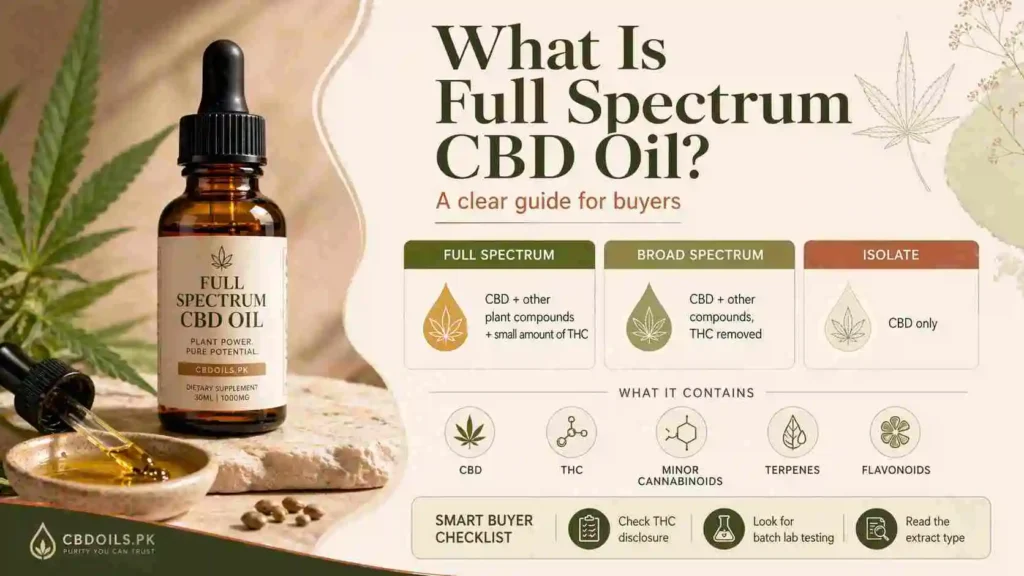
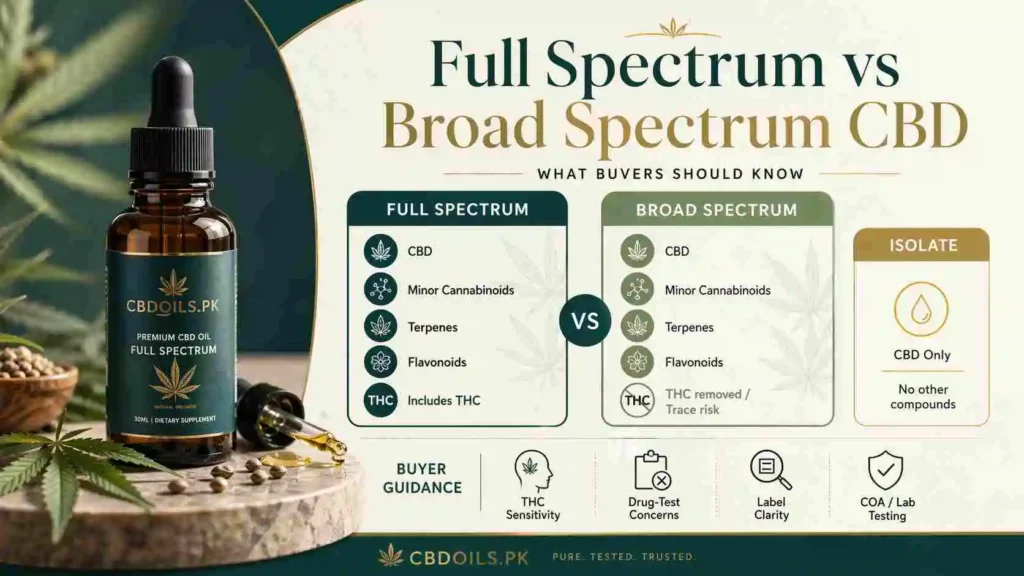
- whether it is full-spectrum, broad-spectrum, or isolate
- whether THC is present
- whether the brand provides a recent third-party Certificate of Analysis
- whether the ingredient list makes sense for a skin product
- whether the brand avoids reckless cure-style claims
The FDA says many CBD products are marketed with unproven medical claims and are of unknown quality, and it has not approved most CBD products on the market. Arthritis Foundation guidance also stresses buying from a reputable company. Broad-spectrum, full-spectrum, and isolate products differ in cannabinoid content, including THC exposure.
What Consumers Should Know About CBD Product Quality in Pakistan and /faqs/.
Is CBD Cream Better Than CBD Oil?
That is the wrong question if you are looking for a universal winner. CBD cream is usually the better fit when someone wants localized topical use. CBD oil is usually the better fit when someone wants an internally used format. These products solve different problems. Public guidance separates topicals from ingested and sublingual CBD for exactly that reason.
So the smarter comparison is not “which one is better?” It is “which one matches what you are trying to do?” Someone looking for a targeted topical product may prefer cream. Someone wanting a broader route may look at oil instead.
Final Takeaway
CBD cream is a topical CBD product applied to the skin for localized use. People commonly use it around muscles, joints, and certain skin concerns, but the evidence is still developing and the quality gap between products is real.