CBD cream seems simple until you try to explain what it actually does after it touches the skin. That gap confuses buyers who want targeted support for one area, but do not want to guess whether the product works locally, enters the bloodstream, or behaves like CBD oil. CBDOils.pk helps make that decision clearer with practical education, quality-focused products, and straightforward guidance for people who want to understand topical CBD before using it.
Quick Answer
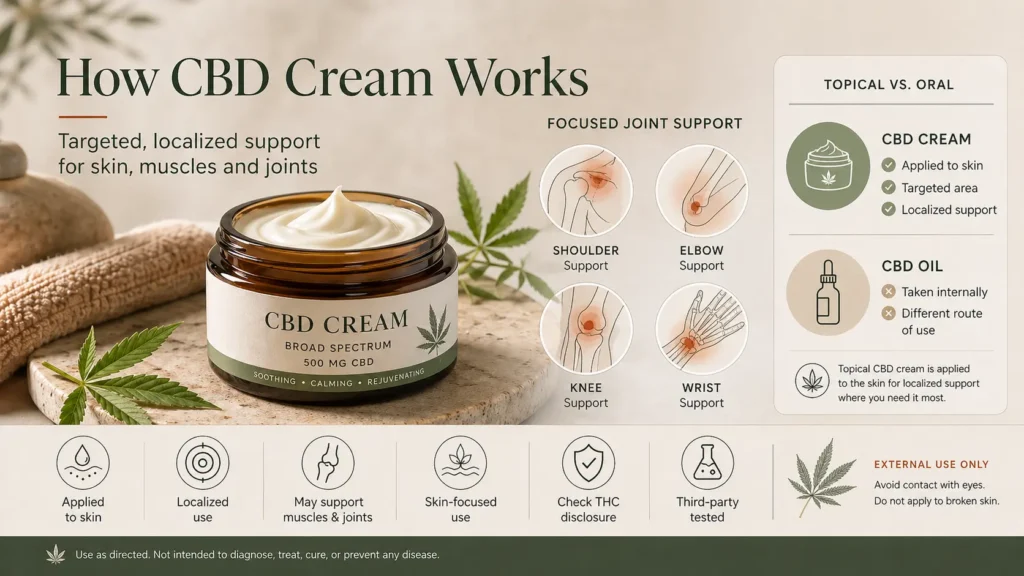
CBD cream works as a topical CBD product. You apply it directly to the skin, where it is intended to act more locally than swallowed or sublingual CBD products. Scientific reviews describe the skin as having an endocannabinoid-related signaling system, and they note that topical CBD is being studied for anti-inflammatory, soothing, pain-related, and skin-supporting effects. The important distinction is route: a cream is used on the surface and nearby tissues, not in the same way as CBD oil taken by mouth.
That means the real answer is not “CBD cream works like CBD oil, but thicker.” It doesn’t. It is a different format with a different use case.
What Happens When You Apply CBD Cream?
Once CBD cream is rubbed onto the skin, the cannabidiol stays focused on the area where you applied it rather than following the same path as an edible or tincture. Reviews of topical cannabinoids explain that the skin contains cannabinoid-responsive receptors and signaling pathways involved in inflammation, itch, skin barrier function, and pain-related processes. That is why topical CBD is usually discussed in terms of localized support rather than broad whole-body effects.
Here’s the thing: people often expect a dramatic sensation. That is the wrong expectation. A topical product may feel subtle, especially if the formula is basic or the buyer is expecting instant, system-wide effects. The more accurate view is that CBD cream is chosen for specific spots — a shoulder, a knee, dry hands, irritated skin — where local application makes more sense than swallowing CBD.
If you want the core definition first, What Is CBD Cream?.
Why CBD Cream Works Differently From CBD Oil
CBD oil is usually taken under the tongue or swallowed, so it is used with a systemic route in mind. CBD cream is external. It is applied to one area and generally chosen when someone wants a more targeted approach. Healthline separates topicals such as creams, lotions, balms, and salves from oils and edibles for exactly this reason.
That difference matters because it changes the buyer’s expectations. Someone looking for broad body effects may lean toward oil. Someone dealing with one localized area may prefer a cream.o How CBD Oil Works in the Body and Benefits of CBD Oil, because people comparing formats are usually trying to match the product to the goal, not chase whichever one sounds trendier.
What CBD Cream May Help Support
Localized muscle and joint discomfort
Topical CBD is commonly used for targeted muscle and joint discomfort. Healthline says people use topical CBD for muscles and joints, while the Arthritis Foundation notes that animal studies and some small human studies suggest CBD may have pain-relieving and anti-inflammatory potential, although better human research is still needed. That is the honest middle ground: there is real interest, but not enough evidence to make reckless cure claims.
Dry, irritated, or problem-prone skin
Topical CBD is also being explored for skin-related concerns. Reviews in dermatology describe CBD as having anti-inflammatory, antioxidant, moisturizing, and anti-itch potential, with interest in conditions involving irritation, barrier disruption, or excess inflammation. But the clinical evidence base is still limited, and product formulation matters a lot.
Everyday targeted use
Not everyone reaches for CBD cream because of a formal condition. Some people use it after a long commute, after gym soreness, or during winter dryness when one part of the body needs extra attention. In Pakistan, that practical use case is easy to picture — dry hands in Islamabad winters, tight shoulders after Lahore traffic, or skin discomfort after long outdoor heat in Karachi. A topical fits those situations better than forcing a whole-body product into a local problem. This localized-use framing is consistent with how public-facing CBD guides describe topicals.
How Long Does CBD Cream Take to Work?
Topical CBD is generally described as acting faster than edibles and more locally than oils taken by mouth. Healthline says topical CBD can produce results anywhere from a few minutes to an hour, while slower oral formats like gummies can take much longer because they must go through digestion. That makes creams appealing to buyers who want a product they can apply directly and judge within a shorter window.
Still, timing depends on the formula, the area of skin, and what the buyer expects “working” to feel like. Too many people use a cream once, in a hurry, and then decide the whole category is useless. That is not a product verdict. That is bad testing.
Does CBD Cream Get You High?
CBD itself is generally described as non-intoxicating, and topical CBD products are not typically expected to create the classic euphoric high associated with THC. Healthline describes CBD as non-intoxicating, and its coverage on topical cannabinoid lotions says CBD lotion is unlikely to cause intoxication.
But there is a catch buyers ignore: product quality. A 2024 study found that many commercially available CBD products were inaccurately labeled, and a 2024 review on cannabinoid products for pain reported THC detection in a substantial share of topical CBD products tested in the United States. That does not mean every cream is risky. It means blind trust in the label is stupid.
What to Look for Before Buying CBD Cream
This section decides whether the article is useful or just decorative.
Before buying CBD cream, check:
- how much CBD is in the jar or tube
- whether it is full-spectrum, broad-spectrum, or isolate
- whether THC is disclosed
- whether there is a recent third-party Certificate of Analysis
- whether the ingredient list makes sense for a skin product
- whether the brand avoids disease-cure promises
The FDA says there are still many unanswered questions about the science, safety, and quality of CBD products, and Harvard Health warns that CBD products can be of very poor quality and should not be marketed with unsupported therapeutic claims.
CBD Oil Side Effects, because even topical products sit inside the same bigger quality-and-safety conversation. It also reinforces why CBDOils.pk should lead with education and testing transparency instead of empty hype.
When to Be More Careful With CBD Cream
“Topical” does not mean “don’t think.” The FDA says there are important unanswered safety questions around CBD products broadly, and it strongly advises against CBD use during pregnancy or breastfeeding. Caution also makes sense if someone has very sensitive skin, uses multiple active skincare products, or is buying from a brand that cannot show current lab testing.
This is where weak content usually lies to the reader by pretending every CBD product is gentle, simple, and universally suitable. It isn’t. A bad cream with trendy branding is still a bad cream.
Final Takeaway
CBD cream works by delivering cannabidiol through a topical route, where it is intended to support a localized area rather than act like a swallowed CBD product. Research reviews suggest CBD may have anti-inflammatory, soothing, antioxidant, and pain-related effects in skin-focused applications, but the human evidence is still developing and the product-quality gap in the market is real.