For first-time CBD users, regular wellness buyers, and anyone in Pakistan worried about timing, side effects, or drug-test risk, this guide is for you. Many people struggle with the same questions: how long CBD stays in the body, whether it can build up with repeated use, and whether a “CBD” product could still create problems because of THC or poor labeling. At CBDOILS.PK, we focus on helping readers understand how CBD works in practical terms so they can choose products more carefully, use them more responsibly, and avoid blind guesses.
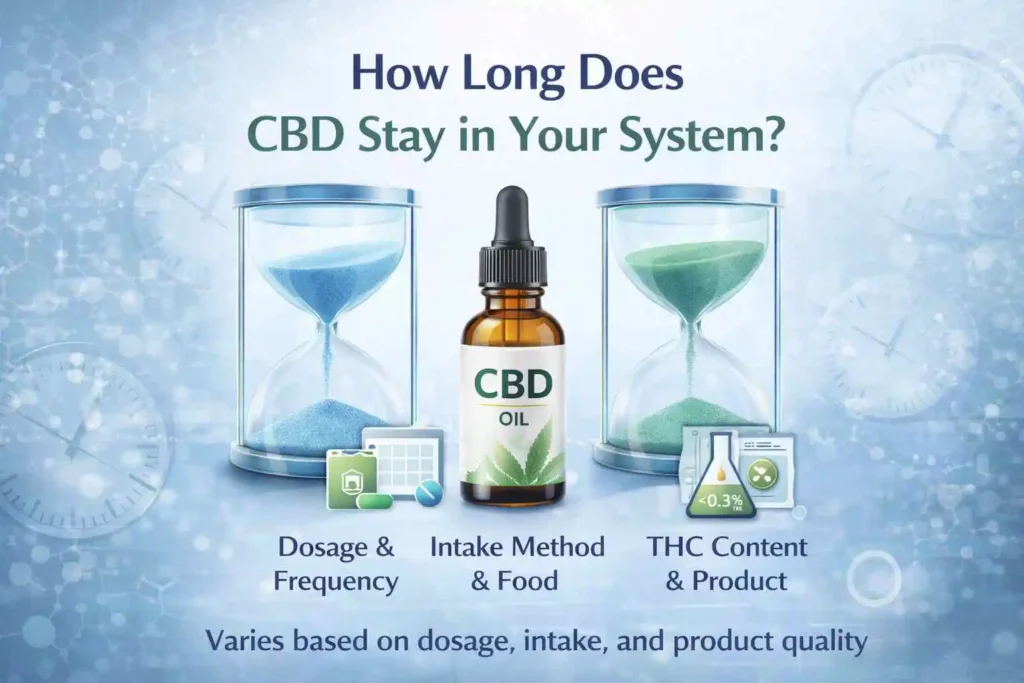
Here’s the part most people miss: there is no one exact CBD timeline that fits everyone. The answer depends on how often you use it, how much you take, whether you take it by mouth or inhale it, whether you take it with food, and what exactly is in the product. A major pharmacokinetic review found CBD half-life can range from hours after some single-dose uses to about 2–5 days after chronic oral use, while the FDA-approved cannabidiol product Epidiolex lists a plasma half-life of 56 to 61 hours after repeated twice-daily dosing.
Short Answer: How Long Does CBD Stay in Your System?
In general, CBD may stay in the body for a few days, and sometimes longer with repeated use. That does not mean you will feel effects for that whole time. It means traces may still be present in the body while your system continues to process and clear it. A review of CBD pharmacokinetics reported half-life estimates ranging from 1.4 to 10.9 hours after some oromucosal dosing, around 24 hours after intravenous dosing, and 2 to 5 days after chronic oral administration.
That is why anyone promising “CBD leaves your body in exactly 24 hours” is guessing.
What Does “Stay in Your System” Actually Mean?
This phrase confuses readers all the time. It can mean three different things:
1. How long you feel the effects
This is usually the shortest window.
2. How long CBD is still circulating or being metabolized
This can last longer than the obvious effects.
3. How long related compounds might matter for testing
This is where people get into trouble, because drug tests usually do not look for CBD itself. They mainly look for THC or THC metabolites. The risk is not usually “pure CBD.” The risk is THC in the product, contamination, or inaccurate labeling.
How Long Do You Feel CBD Effects?
The felt effects depend heavily on how you take it. The StatPearls clinical overview notes that CBD typically reaches peak plasma concentration in about 2.5 to 5 hours after oral use, and that food can significantly increase exposure.
In simple terms:
- oils and capsules usually feel slower
- inhaled CBD acts faster
- edibles can take longer to kick in
- effects often wear off before the compound is fully cleared
For a fuller explanation of absorption and body processing How CBD Oil Works in the Body.
What Affects How Long CBD Stays in Your Body?
Dose
Higher doses generally take longer to clear than smaller ones. That is basic pharmacology, and it is one reason repeated or high-dose CBD can linger longer than occasional low-dose use.
Frequency of use
This is a big one. Occasional users and daily users should not expect the same timeline. Repeated dosing can lead to accumulation, which is why chronic oral use shows longer half-life estimates than one-off use.
Method of use
CBD does not behave the same way in the body across all product types. Inhaled CBD has different bioavailability and timing than oral oils or capsules. StatPearls reports that inhaled CBD bioavailability is about 31%, while oral absorption is slower and more variable.
Food intake
Taking CBD with food, especially a higher-fat meal, can increase exposure. StatPearls states that coadministration with a high-fat, high-calorie meal significantly increases peak concentration and overall exposure compared with fasting.
Body chemistry
Age, body composition, metabolism, liver function, and other medicines can all change how the body handles CBD. The FDA warns that CBD can interact with other medications and alter their effects.
Product quality
This gets ignored too often. A mislabeled product may contain more CBD than stated, less CBD than stated, or measurable THC even when the branding suggests otherwise. A 2024 analysis found that the majority of commercially available CBD products studied were inaccurately labeled.
Can CBD Build Up in Your System?
Yes, it can. Repeated use can increase how long CBD remains in the body compared with a single dose. That is why half-life estimates after chronic oral use are longer than those from some single-dose studies, and why the approved cannabidiol drug label shows a much longer half-life after repeated dosing.
This matters for people who use CBD daily for sleep, stress, or recovery and then assume each dose clears like it was their first.
Can CBD Show Up on a Drug Test?
Usually, standard drug tests are aimed at THC, not CBD. But that does not mean CBD users are risk-free. The problem is that some CBD products contain THC, and even products marketed as “THC-free” have sometimes contained detectable THC. A controlled urine pharmacokinetic study concluded that pure CBD is unlikely to affect drug testing, but hemp products containing low amounts of THC may produce a cannabis-positive urine test. Another study found THC contamination even in products marketed as THC-free.
That is the real danger.
Will Full-Spectrum CBD Stay in Your System Longer?
Not necessarily because of CBD alone, but full-spectrum products may add THC exposure, which complicates the answer. If a person is using full-spectrum CBD regularly, the bigger concern is often not the CBD timeline itself. It is whether trace THC accumulates enough to matter for workplace or screening tests. SAMHSA’s Medical Review Officer guidance notes that based on a daily dose of 30 mg CBD, gastric conversion of CBD itself is unlikely to produce a positive urinary THC test at the federal cutoff, but it does not rule out positive tests from other products or other exposures.
How Long Does CBD Stay in Urine, Blood, or Saliva?
There is no clean one-size-fits-all chart that applies to every product and every person. That is the truth most articles avoid.
What current evidence supports is this:
- CBD can remain detectable in the body beyond the period when you feel it
- repeated oral use can extend the timeline into several days
- drug-test risk usually tracks THC exposure, not CBD alone
If a reader is specifically worried about testing, the smarter advice is to avoid guessing and to assume risk rises when the product is full-spectrum, poorly labeled, or unverified.
How to Lower the Risk of Surprises
If timing or testing matters to you, check these points before using any CBD product:
- choose products with current third-party lab reports
- confirm whether the product is full-spectrum, broad-spectrum, or isolate
- check THC content clearly
- do not assume “hemp” means “zero THC”
- avoid random sellers with weak labels
- be extra cautious if you take other medications
For dosing basics, CBD Dosage Guide.
What About Side Effects While CBD Is Still in the Body?
CBD staying in the system longer does not automatically mean you will feel stronger effects the whole time, but it does matter for safety, especially with repeated use and medication interactions. The FDA says CBD data point to real risks, including liver injury, drug interactions, and changes in alertness.
For a separate side-effect breakdown, CBD Oil Side Effects.
What Pakistan-Based Readers Should Keep in Mind
In Pakistan, buyers often face a quality problem before they face a timing problem. A person in Rawalpindi, Lahore, or Karachi may order a bottle online that looks professional but gives weak THC disclosure and no useful lab data. Then they ask how long “CBD” stays in the system when the bigger issue is that they may not even know what is really in the bottle.
That is why the best answer is not just about biology. It is also about product quality. If the labeling is weak, the timeline becomes harder to predict and the drug-test risk becomes harder to judge.
For readers who need the basics first, direct them here: What Is CBD Oil in Pakistan?.
Final Thoughts
CBD can stay in your system for hours to several days, and sometimes longer with repeated use. The exact timeline depends on dose, frequency, product type, food intake, metabolism, and product quality. The bigger point is this: do not confuse “how long CBD stays in your body” with “how long you feel it,” and do not confuse either of those with “whether a drug test could turn positive.” Those are different questions.