A racing heartbeat gets people’s attention fast. Sometimes it shows up with anxiety, sometimes after caffeine, sometimes for no obvious reason at all. That is why people start looking at CBD and asking whether it can calm the heart down. The problem is that heart rate is not a casual wellness topic, and a lot of CBD content handles it like one. CBDOils.pk tries to take the safer route by explaining what the research actually shows, where the evidence is thin, and why product quality matters when the question involves the heart.
Quick Answer
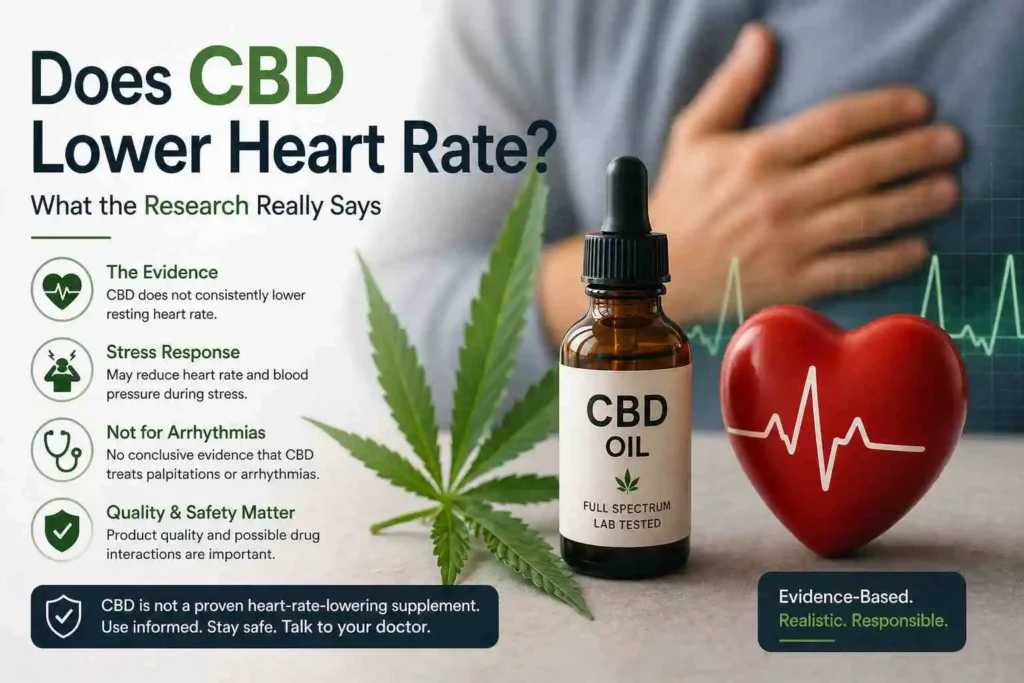
CBD does not have a simple, proven “yes” answer for lowering heart rate. The best summary from human research is this: CBD has not consistently lowered resting heart rate, but some studies and reviews suggest it may blunt stress-related cardiovascular responses in certain situations. One 2017 systematic review and meta-analysis concluded that acute and chronic CBD had no effect on blood pressure or heart rate under control conditions, but it reduced blood pressure and heart rate in stressful conditions based on limited data.
That means the internet version — “CBD lowers heart rate” — is too sloppy to trust.
Why This Question Is Harder Than It Sounds
Heart rate is affected by stress, hydration, sleep, caffeine, medications, fitness level, illness, and underlying heart conditions. So when someone asks whether CBD lowers heart rate, they are often really asking one of three different questions:
- does it lower a normal resting heart rate
- does it lower a stress-driven spike
- can it help with palpitations or arrhythmias
Those are not the same question, and weak content keeps mashing them together. Reviews of CBD’s cardiovascular effects make exactly this point: the evidence is mixed, context matters, and the current clinical data are still limited.
What Human Studies Show About CBD and Heart Rate
The most cited human study here is not cleanly supportive of the claim people want. In a randomized crossover study of healthy volunteers, a single dose of CBD reduced resting blood pressure and the blood pressure response to stress, but it was associated with increased heart rate, not a lower one. The study authors explicitly said these hemodynamic changes should be considered by people taking CBD.
That is the part most “CBD lowers heart rate” articles quietly leave out.
At the same time, broader reviews looking across studies have found that CBD does not appear to affect resting heart rate in normal conditions, while some evidence suggests it may reduce cardiovascular responses during stress. That is a very different claim from saying it is a reliable heart-rate-lowering supplement.
Does CBD Lower Heart Rate Under Stress?
This is the one area where the answer is more promising than flatly negative. Older reviews and more recent cardiovascular summaries both suggest CBD may reduce the heart rate and blood pressure response to stress, possibly through effects on sympathetic drive, vascular tone, or anxiety-related pathways. But even these reviews present this as an emerging signal, not settled clinical proof.
Here’s the thing: that still does not mean someone with a pounding heartbeat should self-treat with random CBD oil and assume they are doing something heart-protective. A stress response in a lab is not the same thing as a real-world heart symptom with an unknown cause.
What About Resting Heart Rate and Blood Pressure?
For resting heart rate, the evidence is underwhelming. Reviews repeatedly report no meaningful effect on resting heart rate under normal conditions.
For blood pressure, the picture is more complicated. The 2017 JCI study found lower resting blood pressure after a single dose in healthy volunteers, and a 2023 randomized crossover study in patients with hypertension reported reduced 24-hour ambulatory blood pressure with chronic oral CBD. But those studies focused on blood pressure more than heart rate, and they do not prove CBD is a general-purpose cardiovascular aid for the average consumer.
So the clean answer is:
CBD may influence blood pressure in some settings, but it is not established as a reliable way to lower resting heart rate.
Can CBD Cause Heart Problems or Palpitations?
There is no conclusive evidence that CBD treats arrhythmias, and Medical News Today notes exactly that in its review of CBD and heart arrhythmia.
At the broader cannabis level, cardiovascular caution is warranted. The CDC says cannabis can make the heart beat faster and raise blood pressure immediately after use, and Harvard Health notes cannabis is known to increase heart rate and blood pressure, though high doses can have the opposite effect. Those statements apply to cannabis broadly, not neatly to purified CBD alone, but they matter because many over-the-counter “CBD” products may contain THC or not match the label.
That is the real-world trap. Someone in Karachi buys a “CBD oil” from a weak seller, assumes it is clean CBD, and never checks whether the product contains THC. Then they blame “CBD” for effects that may actually reflect poor labeling, mixed cannabinoids, or contamination.
This is where you should naturally interlink to FAQs and How CBD Oil Works in the Body.
Who Should Be Extra Careful With CBD?
People with cardiovascular symptoms should not treat this like a casual supplement question. The FDA says CBD can affect how other drugs work and may cause serious side effects through drug interactions; it also warns about liver injury, sedation, and other harms. Harvard Health likewise warns that CBD can raise levels of certain medications in the blood by competing for liver enzymes.
That matters even more for people who:
- take blood pressure medicine
- take blood thinners
- take anti-anxiety, seizure, or heart medications
- already have palpitations, chest pain, dizziness, or fainting
This section should naturally link to CBD Oil Side Effects, because that page should reinforce that “natural” does not mean harmless.
How to Choose a Safer CBD Product
If someone still wants to explore CBD, the smarter move is not chasing the strongest promise on the label. It is checking whether the product clearly states CBD content, whether it contains THC, and whether there is current third-party lab testing. FDA and Harvard Health both stress that CBD products vary widely in quality and may carry real risks.
That is where CBDOils.pk should be positioned carefully: not as a brand promising that CBD lowers heart rate, but as a source that helps customers understand quality, formulation, and realistic expectations before they buy. This is also a clean place to interlink to Benefits of CBD Oil, while making it clear that “potential benefits” are not the same as proven cardiovascular treatment.
Final Takeaway
CBD does not have strong evidence showing that it reliably lowers resting heart rate. The current research suggests something narrower: it may reduce cardiovascular responses to stress in some settings, while showing little or no effect on resting heart rate under normal conditions. One well-known human study even found reduced blood pressure with increased heart rate after acute CBD.