
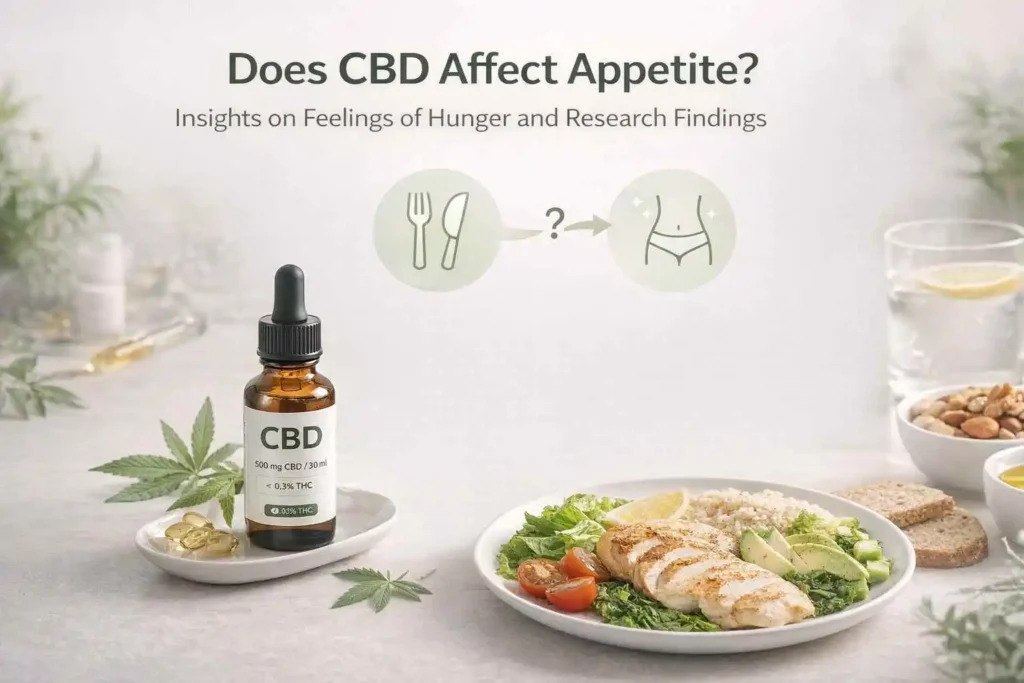
For CBD users in Pakistan, first-time buyers worried about side effects, and readers trying to understand whether CBD might make them hungrier, less hungry, or simply feel different around food, this topic can get confusing fast. The main problem is that people often mix up CBD with THC, assume all cannabis products cause “the munchies,” and then make decisions based on half-correct claims instead of actual research. CBD Pakistan helps readers sort through that confusion by explaining what current studies suggest about appetite, what users often report in real life, and where extra caution still makes sense before adding CBD to a routine.
The short answer: CBD may affect appetite, but not the way many people assume
CBD may affect appetite, but the pattern is not as simple as people think. Unlike THC, which is widely linked with increased hunger, CBD is more often associated in research summaries and side-effect listings with changes in appetite, including decreased appetite in some cases. NCCIH specifically lists decreased appetite among possible CBD side effects, and a 2022 systematic review concluded that CBD appears to have an anorexigenic effect, meaning it may be associated with reduced appetite and lower body weight.
That does not mean CBD always suppresses hunger. It means the evidence leans away from the classic “munchies” story most people expect from cannabis. User experience can still vary depending on product type, dose, and whether THC is also present.
Why people confuse CBD with “the munchies”
This confusion is easy to understand. In Pakistan, once people hear the word “cannabis,” they often assume every related product works the same way. But the “munchies” are mainly linked to THC, not CBD. Healthline’s body-effects guide says an increase in appetite is common with THC, while NCCIH’s CBD guidance points in a different direction by listing decreased appetite among CBD side effects.
Here’s the thing: if someone in Karachi tries a full-spectrum product with trace THC and feels hungrier later, they may blame CBD when the real explanation could be more complicated. Product formulation matters. So does labeling.
What research says about CBD and appetite
CBD and decreased appetite
The most consistent signal in the current evidence is that CBD may be associated with decreased appetite in some users. NCCIH lists decreased appetite as a possible side effect, and Healthline’s dosage and benefits articles also mention changes in appetite and weight among known CBD side effects.
The 2022 systematic review on CBD, appetite, and body weight went further, concluding that CBD appears to have an anorexigenic effect and may correlate with reduced body weight.
CBD, weight, and metabolism research
Some researchers have looked beyond appetite alone and into how CBD may relate to weight and metabolism. Medical News Today notes there is early interest in whether CBD affects how the body interacts with fat, but it also stresses that direct human evidence is limited and not strong enough to support bold weight-loss claims.
A more recent review of cannabis and weight-related behaviors also notes that CBD appears to be associated with decreased appetite, while THC is more strongly associated with increased appetite and cravings.
Why the evidence is still limited
This is the part weak CBD content usually hides. The research is not strong enough to say CBD reliably increases or decreases appetite in everyone. Much of the evidence comes from side-effect reporting, mixed-product studies, or limited human trials rather than large, clean, long-term studies focused only on appetite. Medical News Today explicitly says there are no direct human studies showing that CBD reduces appetite in a settled way, and NCCIH continues to emphasize that much more high-quality research is needed across cannabinoid topics.
What users commonly report about CBD and hunger
User reports tend to fall into three buckets:
- no obvious change in hunger
- less appetite or less mindless snacking
- feeling hungrier, especially when using a product that may also contain THC or when CBD indirectly improves stress or sleep and eating patterns change afterward
That last point matters. Sometimes people do not feel “hungry because of CBD” directly. They feel calmer, sleep better, or experience less discomfort, and their eating pattern shifts as a result. That is plausible, but it is still an inference, not proof of a direct appetite-stimulating effect from CBD itself. does CBD make you hungry appetite effects.
Can CBD make you hungry?
It can, but the better answer is: sometimes, maybe, depending on the product and context. Some articles note that certain people report increased appetite, but Medical News Today says when this happens, it may be related to THC in the product, especially in full-spectrum formulas, rather than CBD acting like THC on its own.
So if a user says, “CBD made me hungry,” that experience should not be dismissed. But it also should not be treated as proof that CBD generally causes the munchies.
Can CBD reduce appetite?
Yes, it may reduce appetite in some users, and this is actually the more research-supported direction overall. NCCIH’s side-effect list, Healthline’s safety summaries, and the systematic review all point toward appetite reduction or appetite change as a more plausible CBD-related pattern than appetite stimulation.
Still, “may reduce appetite” is not the same as “works as an appetite suppressant.” That stronger claim would go beyond the current evidence.
What may change the appetite response
Product type and THC content
This is probably the biggest variable. A CBD isolate product and a full-spectrum product are not the same experience. Full-spectrum products may contain enough THC to matter for some people, especially at higher potencies or in sensitive users. That can change how hunger feels after use.
Dose and timing
Dose may also shape the experience. Some users feel no appetite change at all at lower amounts, while others notice appetite shifts only at higher doses or after repeated use. The broader medical guidance does not establish one appetite-related dose pattern that applies to everyone.
Stress, sleep, and daily routine
Appetite is not only a chemical issue. It is tied to stress, fatigue, recovery, and routine. A student in Lahore who stops stress-snacking after using CBD at night may interpret that as appetite suppression. A desk worker in Karachi who sleeps better and wakes up hungrier may interpret the opposite. Those reactions are real to the person, but they do not automatically tell us the direct mechanism.how CBD oil works in the body.
When to be cautious
Be more careful if you:
- are trying to manage body weight closely
- have a medical condition involving appetite, nausea, or disordered eating
- take medications that already affect hunger or digestion
- are using full-spectrum products and are not sure about THC content
NCCIH notes that CBD may have side effects including decreased appetite, GI symptoms, and drug interactions, which means this is not something to approach lazily if appetite stability really matters for your health.
If someone is using CBD while also managing a complex medical condition, they should speak with a healthcare professional rather than relying on wellness-blog claims.
For general buyer questions, FAQs
Final takeaway
CBD may affect appetite, but it does not seem to do so in the simple, THC-like way many people expect. Current research and safety summaries lean more toward appetite change or decreased appetite than increased hunger, while user experiences still vary depending on THC content, product type, dose, and personal context. The smartest conclusion is not “CBD makes you hungry” or “CBD kills appetite.” It is this: CBD may influence appetite differently from person to person, and the evidence still does not support one univerl effect.