DIY CBD cream sounds easy until the first real question shows up: what exactly should go into it, and how do you make sure the final product is not weak, messy, or poorly balanced? That is where many home users get stuck. They want a simple topical they can trust, but they are often working with unclear CBD strength, random online recipes, and low-quality oils. CBDOils.pk helps close that gap by focusing on product education, dependable CBD quality, and the kind of practical guidance that makes DIY decisions smarter from the start.
Quick Answer
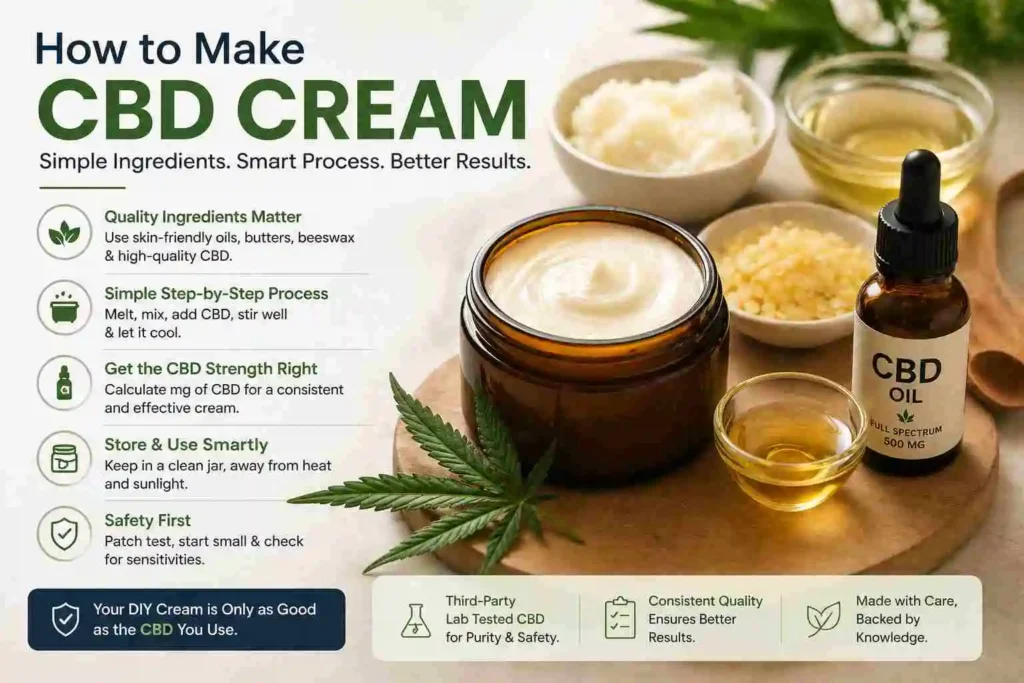
You can make a basic CBD cream at home by combining a skin-friendly base like shea butter or coconut oil with beeswax for structure and a quality CBD oil or CBD isolate for the active ingredient. The simple process is to melt the base ingredients gently, remove them from direct heat, mix in the CBD, stir well, and let the cream cool in a clean container. The recipe itself is not the hard part. The hard part is getting the CBD strength, ingredient quality, and storage right. FDA consumer guidance stresses that CBD product quality and labeling vary widely, which is exactly why your starting CBD matters more than any Pinterest-style recipe.
What You Need to Make CBD Cream
A simple homemade CBD cream usually starts with a few core ingredients:
- Carrier or base oil such as coconut oil, olive oil, or sweet almond oil
- Shea butter or cocoa butter for a richer texture
- Beeswax to thicken and hold the cream together
- CBD oil or CBD isolate
- An optional soothing ingredient like vitamin E oil
- A clean jar or tin for storage
Here’s the thing: many DIY articles act like ingredients are interchangeable. They are not. If you use a thin oil with almost no wax, the result may be too runny. If you overload wax, you end up with something closer to a balm than a cream. And if the CBD source itself is poor, the recipe is already compromised before you start. FDA and health sources both warn that CBD quality is inconsistent across the market, so the ingredient list on the counter is only half the story.
How to Choose High-Quality CBD Oil because that choice affects the whole recipe.
Step-by-Step: How to Make CBD Cream at Home
A simple beginner method looks like this:
1. Melt the base ingredients gently
Add your carrier oil, shea butter, and beeswax to a double boiler or heat-safe bowl over low heat. Stir until fully melted. Low heat matters because overheating delicate ingredients is a stupid way to ruin a formula before it is even mixed.
2. Remove from heat before adding CBD
Once everything has melted and blended, take the mixture off direct heat. Then add your CBD oil or measured CBD isolate. Stir thoroughly so the CBD spreads evenly through the batch.
3. Pour into a clean container
Transfer the mixture into a sterilized glass jar or tin. Let it cool and firm up naturally. As it cools, it will thicken into a cream or balm-like texture depending on your wax and butter ratio.
4. Label the jar
Write down the date, the CBD amount you used, and the approximate total volume. Otherwise, a week later you will have a mystery jar and zero idea how strong it really is.
That basic method aligns with how most reliable DIY topical formulations are built: oil phase first, active ingredient mixed in carefully, then cooled into a stable semi-solid. The reason this article should not oversell the result is simple — homemade creams can vary a lot in consistency and dose unless you are disciplined with measurements. That caution matches broader FDA warnings around quality, consistency, and labeling in CBD products.
How Much CBD Should You Add?
This is the part most DIY recipes handle badly.
The strength of your cream depends on:
- the total milligrams of CBD you add
- the total size of the batch
- how evenly you mix it
For example, if you add 500 mg of CBD to a 50 mL batch, that is very different from adding the same 500 mg to a 150 mL batch. One will be much more concentrated than the other.
That means the smart question is not “how many drops should I add?” It is:
How many milligrams of CBD are in my oil, and how much cream am I making?
If your CBD oil bottle contains 1000 mg total CBD and you use half the bottle, you are adding about 500 mg CBD to the batch. Simple math. But too many people skip this, then complain the cream feels weak. Of course it does. They never calculated the dose.
This is also where buyers need to understand the label properly. A 2024 study found that a large share of commercial CBD products were inaccurately labeled, which means guessing from a weak or misleading product label can wreck the whole DIY process.
Can You Use CBD Oil to Make CBD Cream?
Yes, CBD oil is usually the easiest way to make homemade CBD cream, especially for beginners. It blends more easily into melted oils and butters than raw plant material, and it gives you a clearer idea of how much CBD you are adding — assuming the product label is honest.
You can also use CBD isolate, but that requires more care with measurement and mixing. If you use a poor-quality oil, though, the final cream will still be weak or unreliable. That is why homemade CBD cream is not just a recipe problem. It is a sourcing problem. FDA consumer guidance repeatedly emphasizes that CBD products vary widely in quality and that many safety and labeling questions remain unresolved.
Third-Party Lab Testing CBD, because a DIY cream is only as trustworthy as the CBD you put into it.
For readers who need the product basics first, What Is CBD Cream?.
How to Store Homemade CBD Cream
Homemade CBD cream should be stored in a clean, tightly sealed container away from direct heat, moisture, and strong sunlight. A cool cupboard works for many homes. In hotter cities like Karachi, where room temperatures can stay uncomfortable for long stretches, a soft cream may loosen faster than expected, especially if the formula contains more oil than wax. That is not a disaster. It just means your storage conditions matter.
You should also:
- keep fingers and contaminated tools out of the jar
- use clean hands or a spatula
- label the batch date
- discard it if the smell, texture, or color changes badly
DIY products do not have the preservation systems of professionally made formulations. So pretending they will stay perfect for months is wishful thinking.
Common DIY CBD Cream Mistakes
Here is where people waste time and money:
Using low-quality CBD
A bad oil does not become a good cream because you melted it with shea butter. Garbage in, garbage out.
Not calculating CBD strength
If you do not know how many milligrams are in the final jar, you do not really know what you made.
Overheating the mixture
Excessive heat can damage delicate ingredients and make the texture worse.
Skipping a patch test
This is basic, but people still ignore it. Any topical product can irritate skin depending on the oils, fragrances, waxes, or other additives.
Confusing balm, lotion, and cream
A thick beeswax-heavy product is closer to a balm. A true lotion usually involves water and emulsifiers, which makes formulation more complex. Many DIY “CBD cream” recipes are actually salves or balms. That is fine, but call it what it is.
That last point matters because content quality improves when terminology is accurate. Sloppy naming is a credibility leak.
Why CBD Quality Matters More Than the Recipe
This is the core truth of the whole article.
A neat DIY method means almost nothing if the CBD source is weak, mislabeled, or untested. FDA consumer information says there are still major unanswered questions about the science, safety, and quality of CBD products, and the agency has warned repeatedly about unreliable claims and product inconsistency. Research reviews on CBD in skin health also note promising topical properties, but none of that rescues a poor-quality starting ingredient.
That is why CBDOils.pk should not position DIY cream as some magical shortcut. The stronger position is this: if you are going to make your own, start with tested, clearly labeled CBD and understand what you are mixing. That is far more credible than pretending every homemade recipe is automatically “natural and safe.”
What Consumers Should Know About CBD Product Quality in Pakistan.
Final Takeaway
You can make CBD cream at home with a simple blend of oils, butter, wax, and a quality CBD source. The recipe itself is straightforward. The part that actually matters is CBD strength, product quality, clean mixing, and realistic storage.