For hemp growers, CBD operators, manufacturers, investors, and researchers in Pakistan, the biggest risk is rarely the idea of the business itself. It is whether the business can hold up when regulators look at the paperwork, product standards, THC compliance, and testing trail. CBD Pakistan breaks that pressure down clearly, helping readers see where the real vulnerabilities are before they become expensive problems.
What are the main CCRA penalties and violations in Pakistan?
The short answer is uncomfortable: CCRA risk does not begin only when a business does something dramatic. It begins when a business operates outside the framework set by the Cannabis Control and Regulatory Authority Act, 2024, the rules, and the policy system that followed. Senate-hosted bill text and later Senate search snippets show a general penalty structure where contravention of key sections can trigger fines under Schedule II, and where contravention of the Act, rules, or regulations can lead to up to one year of imprisonment, a fine, or both when no specific penalty is separately provided.
That matters because this is not a “fix it later” sector. Pakistan’s framework was built to regulate, supervise, and monitor industrial and medicinal cannabis activity, not to bless vague commerce after the fact.
Why businesses should take CCRA enforcement seriously
CCRA’s own objectives say the authority exists to oversee industrial and medicinal cannabis licensing and monitoring and to address the social and health harms of unregulated cannabis. The National Cannabis Control and Regulatory Policy, 2025 adds another layer: it says licensing involves background checks and verification of THC-limit compliance, and that certification and testing clearance by the CCRA Laboratory is mandatory for cannabis, hemp, and cannabinoid-based products.CCRA’s Mandate
Here’s the thing: once a framework is built around licensing, testing, THC verification, and monitoring, sloppy operators do not merely look unprofessional. They create enforceable exposure.
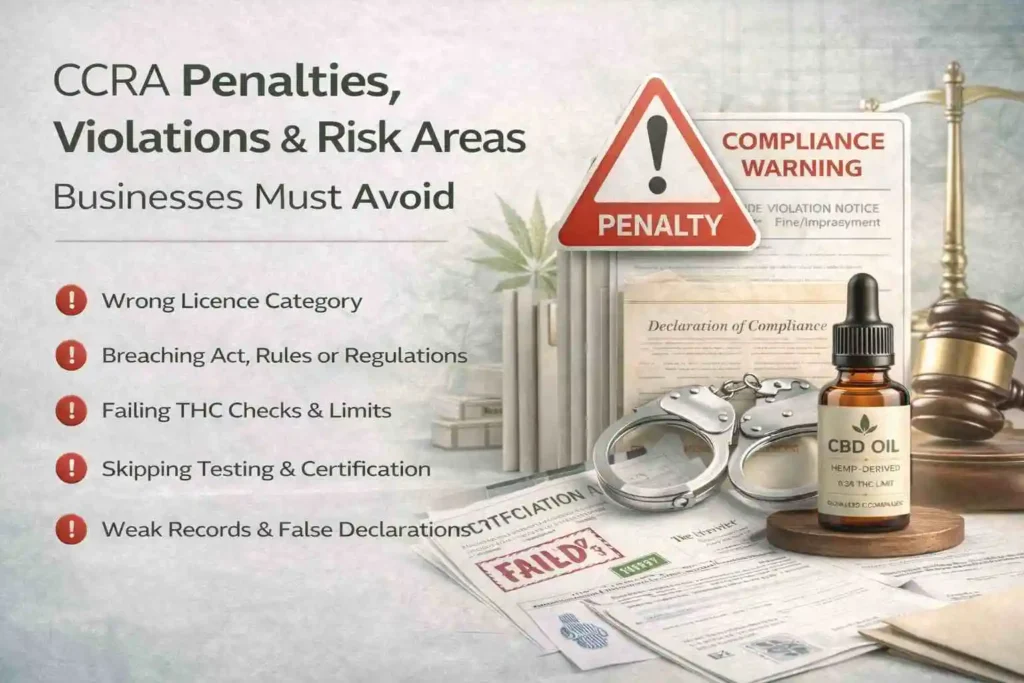
The biggest CCRA risk areas businesses must avoid
Operating under the wrong licence category
One of the easiest ways to create trouble is to operate under the wrong licence logic. CCRA’s public licence page lists distinct categories including A-1 Industrial Hemp Cultivation, A-2 Medicinal Cannabis Cultivation, and additional B- and C-category licences. CCRA’s site also states that all licence types will be issued after approval of the regulations, which means the authority is clearly segmenting the market by function.
If a business is really processing, extracting, manufacturing, or developing CBD-related products but talks as if it is “just hemp,” that is not clever positioning. It is a compliance weakness.
For the full licence map, Types of Licences Under CCRA.
Breaching the Act, rules, or regulations
This is the broadest risk area. Senate search results tied to the Act show that contravention of sections 12, 13, and 14 can trigger fines in accordance with Schedule II, and that where no specific penalty is otherwise provided, contravention of the Act, rules, or regulations may still lead to imprisonment, a fine, or both.
That means a business does not need some movie-style scandal to get into trouble. Repeated regulatory breaches, ignored requirements, or acting outside the framework can be enough.
Failing THC-limit checks
Pakistan’s current policy framework makes THC control a core enforcement issue. The policy says routine testing of industrial cannabis crop is conducted to verify THC levels and ensure compliance with the permissible threshold of less than 0.3%, and it says the licensing process includes verification of compliance with stipulated THC limits. Reporting on Pakistan’s framework also describes 0.3% THC as the maximum threshold used to prevent abuse and recreational misuse.
That means THC is not a branding detail. It is a regulatory boundary.
Skipping mandatory testing and certification
This is one of the clearest risk areas in the policy. The National Cannabis Control and Regulatory Policy, 2025 says that certification and testing clearance issued by the CCRA Laboratory shall be mandatory for cannabis, hemp, and cannabinoid-based products.
A business that tries to lean on packaging, imported-sounding product names, or informal lab claims instead of mandatory clearance is asking for pain.
Weak records, traceability, and monitoring
The same policy points to tracking and tracing, while CCRA’s objectives emphasize licensing and monitoring. CCRA’s homepage also describes its mandate as regulating, supervising, and controlling the sector, including processing and research.
In practical terms, weak inventory records, poor source documentation, inconsistent batch tracking, and vague supply-chain claims are all risk multipliers.
Poor eligibility, false statements, or incomplete documents
CCRA’s prerequisites say the applicant must be a Pakistani citizen or an entity incorporated in Pakistan, and that supporting registration or incorporation documents are part of the process. If your business cannot prove who it is, who owns it, or whether it is properly formed, the compliance problem starts before operations begin.
That is where a lot of operators in Lahore, Karachi, and Islamabad fool themselves. They think structure is paperwork. It is not. It is the base layer of credibility.
For the application process itself, How to Apply for a CCRA Licence in Pakistan.
What penalties can apply under CCRA?
Based on the publicly surfaced legislative text and Senate search snippets, businesses should expect at least three levels of consequence.
The first is financial exposure, because the Act contemplates fines, including fines under Schedule II for contravention of specified sections. The second is criminal exposure, because the general penalty clause surfaced in Senate records refers to up to one year of imprisonment, a fine, or both where no specific penalty is separately provided. The third is regulatory exposure, because a framework built around licensing, testing, THC verification, and monitoring can also affect approvals, ongoing operations, and future licensing position when a business fails to comply.
One thing I am not going to do is invent a neat penalty table the official public snippets do not fully expose. That is how weak legal content gets written.
For the broader rulebook, CCRA Penalties in Pakistan.
How to reduce CCRA compliance risk
Start with the obvious things most businesses avoid.
Match your activity to the right licence category. Keep your corporate or ownership documents clean. Treat THC control as an operational requirement, not a label claim. Build a real testing path that can satisfy mandatory certification rules. Keep records that support traceability. And stop acting like compliance can be solved after launch. CCRA’s own framework points in the opposite direction: testing, monitoring, eligibility, and structured licensing come first.
Final takeaway
The biggest CCRA penalty and violation risks for cannabis and hemp businesses in Pakistan sit in predictable places. They include operating under the wrong licence category, breaching the Act or its rules, failing THC-limit checks, skipping mandatory testing and certification, keeping weak records, and approaching licensing with poor legal structure or incomplete documents. The public record supports fines under Schedule II, a general penalty clause that can reach up to one year of imprisonment, and a broader enforcement logic tied to licensing, monitoring, testing, and THC control.