CCRA Compliance Requirements for Cannabis and Hemp Businesses
If you are a hemp grower, cannabis-sector investor, CBD business owner, manufacturer, or researcher in Pakistan trying to enter this market without stepping into a legal mess, this guide is for you. The real problem is not just getting a licence. It is understanding the compliance burden behind it: wrong category, weak paperwork, THC issues, no testing trail, and false confidence about what the rules actually require. CBD Pakistan helps readers make sense of that complexity by explaining the compliance side in plain language, so businesses can understand what matters before they build on bad assumptions.
What are CCRA compliance requirements in Pakistan?
CCRA compliance requirements are the legal and operational conditions cannabis and hemp businesses must follow under Pakistan’s regulated framework. CCRA says it regulates the cultivation of cannabis, along with extraction, refining, manufacturing, and sale of derivatives for medicinal and industrial purposes. Its stated objectives also include overseeing industrial and medicinal cannabis licensing and monitoring.
That means compliance is not only a farm issue. It touches cultivation, processing, manufacturing, testing, and downstream cannabinoid products as well.
Why compliance matters under CCRA
Pakistan’s National Cannabis Control and Regulatory Policy, 2025 frames the sector around control and regularization, not casual market access. The policy says certification and testing clearance from the CCRA Laboratory is mandatory for all categories of licensees, and it says the licensing process involves background checks plus verification of compliance with stipulated THC limits.
That kills a common fantasy in this market: that a clean-looking bottle, a nice Shopify theme, or vague “hemp-derived” wording is enough. It is not. The framework is moving toward testing, traceability, and review.
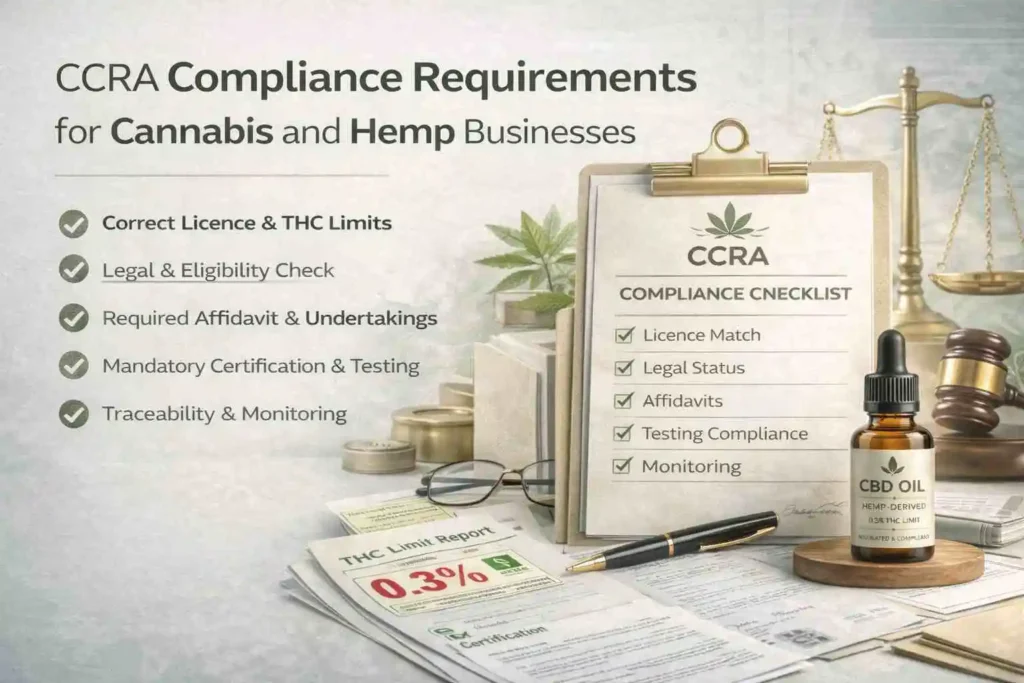
Key CCRA compliance requirements businesses need to understand
Use the correct licence category
The first compliance requirement is basic but decisive: your business activity has to match the right licence type. CCRA’s public licence page lists categories including A-1 Industrial Hemp Cultivation, A-2 Medicinal Cannabis Cultivation, A-3 Medicinal Cannabis Cultivation (Open Field), B-1 Hemp Processing, B-2 Cannabis Extraction, B-3 Pharmaceutical Manufacturing, and B-4 Synthetic/Biosynthetic CBD.
If your actual work is extraction or CBD-related manufacturing but your thinking is stuck at “we’re just a hemp business,” you are already creating compliance risk. For the full category breakdown, Types of Licences Under CCRA.
Meet applicant eligibility rules
CCRA’s prerequisites say the applicant must be a Pakistani citizen or an entity incorporated in Pakistan under the relevant laws. That is not a minor formality. It means informal operators and loosely structured ventures start from a weaker position.
In plain language, if your business structure is fuzzy, your compliance structure is fuzzy too.
Prepare the required legal documents
CCRA’s prerequisites also point to documentation requirements such as Certificate of Incorporation / Registration (SECP or relevant authority). Publicly surfaced prerequisite text also indicates the authority expects a proper legal identity trail before licensing moves ahead.
That matters because businesses in Karachi, Lahore, and Islamabad often rush to product, sourcing, and branding before they clean up the legal base. That is backwards.
Stay within THC limits
The policy makes THC compliance a core control point. It says routine testing of industrial cannabis crop will be conducted to verify THC levels against the permissible threshold of less than 0.3%, and it says licensing includes verification of compliance with the stipulated THC limits.
So THC is not just a label detail. It is a compliance trigger. If your crop, extract, or product drifts outside the permitted range, your regulatory position changes with it.
Pass mandatory testing and certification
This is one of the clearest current requirements in the framework. The policy says certification and testing clearance issued by the CCRA Laboratory shall be mandatory for all categories of licensees, including cultivators, processors, manufacturers, exporters, importers, researchers, and laboratory testing facilities.
That means a business without a real testing path is not building a compliant model. It is building a risk story.
Prepare for background checks, tracking, and monitoring
The policy says the licensing process includes thorough background checks, and it also points to tracking and tracing as part of the framework. CCRA’s objectives separately emphasize licensing and monitoring.
This is where many operators get exposed. They prepare the sales pitch, not the audit trail.
Is the CCRA licensing system fully live yet?
Not fully, based on CCRA’s own public pages. The homepage says the Licensing Portal will be available shortly, the portal page says licensing for Medicinal Cannabis, Industrial Hemp and Synthetic/Bio-Synthetic will be available very soon, and the licence page says all licence types will be issued after approval of the regulations.
So the framework is real, but the rollout is still staged. Anyone telling you the whole system is already smooth and fully mature is overstating what the public record supports. For the application path itself, How to Apply for CCRA Licence in Pakistan.
Common compliance mistakes businesses should avoid
The common failures are not mysterious. They are usually self-inflicted:
- choosing the wrong licence category
- assuming hemp or CBD wording solves THC compliance
- ignoring mandatory testing and certification
- treating compliance like a post-launch problem
- assuming the portal’s existence means the operational process is already complete
- building product plans before cleaning up legal structure.
- CCRA Penalties in Pakistan.
Final takeaway
CCRA compliance requirements for cannabis and hemp businesses in Pakistan go far beyond “get a licence.” The current framework points to several core obligations: use the correct licence category, qualify as an eligible applicant, maintain valid legal documentation, stay within THC limits, obtain mandatory testing and certification, and prepare for background checks, tracking, and monitoring. Those requirements are supported by CCRA’s published mandate, objectives, licence list, prerequisites, and the National Cannabis Control and Regulatory Policy, 2025., objectives, mandate, and the National Cannabis Control and Regulatory Policy, 2025.