A lot of people hear “CCRA licence” and imagine one standard permit that covers the whole cannabis sector. That is not how the framework works. Under Pakistan’s current system, licence categories are more specific, and the category you fall under can shape your next move. CBD Pakistan helps readers understand those public licence types clearly, so they can see where their activity fits before stepping into the market blindly.
What are the main types of licences under CCRA?
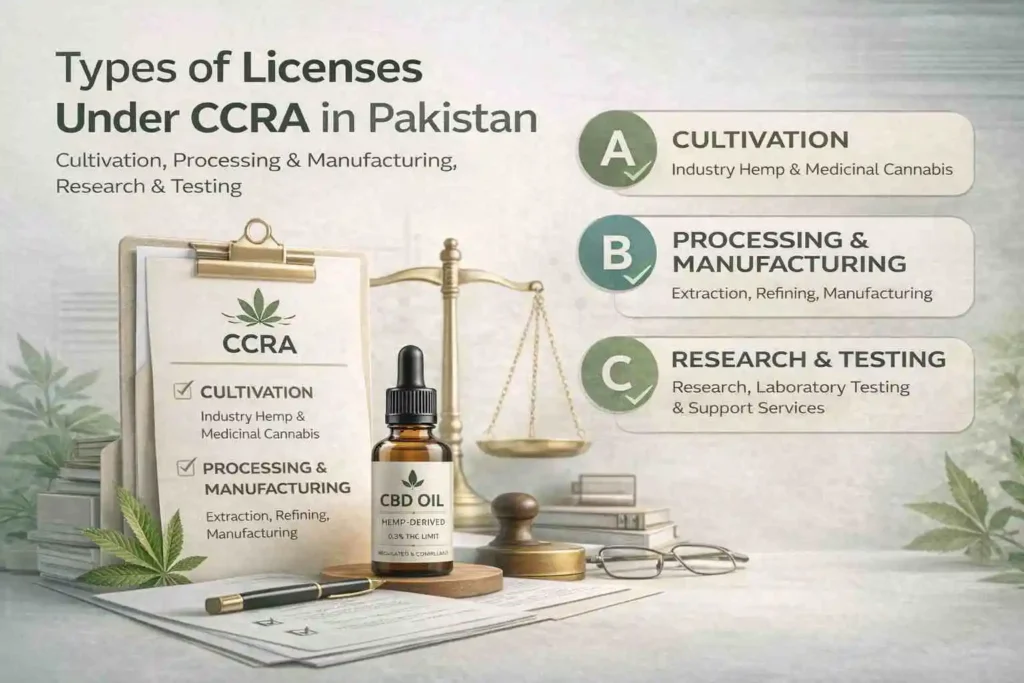
CCRA’s public licensing page shows that licence types are grouped into broad categories, including A-category cultivation licences, B-category processing and manufacturing licences, and C-category research, testing, and support licences. The public search snippet explicitly lists A-1 Industrial Hemp Cultivation, A-2 Medicinal Cannabis Cultivation, B-3 Pharmaceutical Manufacturing, B-4 Synthetic / Biosynthetic CBD, C-1 Research and Development, and C-2 Laboratory Testing, confirming that the framework goes well beyond farming alone.
That matters because CCRA’s legal mandate itself covers the cultivation of cannabis, extraction, refining, manufacturing, and sale of derivatives for medicinal and industrial purposes. So the licensing structure follows that broader mandate.
Cultivation licences under CCRA
This is the easiest category to understand, and it is where many people stop reading too early.
A-1 Industrial Hemp Cultivation
The public CCRA licence list includes A-1 Industrial Hemp Cultivation. This category is aimed at licensed cultivation tied to the industrial hemp side of the sector, which matters for businesses looking at hemp-based raw material, fiber, extracts, or related downstream use.
A-2 Medicinal Cannabis Cultivation (Controlled)
CCRA also publicly lists A-2 Medicinal Cannabis Cultivation, which appears as the controlled cultivation route for medicinal cannabis activity. That tells you right away that Pakistan’s framework is not limited to hemp alone.
A-3 Medicinal Cannabis Cultivation (Open Field)
The public licence list also includes A-3 Medicinal Cannabis Cultivation (Open Field). That distinction matters because it suggests different cultivation environments may sit under different regulatory treatment.
If a reader needs the broader legal background first, What Is CCRA in Pakistan?.
Processing and manufacturing licences under CCRA
Here is where people usually get lazy. They assume licensing ends at cultivation. It does not.
The CCRA licensing material publicly exposes at least two B-category licence types through search results: B-3 Pharmaceutical Manufacturing and B-4 Synthetic / Biosynthetic CBD. That means the framework is already clearly extending into product development and manufacturing, not just raw plant activity.
B-category licences and what they cover
Based on the publicly visible licence names, B-category licences cover downstream operational activity such as:
- pharmaceutical manufacturing
- synthetic or biosynthetic CBD-related activity
That aligns with CCRA’s official mandate over extraction, refining, manufacturing, and derivatives. So even where the full public B-category list is not fully visible in search snippets, the direction is obvious: CCRA is regulating the middle and downstream parts of the supply chain too.
This is exactly why a CBD brand cannot act like compliance is only the farmer’s problem.
Research, testing, and support licences under CCRA
The C-category licences matter more than most people realize, because regulated sectors do not run on cultivation and manufacturing alone. They also depend on testing, validation, and technical support.
C-category licences and why they matter
CCRA’s public licensing snippet lists:
- C-1 Research and Development
- C-2 Laboratory Testing
- at least one additional C-3 category, though the visible snippet truncates before the full title appears.
Even with that truncation, the meaning is clear enough: CCRA’s licensing framework includes formal roles for research and lab work. That supports a more structured ecosystem around product development, compliance, and technical verification. CCRA’s public site also says it is committed to a regulatory ecosystem defined by traceability, accountability, and technological sophistication, which fits that licensing logic.
Who can apply for a CCRA licence?
CCRA’s public prerequisite page says an applicant must be a Pakistani citizen or an entity incorporated in Pakistan under the relevant laws. The same licensing prerequisite snippet indicates corporate documentation, such as incorporation records, forms part of the process.
That is a critical point. This is not a casual market-entry setup. If someone is pretending CCRA licensing is just a light formality, they are either guessing or selling you fantasy.
For readers who want the next step after licence types, How to Apply for CCRA Licence in Pakistan.
Why these licence types matter for CBD and hemp businesses in Pakistan
These licence types matter because they show how Pakistan is trying to structure the sector from crop to finished product. The Cannabis Control and Regulatory Authority Act, 2024 created the authority, and CCRA’s public mandate and policy material show that the state is building a regulated system for medicinal cannabis and industrial hemp rather than treating the whole space as one vague category.
For CBD businesses, the biggest takeaway is this: the framework reaches beyond cultivation into manufacturing, derivatives, lab testing, and research. That makes licensing relevant to:
- growers
- extractors
- manufacturers
- researchers
- testing facilities
- technical service providers
In cities like Lahore, Karachi, and Islamabad, where people often jump from WhatsApp rumors to “business plans” without reading the actual framework, this is exactly where mistakes happen. One wrong assumption about licence type and the whole business model starts on weak ground.
For readers who want the rules side after this, CCRA Compliance Requirements.
How to think about the licence structure strategically
Here’s the practical way to read the system.
Start by asking:
- Are you cultivating, processing, manufacturing, researching, or testing?
- Are you dealing with industrial hemp, medicinal cannabis, or CBD-related derivatives?
- Are you operating as an individual Pakistani applicant or a Pakistan-incorporated entity?
- Are you building something that will need lab validation or pharmaceutical-grade processes?
Those questions matter because the licence names show that CCRA is segmenting the sector by function, not treating every operator the same way.
Final takeaway
The main types of licences under CCRA in Pakistan include cultivation licences, manufacturing-related licences, and research/testing licences. Publicly visible categories include A-1 Industrial Hemp Cultivation, A-2 Medicinal Cannabis Cultivation, A-3 Medicinal Cannabis Cultivation (Open Field), B-3 Pharmaceutical Manufacturing, B-4 Synthetic / Biosynthetic CBD, C-1 Research and Development, and C-2 Laboratory Testing, with at least one additional C-category licence visible but truncated in public search results.