A dog grabbing a gummy, licking spilled oil, or chewing through a bottle turns this question from “just curious” into panic in seconds. Pet owners in that moment are not looking for fluffy wellness claims. They want to know what is actually dangerous, what symptoms matter, and whether they need emergency help now. CBDOils.pk can support that decision with clearer education, stronger quality standards, and product guidance that takes pet safety seriously instead of pretending every “hemp” product is harmless.
Quick Answer
CBD itself is not usually the main reason dogs die after cannabis-type exposures. The bigger danger is THC, human edibles, mislabeled products, or other toxic ingredients that come with the product. Merck’s veterinary manual says acute oral CBD overdose in dogs has caused diarrhea in studies, while THC toxicosis in dogs can cause major neurologic and GI signs; Merck also notes death from THC exposure is extremely rare and most cases are self-limiting with care. The FDA still warns that cannabis products can cause serious adverse effects in pets and says owners should contact a veterinarian or poison center immediately if a pet seems affected.
That means the honest answer is not “CBD kills dogs” and it is not “CBD is totally safe.” It is this: pure CBD appears less dangerous than THC, but real-world products are messy, labels can be wrong, and dogs can absolutely get very sick from what owners think is just CBD.
CBD vs THC: The Difference Pet Owners Cannot Ignore
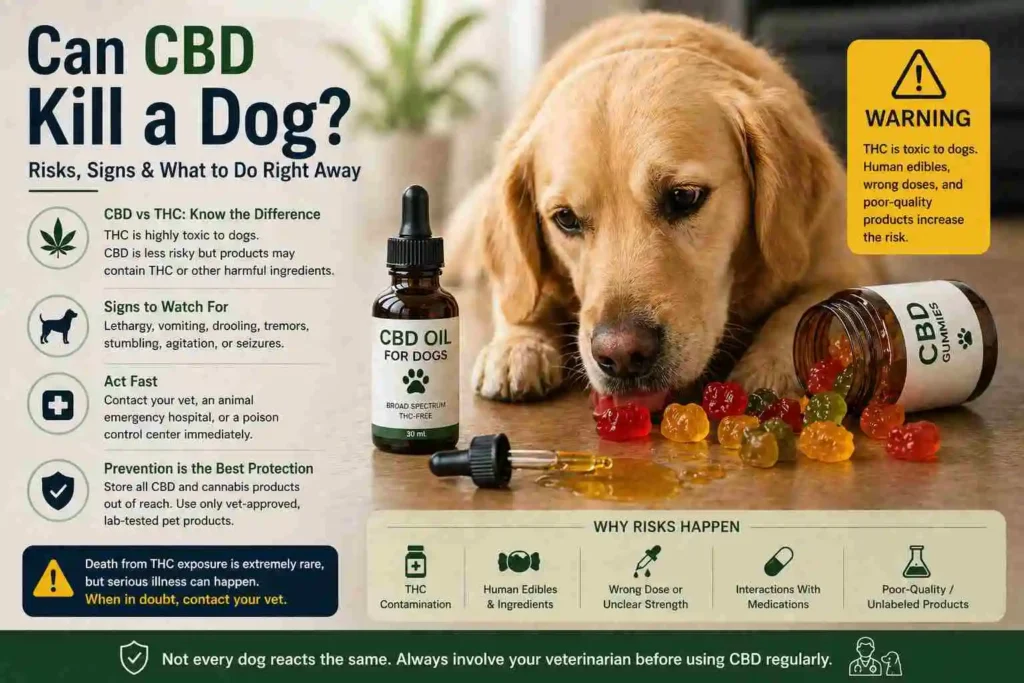
This is the line many articles blur, and that is reckless. THC is far more toxic to dogs than CBD. AKC says dogs have a much more severe reaction to THC than humans, and Merck says THC-containing products commonly cause ataxia, lethargy, trembling, urinary incontinence, and GI signs in dogs. By contrast, Merck’s CBD toxicosis page says studied CBD overdoses in dogs mainly produced diarrhea and some liver enzyme changes in longer-term studies.
So when an owner says, “My dog got into CBD,” the next question should be: was it really CBD-only, or was there THC in it too? Weak-quality products and human gummies make that distinction much harder than people think. AKC specifically warns that pet CBD labels are not always accurate and that THC contamination is a major concern. Is CBD Safe for Dogs?.
What Happens If a Dog Eats CBD?
If the product is truly CBD-predominant and not contaminated, the most likely problems are usually GI upset, sedation, appetite changes, and possibly liver-enzyme effects, not immediate lethal poisoning. Cornell says common owner-reported CBD side effects in dogs include sedation and increased appetite, and Merck reports acute oral CBD overdose up to 62 mg/kg caused diarrhea in dogs.
But real life is messier than the clean version. A dog that eats a “CBD gummy” may also be exposed to THC, chocolate, xylitol, sweeteners, or a huge total dose. That is why the product format matters as much as the cannabinoid. The FDA warns that pets with cannabis adverse effects may show lethargy, depression, drooling, vomiting, agitation, tremors, and convulsions.
Signs a Dog May Be Having a Bad Reaction
Watch for:
- severe lethargy or weakness
- stumbling, wobbling, or crossing the feet
- vomiting or heavy drooling
- tremors or shaking
- agitation or unusual sensitivity
- urinary accidents or dribbling
- seizures or convulsions
AKC lists stumbling, lethargy, dilated pupils, urinary incontinence, vomiting, tremors, and agitation among common marijuana-poisoning signs in dogs. The FDA lists lethargy, depression, drooling, vomiting, agitation, tremors, and convulsions as signs of cannabis adverse effects in pets.
Here’s the thing: owners often misread “quiet and sleepy” as the product calming the dog down. That is not always what is happening. It may be the start of toxicosis.
When the Risk Is Higher
THC contamination
THC raises the danger sharply. AKC says THC toxicosis is the main concern and that dogs react much more strongly to it than humans. Merck says THC exposures in dogs can bring neurologic and GI signs and that supportive care is often needed.
Human gummies and edibles
Human cannabis products are a bad fit for dogs because the problem may not be the CBD alone. Gummies, baked goods, or candies can carry THC and other dangerous ingredients. The FDA says cannabis-containing substances can harm pets, and AKC notes symptom onset after ingestible products often appears within 30 minutes to an hour, though other sources note it can be later depending on the product.
Wrong dose or poor-quality products
There is no guaranteed-safe chart that fixes a badly made product. AKC says labels can be inaccurate, and the FDA says it cannot ensure the safety or effectiveness of cannabis-derived animal products.
Other medications or health problems
Cornell warns that CBD can affect liver enzymes involved in metabolizing many medications. So a dog already on long-term drugs is not a casual test case. How Much CBD for Dogs? and CBD Oil Side Effects.
What to Do Right Away If Your Dog Ate CBD
If your dog got into a CBD oil, gummy, edible, or any cannabis-type product:
- Do not wait for severe symptoms.
- Check the package for CBD amount, THC content, and other ingredients.
- Call your veterinarian, local animal emergency hospital, or animal poison control center immediately if the dog seems abnormal or if you are not sure what was in the product.
- Tell them exactly what the dog ate and when.
The FDA explicitly says to contact a veterinarian, emergency hospital, or animal poison control center immediately if you suspect adverse effects from cannabis ingestion. Merck also stresses that an accurate exposure history is critical for diagnosis and treatment.
Do not waste time trying home fixes you saw online. When a dog ate a mystery gummy in Karachi, Lahore, or Islamabad, the urgent question is not “Which blog said CBD is safe?” The urgent question is what exactly was in that product. /faqs/.
How to Lower the Risk in the Future
The blunt answer is simple:
- keep all human CBD and cannabis products out of reach
- avoid assuming “hemp” means dog-safe
- do not use products without clear lab testing
- do not use THC-containing products for pets
- involve a vet before giving any regular CBD product to a dog
Cornell says veterinary input matters because of possible medication interactions and liver-enzyme effects. The FDA says it has not approved cannabis products for animals and cannot ensure their safety or effectiveness.
This is where CBDOils.pk should position itself carefully: not by pretending every pet CBD product is safe, but by emphasizing tested products, clear labels, and responsible education.
Final Takeaway
CBD is not the same risk as THC for dogs, and pure CBD alone is not usually presented as a common direct cause of death. But that does not make accidental exposure harmless. Dogs can become seriously ill from cannabis-related products, especially when THC, edibles, weak labeling, or toxic extra ingredients are involved. Merck says death from THC exposure is extremely rare, but the FDA still treats cannabis adverse effects in pets as serious enough to warrant immediate veterinary contact.