“Anti-inflammatory” gets thrown around so casually that many buyers start treating CBD like a proven substitute for every ache, flare-up, or swollen joint. That is where the confusion starts. People dealing with stiffness, arthritis, recovery pain, or ongoing inflammation want something that actually helps, but they also do not want to waste money on hype dressed up as science. CBDOils.pk helps close that gap by focusing on clearer education, cleaner product quality, and practical guidance rooted in what the evidence supports — not what the market exaggerates.
Quick Answer
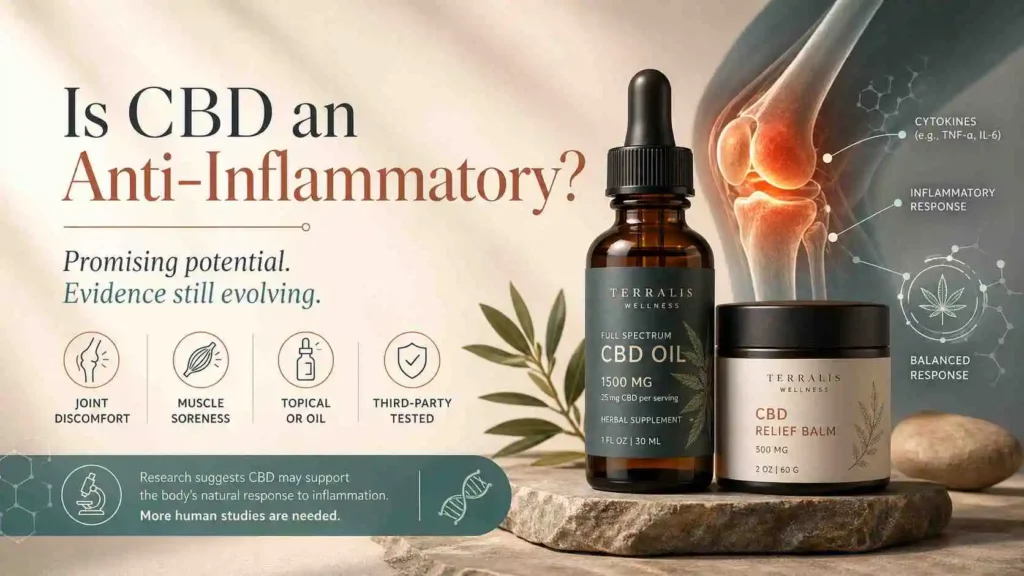
CBD is often described as having anti-inflammatory potential, but the cleanest answer is not “yes, full stop.” Preclinical research and some early human data suggest CBD may influence inflammatory pathways, but major health organizations and arthritis experts still say larger, better-quality human studies are needed before strong conclusions can be made for everyday inflammatory conditions. In other words, the biology is promising, but the marketing has run ahead of the evidence.
Why People Call CBD Anti-Inflammatory
They call it anti-inflammatory because studies and reviews keep finding that CBD can interact with immune signaling, inflammatory mediators, and pain-related pathways. Recent reviews describe CBD as an immune modulator that may suppress some pro-inflammatory cytokines and alter inflammatory responses. That is real science, not fantasy. The problem is that much of this evidence comes from lab models, animal work, or narrow clinical contexts — not from the kind of large, rigorous human trials people assume already exist.
What the Human Research Actually Shows
This is the part weak CBD blogs avoid. Human evidence is mixed and still limited. The Arthritis Foundation says animal studies and some small human studies suggest CBD may have pain-relieving and anti-inflammatory properties, but these effects still need validation in larger, high-quality human studies. NCCIH makes a similar point more broadly: cannabinoids are being studied for pain and related mechanisms, but the evidence base is still being built, not settled.
That means the honest answer to the keyword is uncomfortable but useful: CBD may have anti-inflammatory effects, but it is not currently backed by robust enough human evidence to be treated like a universally proven anti-inflammatory therapy. Anyone presenting that as settled fact is either careless or selling something.
Can CBD Help With Inflammation-Related Pain?
Arthritis and joint discomfort
This is one of the biggest real-world search intents behind the keyword. People are rarely asking about inflammation in the abstract. They are asking because their knees hurt, their hands feel stiff, or their joints flare up after long workdays. The Arthritis Foundation says many people with arthritis try CBD, and some report pain relief, but the evidence remains mixed and incomplete. It also notes that the early anti-inflammatory signal seen in animals and small studies has not yet been confirmed in strong human trials. Is CBD Good for Arthritis?.
Muscle soreness and daily aches
CBD is also commonly discussed for post-workout soreness, everyday aches, or discomfort that people loosely describe as “inflammation.” NCCIH says some cannabis-derived products with THC and CBD combinations may reduce chronic pain in the short term, but that is not the same thing as proving pure CBD alone is a reliable anti-inflammatory treatment for routine aches. That distinction matters, because too many articles quietly switch from “cannabinoid-containing products” to “CBD definitely works” as if those are identical claims. They are not.
Skin and topical use
Topical CBD is often marketed for localized inflammation or irritated skin. The mechanism is biologically plausible, and recent reviews discuss anti-inflammatory potential in skin-related contexts, but again, quality human evidence is not strong enough to justify miracle language. This is why product type matters: a cream used on one area is not the same thing as oil taken internally, and buyers should stop lumping all CBD formats together.
How CBD May Work in the Body
CBD does not work like a classic anti-inflammatory drug such as an NSAID. It appears to interact more indirectly with signaling systems involved in inflammation, immune activity, pain perception, and cellular stress responses. Reviews describe effects on cytokines, macrophages, T cells, and other inflammatory pathways, while NCCIH points to ongoing work investigating cannabinoids’ pain-relieving mechanisms. That makes CBD interesting from a research perspective, but “interesting mechanism” is still not the same thing as “clinically proven outcome.” How CBD Oil Works in the Body and Benefits of CBD Oil.
Does CBD Reduce Inflammation Right Away?
Usually, people asking this want a fast, simple answer. The wrong answer is yes. The better answer is that any benefit, if it occurs, depends on the product, the dose, the condition, the route of use, and the person. There is no universal “CBD lowers inflammation in 30 minutes” rule supported by solid evidence. Some people report symptom relief, especially around pain or sleep, but that is not a reliable stopwatch for inflammation itself. The Arthritis Foundation’s guidance reflects this uncertainty and advises consumers to approach CBD carefully rather than like a guaranteed quick fix.
What CBD Cannot Promise
CBD cannot honestly promise to cure inflammatory diseases, replace every standard treatment, or work the same way for every person. The FDA has repeatedly warned that many CBD products are marketed with unsupported medical claims and that important questions remain about their safety and quality. Harvard Health has also warned that CBD products can be poorly made and promoted far beyond what the evidence supports.
Let’s be real—this is where buyers get trapped. Someone dealing with chronic joint pain in Lahore or morning stiffness in Islamabad reads “anti-inflammatory” on a label and starts expecting the product to behave like a proven medication. That expectation is the problem. A quality CBD product may be worth exploring, but it should be explored realistically, not romantically.
Side Effects, Drug Interactions, and Who Should Be Careful
Even if CBD has anti-inflammatory potential, that does not make it risk-free. The FDA says CBD may interact with medications and may increase or decrease the effects of other drugs. It also points to risks including liver injury and changes in alertness, and strongly advises against CBD use during pregnancy or breastfeeding. That matters a lot for people taking pain medications, psychiatric medications, seizure medications, or other prescription drugs. CBD Oil Side Effects.
How to Choose a Smarter CBD Product
If someone wants to try CBD for inflammation-related concerns, the smarter move is not chasing the boldest claim. It is checking whether the product is clearly labeled, whether it contains THC, whether third-party lab testing exists, and whether the brand explains what the product is actually meant to do. The Arthritis Foundation advises smart shopping and reputable sourcing, and FDA guidance makes clear that product quality across the market remains inconsistent.
That is where CBDOils.pk has a stronger role to play: not pretending CBD is a miracle anti-inflammatory, but helping customers understand product type, evidence level, and quality signals before they spend money.
Final Takeaway
CBD does appear to have anti-inflammatory potential, and that conclusion is supported by a growing body of mechanistic, preclinical, and early human research. But the stronger and more honest conclusion is narrower: CBD is promising, not proven across the board, especially for common inflammatory conditions where high-quality human evidence is still limited.