Making a CBD tincture at home makes the most sense for readers who want control over strength, ingredients, and carrier oil rather than relying on a ready-made bottle they barely understand. The usual problems show up fast: people are unsure which CBD extract to start with, how much MCT oil to use, how to calculate strength per dropper, and whether a homemade tincture will actually be consistent. At CBDOILS.PK, we help readers make sense of those decisions with practical guidance on product quality, clear labeling, and sensible formulation so the process is simpler from the start.
Here’s the useful truth: making a basic CBD tincture with MCT oil is not difficult, but making a predictable tincture is where most people fail. CBD is fat-soluble, which is one reason lipid carriers such as coconut oil and MCT oil are commonly used. Project CBD notes that CBD can be extracted using lipid solvents including coconut or MCT oil, and a UK toxicology review cites evidence that an MCT-oil formulation can improve CBD solubilization and absorption compared with some other preparations.
Short Answer: How Do You Make CBD Tincture With MCT Oil?
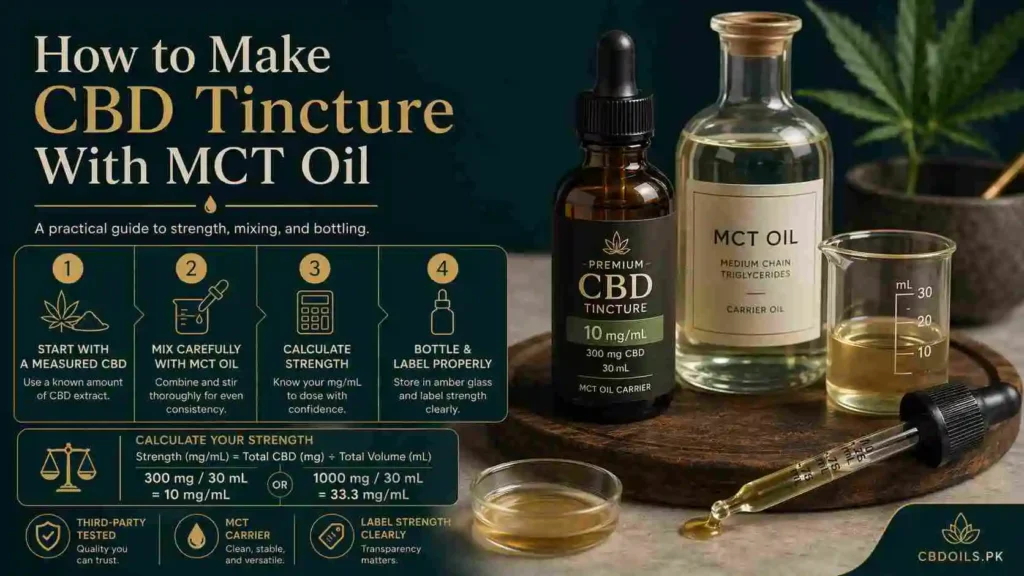
At the simplest level, you make a CBD tincture with MCT oil by combining a measured CBD ingredient with a measured amount of MCT oil, mixing it thoroughly, bottling it in a dropper bottle, and calculating the concentration in mg of CBD per mL. If someone is working from hemp flower instead of a tested CBD ingredient, the process becomes less predictable because potency depends on decarboxylation, extraction efficiency, and filtration. Healthline’s home CBD oil guide uses decarboxylated high-CBD hemp with a carrier oil and low gentle heat, while its label guide stresses that mg/mL is the figure buyers should look for when judging CBD concentration.
That means the cleanest homemade route is not kitchen guesswork with random plant material. It is starting with a known CBD input and doing the math properly.
Why MCT Oil Is Commonly Used for CBD Tinctures
MCT oil is popular because it works as a carrier for a fat-soluble compound like CBD and is widely used in oral CBD oil drops. The UK Committee on Toxicity notes that a large portion of CBD supplements in its market review were formulated with MCT oil and cites research where an MCT-based formulation showed improved CBD solubilization and strong bioavailability metrics compared with some other preparations. Project CBD also lists MCT oil among the lipid solvents and carrier vehicles used with CBD.
Let’s be real—many people choose MCT oil for one more reason: it is neutral enough in taste and easy to work with compared with heavier oils. That makes it practical for everyday tincture use.
What You Need to Make CBD Tincture With MCT Oil
A simple homemade tincture usually needs:
- MCT oil
- a CBD ingredient with a known strength
- a clean glass bottle, ideally amber or otherwise light-protective
- a dropper top
- measuring tools
- labels for concentration and date
If you are planning to use hemp flower instead of a tested CBD concentrate or isolate, you also need a low, controlled heat source, straining tools, and much more patience. Healthline’s home oil guide lists low-heat equipment, filtration tools, and storage containers for a plant-based infusion method.
Step 1: Start With a CBD Ingredient You Can Actually Measure
This is where most homemade tincture guides waste the reader’s time. If you do not know how much CBD is going into the bottle, you do not know what you are making.
A sensible homemade tincture begins with a CBD ingredient that has a clear potency backed by testing. Healthline’s guide on shopping for CBD says many CBD products are inaccurately labeled and recommends third-party testing reports and careful review of ingredients and concentration. The FDA also says there are still significant unanswered questions around the science, safety, and quality of CBD products, which is exactly why source quality matters before you ever start mixing anything.
How to Choose High-Quality CBD Oil
Step 2: Decide the Strength You Want Per Bottle
Do not start mixing until you decide the finished strength. This is basic, and too many people skip it.
For example:
- 300 mg CBD in 30 mL MCT oil = 10 mg/mL
- 600 mg CBD in 30 mL MCT oil = 20 mg/mL
- 1000 mg CBD in 30 mL MCT oil = about 33.3 mg/mL
Healthline’s label guide says mg/mL is the key number to judge CBD concentration in an oil. That is the exact same number you should calculate in a homemade tincture if you want it to be usable and repeatable.
Step 3: Mix the CBD With MCT Oil Carefully
If you are using a measured CBD ingredient that dissolves into oil, add it to the MCT oil and mix thoroughly until the tincture looks uniform. If gentle warming is needed, use low heat only. Healthline’s home CBD oil guide specifically warns against overheating and suggests keeping infused oil in a relatively low range, around 130°F to 150°F, during a plant-infusion process to avoid degrading cannabinoids.
Here’s the thing: high heat is not “faster.” It is just a better way to ruin consistency.
Step 4: Bottle It Properly
Once mixed, transfer the tincture to a clean dropper bottle and label it with:
- total CBD in the bottle
- bottle size in mL
- mg/mL concentration
- date made
- type of extract used if relevant
This matters because once the liquid is in a bottle, people forget what they did. Then a week later they are guessing whether one full dropper is 5 mg or 25 mg. That is amateur work.
Step 5: Understand the Dose Per Dropper
A lot of people read “1000 mg CBD” and think that is the dose per serving. It usually is not. Healthline explicitly warns that the large number on the bottle often refers to the total CBD in the whole product, not each serving, and says mg/mL is what determines concentration.
If your tincture is 20 mg/mL and your dropper holds 1 mL, then:
- 0.25 mL = 5 mg
- 0.5 mL = 10 mg
- 1 mL = 20 mg
That is why labeling your homemade tincture properly matters.
For broader serving guidance,Third-Party Lab Testing for CBD — because without verified potency, even the dosage math becomes weak.
Can You Make CBD Tincture From Hemp Flower and MCT Oil?
Yes, but it is less precise. Healthline’s home CBD oil guide describes a method using decarboxylated high-CBD hemp and coconut oil, with low heat, straining, and storage afterward. Project CBD also notes that MCT oil can be used as a lipid solvent with CBD. But the problem with flower-based home infusion is consistency: plant potency varies, extraction efficiency varies, and most home kitchens do not verify the final cannabinoid content with lab testing.
So the honest answer is this: you can do it, but you should not pretend a flower-infused homemade tincture is as predictable as one made from a verified CBD ingredient.
Why Third-Party Testing Still Matters for Homemade Tinctures
People hear “homemade” and think that means safer because they made it themselves. That logic is weak. Homemade only means you controlled the process. It does not prove you controlled the chemistry.
Healthline says many CBD products are inaccurately labeled, and the FDA continues to warn that there are significant open questions around product safety and quality. If your starting CBD ingredient has no Certificate of Analysis, your finished tincture is built on guesswork.
Third-Party Lab Testing for CBD
How to Store CBD Tincture Made With MCT Oil
Store the bottle in a cool, dark place and keep it tightly sealed. Healthline’s home oil guide recommends cool, dark storage for homemade CBD oil and notes that degradation over time is a practical concern even if the carrier oil itself remains usable.
If you are making tincture in Pakistan, that point matters more in warm months. A bottle left near a sunny kitchen shelf in Lahore or Karachi is being stored badly, no matter how good the recipe looked on paper.
Common Mistakes When Making CBD Tincture With MCT Oil
Using an unverified CBD ingredient
If the starting ingredient is weak or mislabeled, the whole tincture is unreliable. Healthline says third-party testing matters precisely because many CBD products are not accurately labeled.
Skipping the mg/mL calculation
Without concentration math, there is no real dosage control. Healthline explicitly points buyers to mg/mL as the important measure.
Overheating the mixture
Low heat matters. Healthline’s home infusion guide warns against getting the oil too hot because cannabinoids can be denatured.
Confusing hemp seed oil with CBD oil
Project CBD warns that hemp seed oil is not the same thing as CBD oil, and hemp seeds themselves do not contain CBD or THC. That confusion is common and expensive.
What Beginners in Pakistan Should Keep in Mind
A homemade CBD tincture is only as good as the CBD input and the math behind it. That is the truth people avoid. A person in Islamabad or Rawalpindi may buy a bottle labeled “hemp extract,” mix it into MCT oil, and assume they made a quality tincture. But if the input had unclear potency or weak testing, the finished product is still uncertain.
At CBDOILS.PK, we believe people need clarity before they start experimenting. Better sourcing, better labeling, and better concentration math make a homemade tincture far more useful than blindly copying a DIY recipe.
For readers who want the wider process context, How to Make CBD Oil
Final Thoughts
Making CBD tincture with MCT oil is straightforward when the goal is clear: use a measured CBD ingredient, choose the bottle strength you want, mix it into MCT oil carefully, calculate the mg/mL properly, and store it well. MCT oil is widely used as a CBD carrier, and current sources support its practical role in formulation, but quality still depends on what you start with and how carefully you document the result.