Full-spectrum CBD is often recommended in the market, but many buyers are not given a clear explanation of what that term actually means. The result is confusion around THC content, product strength, and whether a full-spectrum formula is the right choice for someone trying to avoid unnecessary risk or uncertainty. This article by CBDOILS.PK is designed to break down the topic in a more practical way, helping readers understand what full-spectrum CBD contains and how to evaluate it more carefully.
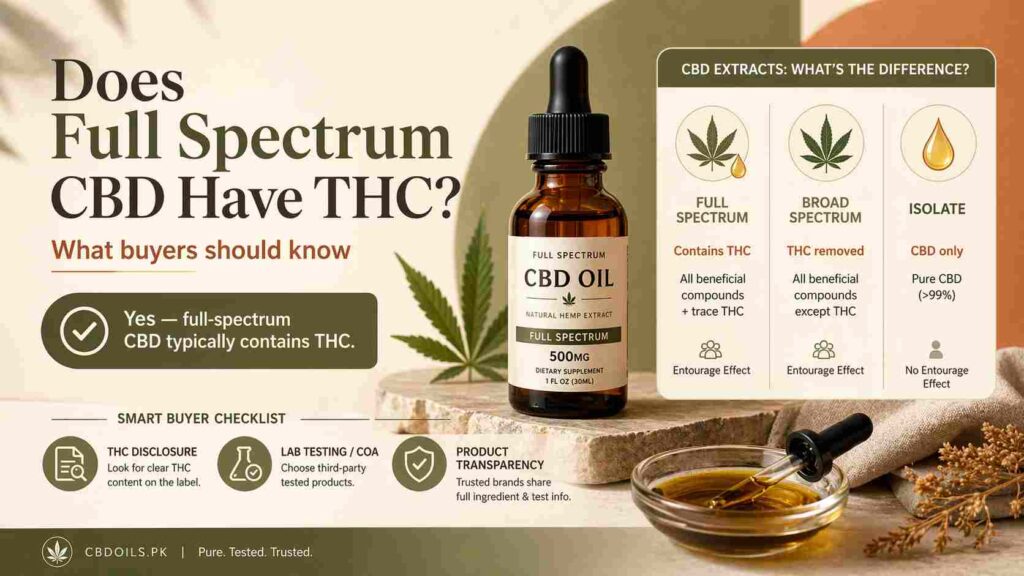
The direct answer is yes, full-spectrum CBD typically does have THC. Full-spectrum products are generally described as containing the full range of naturally occurring cannabis or hemp compounds, including CBD, other cannabinoids, terpenes, flavonoids, and THC. In hemp-derived products, that THC is commonly described as staying at or below 0.3% on a dry-weight basis in U.S.-style consumer guidance, but product quality and labeling accuracy still matter.
Short Answer: Does Full Spectrum CBD Have THC?
Yes. Full-spectrum CBD is the category most likely to contain THC by design. That is what separates it from broad-spectrum CBD and isolate. Healthline describes full-spectrum CBD as containing all naturally available plant compounds, including THC, while Medical News Today also states that full-spectrum CBD products contain all compounds found naturally in cannabis, including THC.
That does not mean every full-spectrum product contains the same amount of THC. It means THC is part of the formulation concept. If a buyer wants to avoid THC as much as possible, full-spectrum is usually not the first place to start. For readers comparing categories,What Is Broad Spectrum CBD?.
Why Full Spectrum CBD Contains THC
Full-spectrum CBD is meant to preserve a wider profile of plant compounds instead of isolating CBD alone. That broader profile can include minor cannabinoids, terpenes, flavonoids, and THC. Healthline’s overview of CBD types describes full-spectrum CBD as containing all plant compounds, including THC, while broad-spectrum contains fewer plant compounds and may contain trace THC or none at all depending on the product.
Here’s the thing: a lot of buyers want the “whole plant” idea without thinking through the consequence. If the extract keeps more of the plant profile, THC is often part of that profile. That is not hidden fine print. That is the category itself.
How Much THC Is Usually in Full Spectrum CBD?
Consumer-facing CBD guidance often says hemp-derived full-spectrum products contain no more than 0.3% THC on a dry-weight basis, but that does not mean the buyer should treat the number as meaningless. Hea===lthline explains that hemp-derived full-spectrum CBD typically stays at or below that threshold, and Pakistan’s National Cannabis Control and Regulatory Policy 2025 also refers to a compliance threshold of less than 0.3% THC for industrial cannabis crop testing.
That number matters for two reasons. First, it helps explain why full-spectrum CBD is not the same as THC-free CBD. Second, even low THC exposure may still matter to users who are highly sensitive, cautious about travel, or worried about drug testing. Healthline notes that up to 0.3% THC is not usually enough to produce a high, but it could still show up on a drug test.
For local regulatory context, THC Limit for Hemp in Pakistan
Can Full Spectrum CBD Make You Feel High?
Usually, full-spectrum CBD is not sold as a product meant to create the classic THC high, and low-THC hemp-derived formulas are typically described as staying below intoxicating levels. But “not meant to” is not the same as “no risk at all.” Healthline explains that THC is the psychoactive compound associated with the high, while CBD is generally considered non-intoxicating.
A buyer using a low-THC full-spectrum product may not feel high in the way they would from a THC-dominant cannabis product, but sensitivity, dose size, repeated use, and weak labeling can still change the experience. That is why lazy articles that say “full-spectrum CBD has THC but won’t matter” are sloppy. The honest answer is that it depends on the formulation and the user.
For readers who need the basics of the compounds themselves, CBD vs THC
Why This Matters for Buyers
This is not just a labeling question. It affects real buying decisions.
Full-spectrum THC content can matter if the buyer:
- wants to avoid THC completely
- is concerned about workplace testing
- is sensitive to THC
- is traveling internationally
- is comparing full-spectrum against broad-spectrum or isolate
Medical News Today notes that full-spectrum contains THC, while broad-spectrum is typically described as THC-free and isolate contains only CBD. That is the comparison buyers actually need before they spend money.
What the Label Should Tell You
A serious full-spectrum CBD product should make a few things obvious:
- that it is full-spectrum
- how much CBD is in each serving or per mL
- whether THC is present
- how to access a current Certificate of Analysis
- who made or distributed the product
If those basics are unclear, the product is not earning trust. The FDA says there are still many unanswered questions about the safety, science, and quality of CBD products, which is exactly why transparent labeling matters.
Why Third-Party Testing Matters Even More With Full Spectrum Products
Full-spectrum products need stronger verification than softer “hemp wellness” marketing language. A Certificate of Analysis is what helps confirm cannabinoid content, including THC levels. FDA materials note that COAs are used by manufacturers to communicate product quality and THC levels to consumers.
Let’s be real—if a seller says “full-spectrum” but cannot show the lab report, they are asking the buyer to trust branding instead of evidence. That is weak.Third-Party Lab Testing for CBD
What Buyers in Pakistan Should Keep in Mind
In Pakistan, consumers often shop through online stores, social pages, and reseller channels where product descriptions can sound polished but still say almost nothing useful. A buyer in Lahore, Islamabad, Karachi, or Rawalpindi may see “premium full-spectrum CBD” on a page and still get no clear THC disclosure, no current batch report, and no explanation of what full-spectrum means in practice.
Pakistan’s policy framework uses a less than 0.3% THC threshold for industrial cannabis compliance, but buyers should not confuse that policy threshold with a promise that every product sold in the market is equally well documented. The real test is whether the product has clear, current, batch-specific evidence behind it.
How Full Spectrum CBD Compares With Other Types
A cleaner comparison looks like this:
Full-spectrum CBD
Contains CBD plus other plant compounds, including THC.
Broad-spectrum CBD
Usually contains multiple plant compounds but is typically made without THC or with THC removed to trace levels.
CBD isolate
Contains only CBD, without the broader mix of cannabinoids and terpenes found in fuller extracts.
That is why product choice should follow the buyer’s actual goal, not just the product’s branding.
Common Questions Buyers Ask
Is full-spectrum CBD the same as THC-free CBD?
No. Full-spectrum CBD is the opposite of THC-free positioning because it is specifically described as including THC alongside other plant compounds.
Is the THC in full-spectrum CBD legal?
That depends on the jurisdiction and the regulatory framework. In Pakistan’s current policy material, industrial cannabis compliance uses a threshold of less than 0.3% THC.
Can trace THC matter?
Yes. Even if it is not enough to create a strong intoxicating effect, it may still matter to sensitive users or in drug-testing contexts. Healthline specifically notes that up to 0.3% THC may still show up on a drug test.
Final Thoughts
Yes, full-spectrum CBD does usually have THC. That is one of its defining features. The smarter question is not whether THC is present in theory, but how much is present in this exact product, and can the seller prove it with current testing? Healthline, Medical News Today, and FDA materials all point in the same direction: formulation matters, labeling matters, and product quality matters.