For consumers comparing CBD gummies for the first time, regular users trying to avoid unwanted THC, and buyers in Pakistan who want clearer product guidance before ordering, this topic matters more than it seems. Many people are unsure whether CBD gummies contain THC, whether trace amounts can still matter, and whether a label that says “hemp” or “CBD” is enough to trust. At CBDOILS.PK, we focus on practical education that helps readers understand what different gummy types contain, what product labels really mean, and what to verify before choosing any CBD edible.
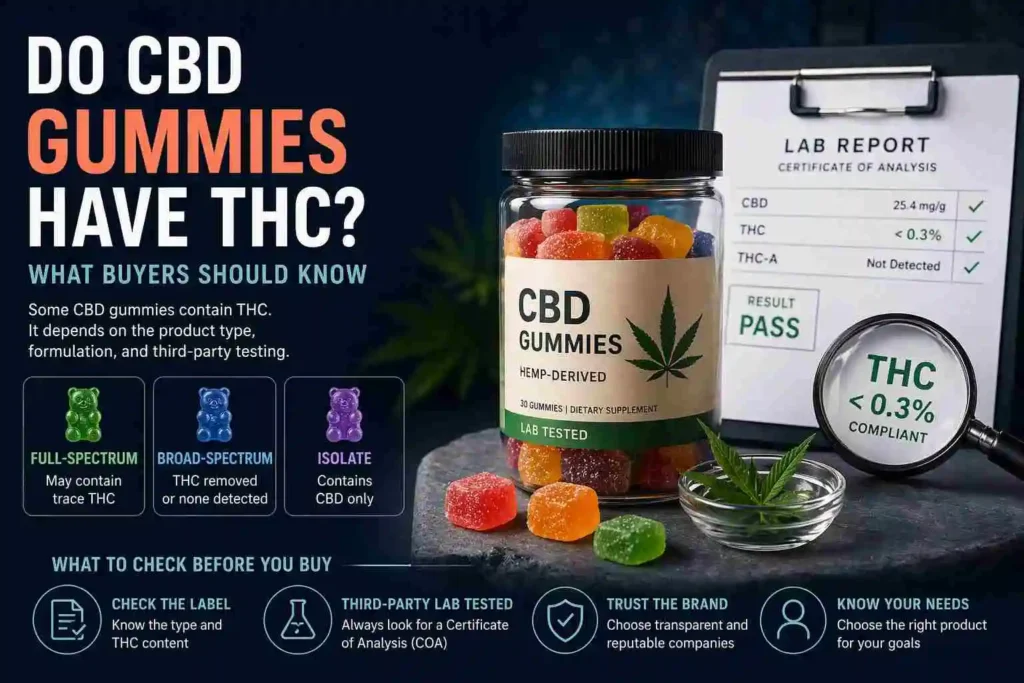
Here is the short answer: some CBD gummies do have THC, and some do not. Full-spectrum CBD gummies usually contain multiple cannabinoids, including THC in low amounts, while broad-spectrum products are typically made to remove THC and CBD isolate products are intended to contain only CBD. The problem is that the label is not always enough, because commercial CBD products are often mislabeled or incompletely labeled.
Short Answer: Do CBD Gummies Have THC?
Yes, CBD gummies can contain THC, but it depends on the product type. If the gummies are full-spectrum, they may include trace THC. If they are broad-spectrum, they are usually marketed as THC-free or with THC removed. If they are made with CBD isolate, they are intended to contain CBD only. That is the cleanest answer to the keyword, and it is also the answer most AI summaries are built around.
What buyers get wrong is assuming that “CBD gummy” automatically means “no THC.” It does not. The more accurate rule is this: the formula determines the THC risk, and the testing determines whether you should trust the claim. A 2024 analysis found that the majority of commercial CBD products examined were inaccurately labeled, which is exactly why blind trust is a mistake.
Why Some CBD Gummies Contain THC
CBD and THC both come from cannabis or hemp plants. A manufacturer making a full-spectrum extract may keep several plant compounds together in the final product, including cannabinoids and terpenes. That is why some full-spectrum gummies contain low levels of THC even when the product is sold as hemp-derived CBD. Medical News Today’s CBD gummy buying guidance also describes full-spectrum products as containing THC, while broad-spectrum products do not.
For readers who need the foundational difference first, this is the natural place to link to CBD vs THC.
Full-Spectrum vs Broad-Spectrum vs Isolate Gummies
Full-spectrum CBD gummies
These usually contain multiple cannabis plant compounds, including trace THC. For some users, that is acceptable. For others, especially those worried about workplace testing or strict THC avoidance, it is the wrong product type. Health-focused guidance consistently describes full-spectrum CBD as including THC.
Broad-spectrum CBD gummies
These products are typically marketed as containing several cannabinoids but without THC. They may appeal to buyers who want a wider hemp profile without choosing a full-spectrum gummy. Still, “without THC” is only meaningful if the testing actually supports it.
CBD isolate gummies
These are intended to contain only CBD. In theory, this is the lowest-THC option. In practice, contamination, weak quality control, or sloppy labeling can still create problems if the manufacturer is unreliable.
Can CBD Gummies Get You High?
Usually, CBD itself does not cause the intoxicating high associated with THC. Healthline and Medical News Today both distinguish CBD from THC on this point. But if a gummy contains THC, especially more than the buyer expects, the experience can change. That is why users asking “Can CBD oil make you feel stoned?” are often really asking a THC question, not a CBD question.
Here’s the thing: buyers often focus on the word “CBD” and ignore the formulation. That is sloppy. A full-spectrum gummy and an isolate gummy are not the same product in any meaningful risk sense.
Can THC in CBD Gummies Matter for Drug Tests?
Yes. That is one of the main reasons this topic matters. If a CBD gummy contains THC, even at low levels, it may matter to users subject to workplace or other testing. The FDA also continues to caution consumers that there are major unanswered questions around CBD product quality and consistency in the market, which makes accurate labeling and third-party verification more important.
If a buyer cannot afford even a small THC risk, they should not casually buy full-spectrum gummies and hope for the best. That is not a strategy. It is wishful thinking.
What the Label Should Tell You
A serious CBD gummy label should clearly tell the buyer:
- whether it is full-spectrum, broad-spectrum, or isolate
- how much CBD is in each gummy
- whether THC is present
- how to access batch-specific lab testing
- who manufactured or distributed the product
If those basics are missing, the product has not earned trust. The FDA’s consumer guidance and market-quality concerns make this especially important because most over-the-counter CBD products are not FDA-approved drugs, and quality can vary widely.
This is where your internal link belongs naturally: Third-Party Lab Testing for CBD
Why Third-Party Testing Matters More Than Marketing
A package can say “premium hemp,” “THC-free,” or “pure CBD,” but none of that means much without a Certificate of Analysis. Independent testing is what helps confirm cannabinoid content, including whether THC is actually present. The labeling problem is not theoretical. The 2024 study on product-label accuracy found most commercial CBD products studied were inaccurately labeled. Older analyses have also found THC in products where buyers might not expect it.
That is why buyers in Pakistan should be especially careful with online listings, reseller products, and imported gummies that look polished but provide little evidence.
What Buyers in Pakistan Should Check Before Buying CBD Gummies
In Pakistan, consumers often face a product-clarity problem before anything else. A buyer in Islamabad, Lahore, Karachi, or Rawalpindi may see a gummy product online that looks professional, but still offers weak THC disclosure, vague cannabinoid wording, and no batch-specific testing. That is exactly how confusion starts.
Before buying, check:
- the product type
- the THC claim
- the lab report
- the batch number
- whether the seller explains the formula clearly
If the seller cannot explain whether the gummy is full-spectrum, broad-spectrum, or isolate, the product is not ready to be trusted. Pakistan’s cannabis policy framework also uses a less than 0.3% THC threshold for industrial hemp, which makes THC disclosure especially relevant in local buyer education.
For readers who need the hemp threshold context, THC Limit for Hemp in Pakistan
How to Choose CBD Gummies More Carefully
A smarter buyer approach looks like this:
Choose the right product type
If you want to avoid THC as much as possible, do not start with full-spectrum gummies.
Read the lab report
Do not rely only on the front label.
Match the batch number
If the report is not tied to the product batch, it is weak evidence.
Avoid vague “hemp extract” language
That phrase alone tells you almost nothing.
Buy from sellers who educate clearly
A serious brand should explain the difference between gummy types, not hide behind soft marketing words.
For a broader buyer framework, How to Choose High-Quality CBD Oil
Common Questions Buyers Ask
Do all CBD gummies have THC?
No. Some do, some do not. Full-spectrum gummies usually do contain THC, while broad-spectrum and isolate products are intended to reduce or eliminate it.
Can THC-free gummies still contain THC?
They can, if the product is mislabeled or poorly made. That is why third-party testing matters.
Will trace THC matter?
It can matter depending on the buyer’s sensitivity, frequency of use, or concern about drug testing. That is exactly why people should not guess.
Final Thoughts
Do CBD gummies have THC? Sometimes yes, sometimes no. The deciding factor is the formulation, and the deciding proof is the lab test. Full-spectrum gummies commonly contain THC, broad-spectrum gummies are usually marketed without it, and isolate gummies are intended to contain only CBD. But because labeling accuracy in the CBD market is a real problem, buyers should verify rather than assume.