Buying CBD in Pakistan can feel like walking through a market where every bottle claims to be premium, pure, and effective, but very few explain how those claims are actually proven. That is the real pain point for cautious buyers, first-time users, and anyone trying to avoid weak products, hidden THC, or misleading labels. CBD Pakistan helps cut through that uncertainty by showing readers why third-party lab testing matters, what a proper lab report should include, and how to use that information before trusting a product with your money or your health.
What is third-party lab testing for CBD?
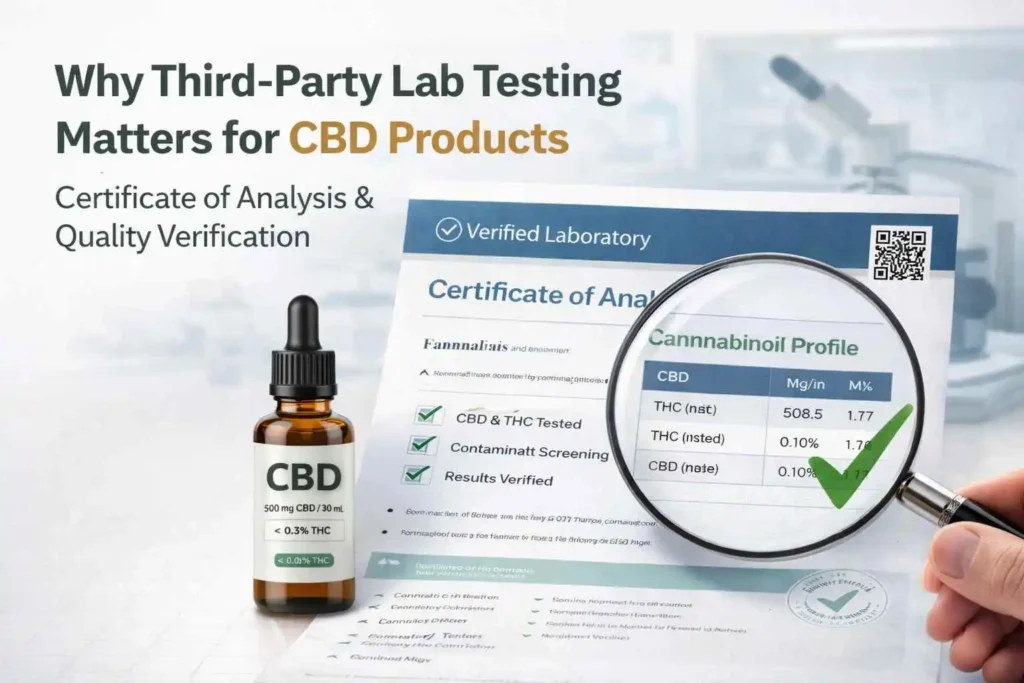
Third-party lab testing means a CBD product is tested by an independent laboratory rather than only by the company selling it. The result is usually a Certificate of Analysis, or COA, which is meant to show what is in the product and whether it matches the label. Healthline’s label-reading guidance describes a COA as a core quality signal for reputable CBD products, and FDA materials continue to stress ongoing questions about CBD product safety, quality, and labeling.
Why lab testing matters more than branding
It verifies CBD and THC content
A good CBD product should not leave the buyer guessing about potency. Third-party testing helps confirm the cannabinoid profile, including how much CBD is present and whether the THC level is what the label suggests. This matters because hemp-derived CBD products are often discussed in the context of low THC, but low THC should be verified, not assumed. FDA consumer guidance emphasizes that many questions remain about CBD product quality and consistency, which is exactly why confirmed potency matters.
For buyers who are sensitive to THC, worried about getting unexpected effects, or simply trying to avoid the wrong kind of product, that verification is not optional. It is basic risk control. Healthline’s CBD label guide also treats THC disclosure and COA access as core shopping criteria.
It helps check for contaminants
A lab report is not only about CBD strength. It can also help show whether a product was screened for contaminants such as pesticides, heavy metals, residual solvents, or microbial issues, depending on the report format and the lab. FDA has repeatedly raised broader concerns about the safety and quality of CBD products, while NCCIH warns that cannabis and cannabinoid products can carry risks, including variability in what they contain.
That matters more than most buyers realize. A bottle can look polished online and still tell you very little about what is actually inside it. Third-party testing is one of the few tools that pushes the conversation away from branding and toward evidence.
It makes label claims easier to trust
Without a COA, the customer is stuck with a seller’s word. With a COA, the customer at least has something external to compare against the label. That does not make every product perfect, but it does make it harder for weak brands to hide behind vague language like “premium hemp extract” or “high potency” without proof. FDA warning letters for cannabis-derived products show that unsupported claims remain common enough to justify ongoing enforcement.
What a CBD Certificate of Analysis should show
A useful COA should make it easier, not harder, to understand what was tested.
Cannabinoid profile
Look for the reported levels of key cannabinoids, especially CBD. If the bottle claims a certain CBD strength, the report should line up reasonably with that claim. A report that leaves the main cannabinoid unclear is not doing the job. Healthline’s consumer guidance specifically points buyers to cannabinoid content as a core part of the COA.
THC level
The COA should also show the THC content, because this affects product classification, user comfort, and trust. For many buyers, especially beginners, this is one of the most important numbers on the report. It is also one of the easiest places for a bad product to create unwanted surprises if the label is weak or misleading.
Contaminant screening
A stronger COA usually includes screening information beyond cannabinoids. Depending on the report, that may cover contamination checks that help the buyer assess purity and safety more realistically. FDA’s broader messaging on CBD repeatedly emphasizes that safety and product quality are not settled issues, which is exactly why these sections matter.
Batch details and testing date
A serious COA should be tied to the specific batch and should not look stale. If a report is old, generic, or clearly not connected to the product in front of you, it loses value fast. Healthline’s guidance on reading CBD labels points buyers toward accessible, product-specific COAs, often through a QR code.
How to read a CBD lab report without overcomplicating it
Most buyers do not need to become lab specialists. They need a simple filter.
Check these first:
- Does the report match the product name or batch?
- Does it show CBD content clearly?
- Does it show THC content clearly?
- Does it include contamination screening?
- Is it recent enough to feel relevant?
If the answer to those basic questions is unclear, the product is already harder to trust. That is the real point. A good COA should reduce confusion, not create more of it.
For readers already comparing products, How to Choose High-Quality CBD Oil.
Red flags when a CBD brand avoids lab transparency
Let’s be real—buyers usually do not need a long investigation to spot trouble.
Watch for:
- no COA at all
- a report that is hard to access
- no batch link between the report and the product
- no THC disclosure
- no contamination section
- a brand making bold health claims while offering little proof
FDA’s public warnings around cannabis-derived products are a reminder that aggressive claims and weak documentation still show up in this industry. A company that makes the product easy to buy but hard to verify is telling you something important.
For site structure, this is also a natural place to mention CBD Oil once if you are guiding readers from education into product review.
What this means for CBD buyers in Pakistan
In Pakistan, buyers often face an extra layer of uncertainty because the average customer is not standing in a tightly regulated pharmacy aisle comparing standardized wellness products. Many are judging oils through websites, seller claims, WhatsApp recommendations, or social chatter. That makes independent testing even more important. A COA does not solve every problem, but it gives the buyer something concrete in a space where too much is still sold through confidence instead of clarity.
This is where CBD Pakistan can position itself well: not by shouting “best quality” louder than everyone else, but by showing the proof clearly and helping readers understand what they are looking at. That is far more credible than generic wellness language. FAQs.
Final takeaway
Third-party lab testing matters because it turns CBD quality from a marketing claim into something a buyer can actually examine. A proper COA can help verify CBD and THC content, provide contamination screening, and make the label easier to trust in a market where product quality and consistency are still uneven. FDA, NCCIH, and consumer health guidance all point to the same larger truth: buyers should not assume a CBD product is transparent just because it looks clean on the shelf or online.