If you’re a health-conscious adult, a patient exploring natural wellness options, or someone in Pakistan trying to understand whether CBD oil is “just another form of charas,” you’re not alone. Most readers land on this question because they’re worried about three things at once: getting intoxicated, doing something legally risky, or buying into hype without real facts. At CBD Pakistan, we focus on clearing up that confusion by helping readers understand the real difference between CBD and THC, what reputable hemp-derived products are, and how to make more informed wellness decisions without the noise.
Here’s the thing: this question matters more than people think.
A lot of people in Pakistan hear the word “cannabis” and immediately think high, illegal, unsafe, or socially risky. Fair enough. In local conversations, CBD often gets lumped together with marijuana, charas, or anything cannabis-related. But chemically and functionally, that’s too simplistic.
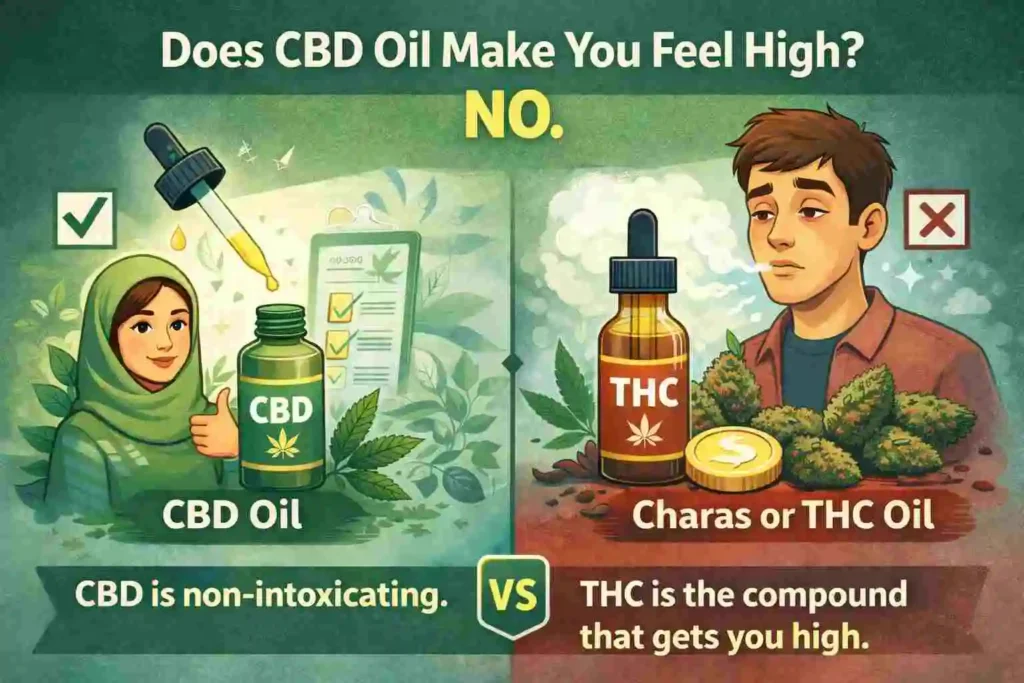
The short answer: does CBD oil make you feel high?
No. CBD itself is generally considered non-intoxicating, which means it does not produce the classic “high” associated with THC.
That matters because THC – not CBD – is the compound most associated with euphoria, intoxication, and the mentally altered feeling people usually mean when they ask whether something gets you high.
So if you’re asking whether a standard CBD oil is supposed to make you feel stoned, euphoric, or mentally impaired, the answer is no.
Why people confuse CBD with marijuana
The confusion happens because both CBD and THC come from the cannabis plant. Same plant family, very different effects.
And let’s be real – most people do not care about cannabinoid chemistry until they are worried about side effects, religion, family judgment, or whether they are about to buy the wrong thing online.
CBD vs THC: the difference that matters
The simplest explanation is this:
- THC is the main intoxicating compound in cannabis and is the one associated with a high.
- CBD is generally described as non-intoxicating and does not create that same euphoric effect.
- That is why two products can both come from cannabis but lead to very different experiences.
If you want a deeper breakdown, read CBD vs THC.
What “non-intoxicating” actually means
Non-intoxicating does not mean you feel absolutely nothing.
Some people say they feel more relaxed. Others notice they become a bit sleepy, especially if they take too much or are already sensitive to supplements. That is not the same as being high.
- Feeling calm is not the same as intoxication.
- Feeling sleepy is not the same as euphoria.
- Having a side effect is not proof that a product got you high.
Can any CBD product still make you feel different?
Yes, and this is where people get careless.
Not every product labeled “CBD” is identical. Some oils may contain trace amounts of THC. Others may be poorly labeled. And in markets where buyers rely on online sellers without understanding the formulation, that can create confusion fast.
Full-spectrum products and trace THC
A full-spectrum CBD product may contain multiple cannabinoids, including small amounts of THC. Depending on the product, the serving size, and the quality of manufacturing, that can matter.
So while CBD itself is not supposed to get you high, a product marketed loosely as CBD may still feel different if it contains more THC than the buyer expected.
For another common concern, see Can CBD Oil Make You Hallucinate? and CBD vs THC.
Side effects are not the same as a high
Some users may notice dry mouth, drowsiness, fatigue, or mild stomach discomfort. Those are possible side effects. They are not the same thing as THC-style intoxication.
Will CBD oil show up on a drug test?
This is where too many people make bad assumptions.
CBD itself is not usually the main target of standard cannabis drug testing. The real issue is THC contamination or trace THC content in some products. That means a CBD product can still create risk if it contains more THC than expected.
That distinction matters for employees, athletes, drivers, and anyone in a profession where screening is taken seriously.
If that is your main concern, add an internal read here: CBD vs THC or a future article on drug testing if you plan to publish one.
Is CBD oil legal in Pakistan?
This is one area where sloppy content does real damage.
The legal position around cannabis-derived products in Pakistan is regulated and evolving. So readers should not assume that every CBD product is automatically unrestricted, fully approved, or identical under local law.
The safer position is this: check the source, check the formulation, check the THC content, and avoid acting on random social media claims.
For general questions, visit CBD Pakistan FAQs.
Is CBD oil considered a drug?
That depends on the legal and regulatory context.
CBD is a compound. CBD oil is a product format. A specific product may be sold as a wellness product, researched for therapeutic use, or regulated differently depending on how it is formulated and marketed.
So no, you should not casually assume every CBD oil is a prescription drug. But you also should not assume every CBD oil has been clinically approved for treatment claims.
What is CBD oil useful for?
Many readers asking whether CBD gets you high are really asking something else: if it does not intoxicate you, what is it actually used for?
CBD is often discussed in relation to general wellness, stress support, sleep support, inflammation, and discomfort management. But it should not be treated like a miracle cure. Honest education matters here.
That is where CBD Pakistan has a real role – helping people understand what CBD may support, what it does not do, and which claims deserve caution.
Can Muslims use CBD oil?
This question comes up often in Pakistan, and usually for understandable reasons.
In most cases, the concern is not just the ingredient itself. It is whether the product intoxicates, whether it contains questionable additives, and whether the purpose of use is legitimate. Since CBD is generally described as non-intoxicating, many people start their assessment there – then look at the formulation and seek guidance from a trusted scholar if needed.
For broader religious and product questions, direct readers to CBD Pakistan FAQs.
How to choose CBD information and products more carefully in Pakistan
If this still feels confusing, good. That means you are taking the decision seriously.
Use this simple checklist before trusting a product or a claim:
- Check whether the product clearly explains what it contains.
- Look for transparency about CBD content, THC content, and ingredients.
- Avoid sellers making sweeping cure-all claims.
- Be extra cautious if you have a workplace testing risk.
- Read educational resources before buying anything.
Final verdict: will CBD oil get you high?
CBD itself is generally considered non-intoxicating and does not produce the typical cannabis high associated with THC.
The two catches are simple:
- Some CBD products may contain THC, especially if they are full-spectrum or poorly labeled.
- The legal and product-quality landscape can be confusing, so buyers in Pakistan should not rely on assumptions.
So the smartest answer is not just “CBD won’t get you high.” It is this: pure CBD is not the compound people typically get high from. THC is. And if you want to avoid confusion, bad products, and bad assumptions, start with trustworthy education first.