Homemade CBD gummy candy appeals most to readers who want more control over ingredients, flavor, and serving size than many ready-made products offer. The problem is that most people run into the same issues almost immediately: weak texture, uneven dosing, overheating the CBD, or not knowing how much to take once the gummies are ready. At CBDOILS.PK, we focus on practical CBD education that helps readers make better choices from the start, whether that means choosing a quality oil, calculating dosage properly, or understanding how gummies fit into a daily routine.
The biggest mistake people make is treating CBD gummy candy like ordinary sweets with a few drops of oil added in. It is not that simple. Good homemade gummies depend on three things: a stable gummy base, careful heat control, and accurate CBD calculation. Your uploaded gummies notes also stress the same points, including gentle heating, adding CBD after removing the mixture from heat, and dividing the total CBD in the batch by the number of gummies for more reliable dosing.
Short Answer: How Do You Make CBD Gummy Candy?
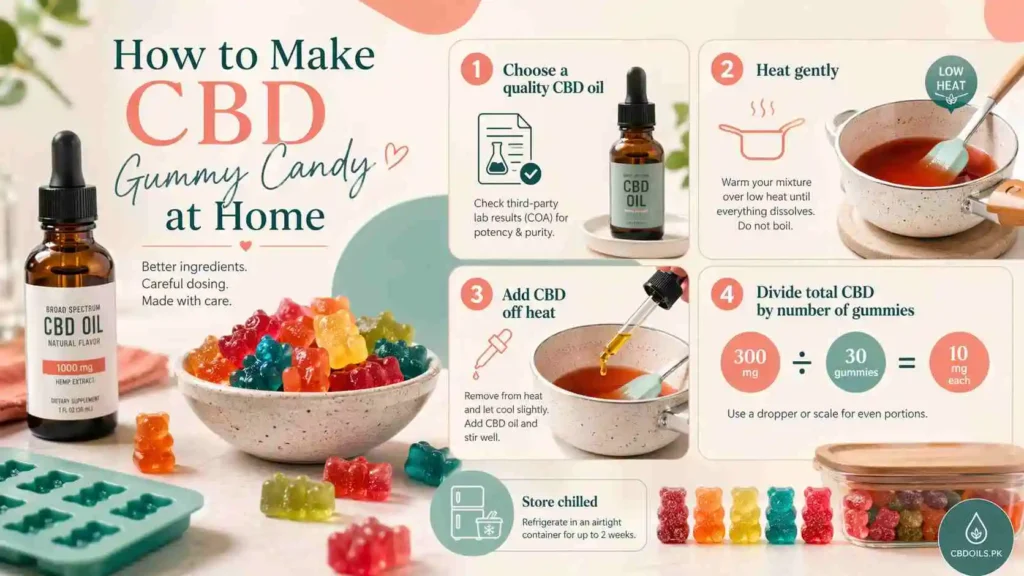
You make CBD gummy candy by preparing a simple gummy base, heating it gently, adding CBD oil after the mixture is off direct heat, pouring it into molds, and letting it set before storing it properly. The core ingredients in your recipe notes are CBD oil or tincture, gelatin or pectin, sweeteners, flavoring, and fruit juice or puree, with silicone molds and accurate measuring tools recommended for better consistency.
That process sounds easy, but the quality of the final gummies depends heavily on the CBD extract you start with. A reputable CBD product should come with a Certificate of Analysis so buyers can verify cannabinoid content and look for third-party testing rather than trusting marketing claims alone.
What You Need to Make CBD Gummies
A simple homemade batch usually includes:
- CBD oil or tincture
- gelatin or pectin
- fruit juice or fruit puree
- sweetener such as honey, agave, or sugar
- optional natural flavoring
- silicone molds
- saucepan, spatula, and measuring tools
If you want a vegan version, pectin is the cleaner choice because your uploaded notes specifically position pectin as the plant-based alternative to gelatin.
Step 1: Choose the Right CBD Oil First
This step matters more than most recipe blogs admit. If the CBD oil is low quality, poorly labeled, or unclear on strength, your gummies will be inconsistent before you even start cooking. Your uploaded notes highlight third-party lab testing, organic cultivation, and clear extraction details as quality indicators for the oil used in gummies.
That lines up with Healthline’s shopping guidance, which says a reputable CBD product should have a COA from third-party testing and that buyers should be able to review it while shopping.
Step 2: Prepare the Gummy Base
Start by combining your liquid ingredients and your gelling agent slowly so the mixture stays smooth. Your notes recommend mixing gelatin or pectin slowly to avoid clumps and dissolving it fully for a better texture. Sweeteners should go in early for even distribution, while flavors are best added later to preserve aroma and taste.
This is where many homemade batches start to go wrong. If the mixture is rushed, clumpy, or overheated, the texture becomes inconsistent and the final gummies feel more like sticky candy blobs than proper gummies. That is not a minor issue. It ruins the whole batch.
Step 3: Heat Gently, Not Aggressively
CBD is sensitive to heat, which is why your recipe notes explicitly recommend heating ingredients gently and adding the CBD after the mixture comes off the heat. Overheating can damage texture and may also reduce cannabinoid quality.
Here’s the thing: many people in Pakistan try this kind of recipe in a hurry on a high flame and then blame the oil when the results are poor. That is usually user error, not a mystery.
Step 4: Add the CBD Oil After Removing From Heat
This is one of the most important steps in the whole method. Your notes say to add the CBD after removing the mixture from heat to reduce the chance of degradation and improve dosing accuracy.
Once the mixture is off heat, stir thoroughly so the CBD is distributed as evenly as possible. If the CBD is not mixed properly, the gummies may vary from one piece to the next, which makes dosage guesswork instead of dosing control.
For readers who want a separate step-by-step version of the process, this internal page fits naturally here: How Do You Make CBD Gummies?
Step 5: Calculate the Dose Per Gummy
This is where homemade CBD gummy candy becomes either smart or sloppy.
Your recipe notes give the right basic method: determine the total amount of CBD in the batch, then divide it by the number of gummies you make. That gives you the approximate CBD amount per gummy.
For example, if you use 300 mg of CBD oil in a batch and the recipe fills 30 molds, each gummy will contain about 10 mg of CBD. That does not automatically mean 10 mg is the right amount for every user. Healthline’s dosage guidance says it is best to start small and increase slowly until you find the desired effect, because ideal CBD dosage varies by body weight, body chemistry, and product concentration.
For a broader serving framework,CBD Dosage Guide
Step 6: Pour Into Molds and Let Them Set
Your notes recommend pouring the warm mixture slowly into silicone molds and tapping gently to reduce air bubbles. They also note that gummies typically set in about 30 to 60 minutes in the refrigerator, while room-temperature setting takes longer and may keep a softer texture.
That is practical advice. Silicone molds matter because they make removal easier and help keep the gummy shape consistent from piece to piece. If you are aiming for neat, uniform candy rather than a messy homemade trial batch, this part matters more than people think.
Step 7: Store Them Properly
Homemade CBD gummies are not shelf-stable like mass-produced candy. Your notes say they usually last around 2 to 3 weeks when refrigerated and should be stored in airtight containers away from heat and light.
That also means you should not make a huge batch unless you know you will use it in time. Too many people make a tray once, forget it in the fridge, and then act surprised when the texture changes or the taste fades.
How Long Do CBD Gummies Take to Start?
This is one of the most searched follow-up questions, and it matters because gummies do not act as quickly as inhaled CBD. Healthline notes that CBD gummies typically take time to work because they are digested first, and its 2024 guide says the effects typically last about 4 to 6 hours, with onset and duration varying by dose and metabolism.
That means a first-time user should not eat one gummy, wait a few minutes, feel nothing dramatic, and then immediately take several more. That is how people overshoot.
This is the natural spot for: How Long Do CBD Gummies Take to Start?
How Many CBD Gummies Should You Take?
There is no universal number that fits everyone. That depends on the strength of each gummy, the user’s experience level, and why they are taking CBD in the first place. Healthline’s dosage guidance recommends starting low and increasing slowly rather than jumping into large servings.
So if your homemade gummies contain 10 mg each, starting with one is usually a more sensible approach than taking three or four and hoping for the best.
How Many CBD Gummies Should I Take?
Common Mistakes When Making CBD Gummy Candy
The most common mistakes from your recipe notes are:
- overheating the CBD
- miscalculating dosage
- skipping proper cooling
- poor storage
- inconsistent mixing
There is also a quality mistake people ignore: starting with weak CBD oil and expecting a strong, reliable gummy. FDA consumer guidance continues to stress that there are still open questions about the science, safety, and quality of many CBD products, which is exactly why careful sourcing matters.
Should You Use Full-Spectrum, Broad-Spectrum, or Isolate?
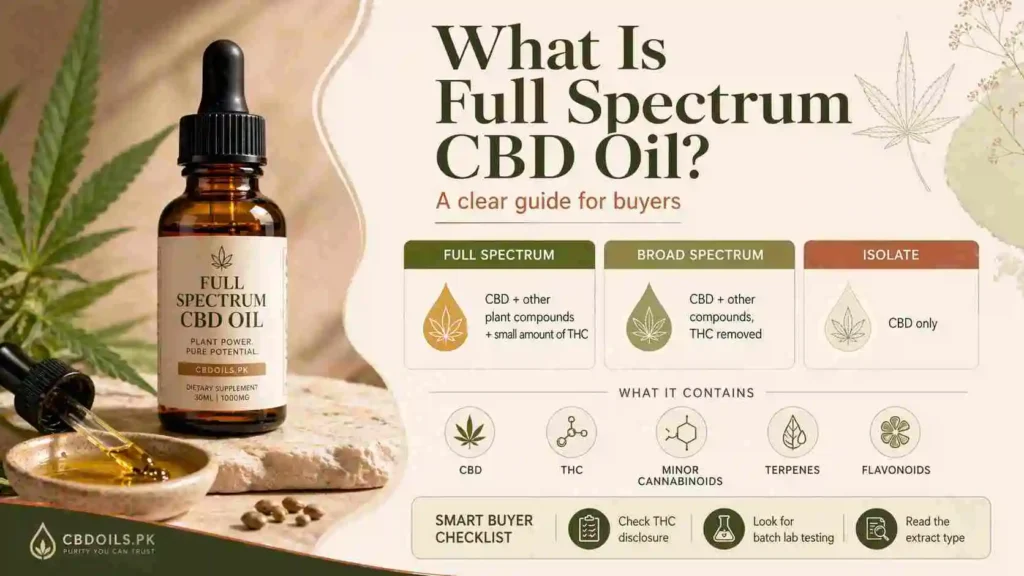
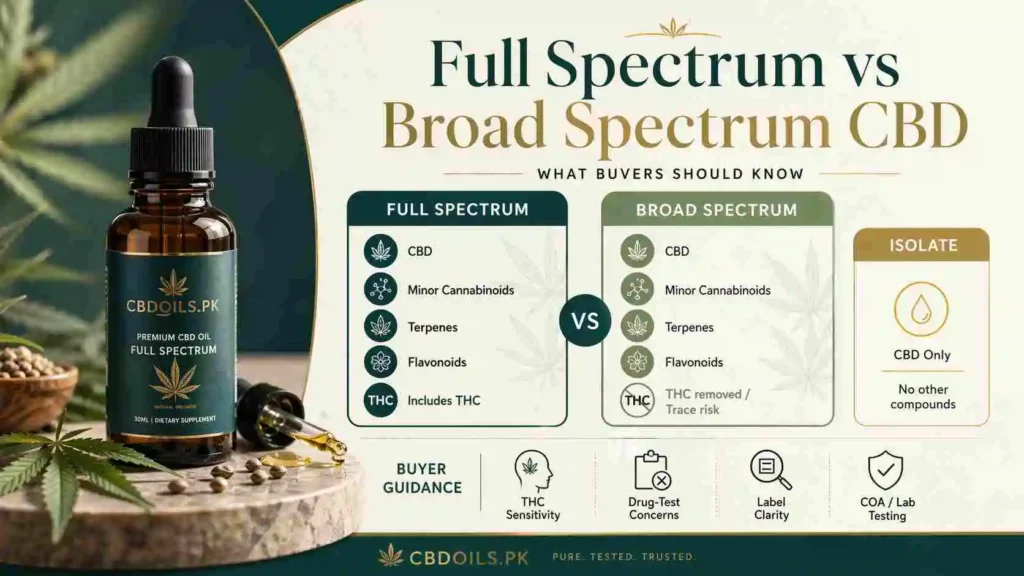
Your uploaded notes correctly explain the broad difference: full-spectrum contains all cannabinoids including trace THC, broad-spectrum keeps multiple cannabinoids without THC, and isolate is pure CBD.
That choice changes the final gummy. Medical News Today likewise explains that full-spectrum products contain other cannabis compounds, while isolate is pure CBD, and broad-spectrum sits between the two.
If a buyer wants to reduce THC exposure as much as possible, broad-spectrum or isolate may be a cleaner starting point than full-spectrum.
What Beginners in Pakistan Should Keep in Mind
Homemade CBD gummy candy sounds fun until you remember that dosing mistakes are easier with edibles than with many other product types. A person in Lahore or Islamabad might make a batch, misread the CBD strength on the bottle, and end up with gummies that are either too weak to judge properly or stronger than expected.
That is why CBDOILS.PK emphasizes product clarity first. Good homemade gummies start with:
- a clearly labeled CBD oil
- a current COA
- realistic serving expectations
- proper storage
- patience with onset time
Final Thoughts
Homemade CBD gummy candy can work well when the process is controlled properly. The essentials are simple: choose a reliable oil, heat gently, add the CBD after removing the base from heat, calculate the dose per gummy carefully, and store the final batch correctly. Your uploaded recipe notes reinforce all of those points, especially the need for gentle heating, accurate division of total CBD, and refrigerated storage for a limited shelf life.