Choosing between full-spectrum and broad-spectrum CBD can feel more confusing than it should be. Many buyers come across both terms on product labels but are left wondering what actually separates them, whether THC is involved, and which option makes more sense for their needs. At CBDOILS.PK, we aim to simplify that decision with clear, practical guidance so readers can understand the real difference between these two extract types and evaluate products with more confidence before buying.
Here is the short version: full-spectrum CBD usually includes THC, while broad-spectrum CBD is generally marketed with THC removed or reduced to non-detectable or trace levels. Both may contain CBD plus other hemp compounds such as minor cannabinoids and terpenes, but full-spectrum keeps the wider original plant profile, including THC. Broad-spectrum is usually the middle-ground option for buyers who want more than isolate but less THC exposure than full-spectrum.
Short Answer: Full Spectrum vs Broad Spectrum CBD
The main difference is THC content.
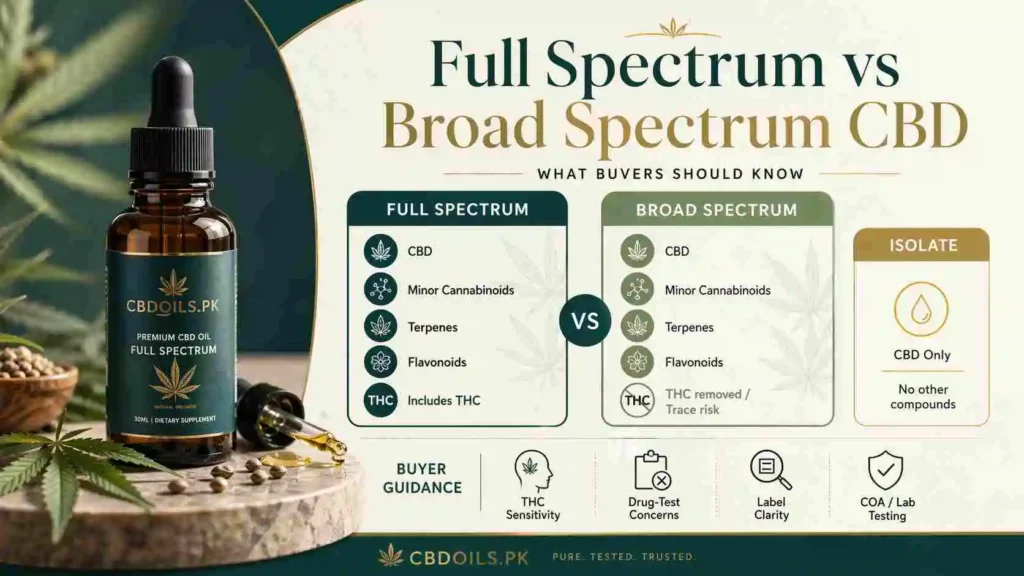
- Full-spectrum CBD contains CBD, other cannabinoids, terpenes, flavonoids, and THC. In common hemp-product guidance, that THC is usually described as up to 0.3% on a dry-weight basis.
- Broad-spectrum CBD contains CBD and other plant compounds too, but is generally made with THC removed. Healthline notes this is true “in theory,” while also cautioning that some products may still contain trace amounts depending on formulation and testing.
That difference matters because it changes the buyer’s decision around THC sensitivity, labeling, travel, and drug-testing concerns.
What Is Full Spectrum CBD?
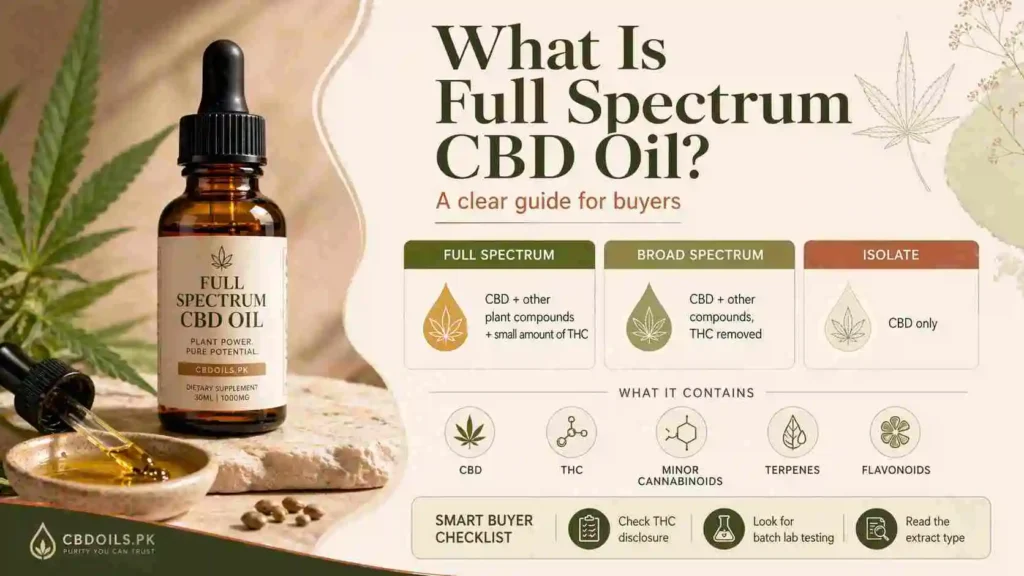
Full-spectrum CBD is a broader hemp extract that keeps multiple naturally occurring plant compounds together. That usually includes:
- CBD
- small amounts of THC
- minor cannabinoids such as CBG and CBN
- terpenes
- flavonoids
For readers who want the dedicated breakdown,What Is Full Spectrum CBD Oil?
What Is Broad Spectrum CBD?
Broad-spectrum CBD is usually presented as the middle option between full-spectrum and isolate. It keeps CBD plus some additional hemp compounds, but is generally marketed without THC. The problem is that “broad-spectrum” is not a magic guarantee. Medical News Today notes these spectrum terms are not tightly regulated scientific definitions, which is why product testing matters more than branding language.
For a fuller explanation, What Is Broad Spectrum CBD?
The Biggest Difference: THC
This is the part buyers actually care about.
Full-spectrum CBD contains THC
Full-spectrum products are specifically described as containing multiple hemp compounds including THC. That is part of what defines them.
Broad-spectrum CBD usually does not
Broad-spectrum products are generally made to remove THC while keeping other cannabinoids and terpenes. But the smart buyer should pay attention to the phrase “usually.” Healthline explicitly notes that broad-spectrum does not contain THC in theory, but trace amounts may still appear in some products.
If you want the THC point explained separately,Does Full Spectrum CBD Have THC?
Why This Difference Matters
A lot of buyers act like the distinction is technical trivia. It isn’t.
It matters if you:
- want to avoid THC as much as possible
- are worried about workplace or pre-employment testing
- are sensitive to THC
- are traveling
- want a simpler or more cautious starting point
Let’s be real—someone buying full-spectrum CBD while saying “I want absolutely no THC” is choosing the wrong category from the start.
Full Spectrum vs Broad Spectrum: Which Has More Plant Compounds?
Full-spectrum usually keeps the widest original plant profile, including THC. Broad-spectrum may still include multiple cannabinoids and terpenes, but it is generally processed to remove THC. Healthline describes broad-spectrum as the “middle child” of the three common choices: fuller than isolate, but less complete than full-spectrum.
That is why some buyers see broad-spectrum as the compromise option:
- more than pure CBD isolate
- less THC concern than full-spectrum
- often easier for cautious users to consider first
Can Full Spectrum or Broad Spectrum CBD Make You Feel High?
CBD itself is generally described as non-intoxicating, unlike THC. Healthline’s comparison of CBD and THC makes that distinction clearly.
But here is where lazy content goes wrong: saying “CBD won’t get you high” is too broad. A full-spectrum product includes THC, even if in low amounts, so the user experience is not identical to a broad-spectrum product. Broad-spectrum is generally chosen by people who want to reduce that THC exposure.
For readers who are still mixing up the compounds,CBD vs THC
Which One Is Better for Drug-Test Concerns?
Neither category should be treated casually if drug testing matters.
- Full-spectrum CBD carries the clearer risk because it includes THC by definition.
- Broad-spectrum CBD may be lower risk in theory, but weak manufacturing or inaccurate labeling can still create problems. A 2024 peer-reviewed analysis found that the majority of commercial CBD products studied were inaccurately labeled across “full spectrum,” “broad spectrum,” and “CBD isolate” claims.
That is why the real question is not just “Which type sounds safer?” It is “Can this exact product prove what is in it?”
Why Labeling and Testing Matter More Than the Spectrum Claim
This is the part most buyers ignore until after they have already bought the product.
The FDA says there are still many unanswered questions around the science, safety, and quality of cannabis-derived products, including CBD. That is why label clarity and independent testing matter so much.
A product should clearly tell you:
- whether it is full-spectrum or broad-spectrum
- how much CBD is in each serving or per mL
- whether THC is present
- how to access a current Certificate of Analysis
- which batch the report applies to
If the seller cannot show those basics, the label is weak. The branding might be polished. The proof is not.
What Buyers in Pakistan Should Check
Pakistan’s National Cannabis Control and Regulatory Policy 2025 uses a less than 0.3% THC threshold for industrial cannabis regulation. That gives local context to why THC disclosure matters in hemp-derived products.
But do not make the lazy leap from “policy threshold exists” to “every product in the market is well documented.” It is not. A buyer in Lahore, Karachi, Islamabad, or Rawalpindi may still find products with vague labeling, copied claims, or no usable lab report at all.
A smarter checklist looks like this:
- confirm whether the product is full-spectrum or broad-spectrum
- check whether THC is disclosed clearly
- review the current Certificate of Analysis
- match the batch number on the product to the report
- avoid sellers using vague phrases like “premium hemp extract” without details
Which One Should You Choose?
Full-spectrum may suit you if:
- you are comfortable with THC being present
- you want the broadest plant profile
- you understand the label and have current testing to back it up
Broad-spectrum may suit you if:
- you want to avoid THC as much as possible
- you still want more than pure CBD isolate
- you are choosing cautiously and reading lab reports carefully
There is no serious “best for everyone” answer here. Anyone pretending otherwise is selling, not educating.
Final Thoughts
Full-spectrum CBD and broad-spectrum CBD are not the same thing. Full-spectrum usually includes THC along with a wider range of plant compounds, while broad-spectrum is generally marketed with THC removed but may still require verification through testing. That difference affects real buying decisions, especially for cautious users, first-time buyers, and anyone in Pakistan trying to choose products more carefully.