People who are new to CBD oil, returning to it after a break, or trying to use it more consistently often want one clear answer: how long it takes to start working. The confusion usually begins when one person says they felt something quickly, another says it took hours, and many products give little guidance on timing, dose, or what to expect the first time. At CBDOILS.PK, we take an educational approach to these questions by helping readers understand what influences onset time, how different usage habits change the experience, and why product clarity matters before making assumptions.
The short truth is this: CBD oil does not work instantly for most people, and it does not work on the same timeline for everyone. Clinical reference material notes that cannabidiol typically reaches peak plasma concentration between about 2.5 and 5 hours after oral use, and that taking it with a high-fat meal can significantly increase absorption. That means a slow start does not always mean the product failed. It often means the body is still absorbing and processing it.
Short Answer: How Long Does CBD Oil Take to Work?
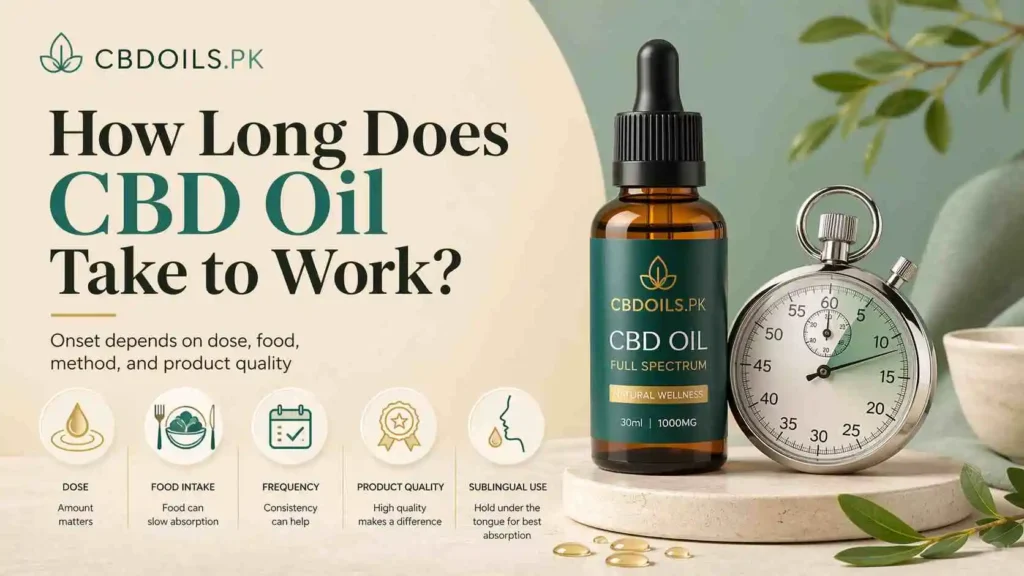
For most users, CBD oil may begin to feel noticeable gradually rather than immediately, especially when taken orally. A common mistake is expecting a dramatic effect within 15 or 20 minutes and deciding too early that the product is not working. Oral CBD generally has a slower onset than inhaled CBD, and the timing can shift based on food intake, dose, and individual metabolism. StatPearls reports that cannabidiol reaches peak plasma levels in roughly 2.5 to 5 hours, while inhaled bioavailability is higher and faster by comparison.
So the practical answer is not a fake exact number. It is this: CBD oil often works more slowly than people expect, and the onset can be delayed further by formulation and digestive factors.
Why Timing Feels Different From One Person to Another
Here’s the thing: users are not all starting from the same place. One person takes CBD oil after a heavy dinner. Another takes it on an empty stomach. One uses a carefully tested oil with clear strength per milliliter. Another buys a vague “hemp extract” bottle online and has no real idea what is inside. Those are not comparable situations.
A major pharmacokinetic review found that CBD timing and persistence vary meaningfully by route of administration and dosing pattern, with half-life estimates ranging from 1.4 to 10.9 hours after some oromucosal dosing, around 24 hours after intravenous dosing, and 2 to 5 days after chronic oral administration. That does not mean you feel it for days. It means the body handles CBD differently depending on how it is taken and how often it is used.
What Affects How Long CBD Oil Takes to Work?
Food intake
Food can make a real difference. StatPearls states that taking CBD with a high-fat, high-calorie meal significantly increases both maximum concentration and overall exposure compared with fasting. So if someone in Lahore takes CBD oil right after dinner and feels it differently than they did on an empty stomach, that change may be real, not imagined.
Dose
A very small amount may feel subtle or delayed, while a larger amount may feel more noticeable. That does not mean higher is always better. It means onset and intensity can shift with dose, and careless use creates more confusion than clarity. The pharmacokinetic literature supports meaningful variability in exposure depending on dose and use pattern.
Frequency of use
Someone using CBD occasionally may experience it differently from a daily user. Repeated use changes the exposure profile, which is one reason chronic oral administration shows longer half-life estimates than one-off use.
Product quality
This gets ignored too often. If the product does not contain the CBD amount it claims, or if it contains other cannabinoids without clear disclosure, the timing can feel inconsistent. The FDA continues to note that, apart from specific approved prescription products, most CBD products on the market are not FDA-approved drugs, and quality and safety questions remain.
Your body chemistry
Metabolism, body composition, liver processing, and other medicines can all influence how CBD is absorbed and felt. The FDA also warns that CBD can interact with other medications and may increase risks such as drowsiness in some settings.
Does CBD Oil Work Faster Under the Tongue?
Many users ask this because they hear that holding CBD oil under the tongue makes it act faster. That can be true in practical use, but the hard clinical literature still shows a lot of variability depending on product form and study design. What is clear is that oral and oral-mucosal routes do not behave exactly the same way, and that users should not expect a single universal onset time. The broader pharmacokinetic review shows route-dependent variation rather than one neat timing rule.
This is also why technique matters. If a user swallows the oil immediately, the experience may lean more toward ordinary oral absorption than toward sublingual-style use.
For practical use instructions, How to Use CBD Oil
How Long Does CBD Oil Take to Work the First Time?
For first-time users, the onset may feel even harder to judge because expectations are often wrong. Some expect something dramatic. Others are so cautious with dosing that they barely use enough to notice anything. A first-time user in Rawalpindi might take a small amount, wait 20 minutes, feel nothing obvious, and assume the oil is useless. That conclusion is often premature when oral CBD may still be approaching peak levels hours later.
The first experience may feel:
- subtle
- gradual
- mildly calming
- slightly drowsy
- or not especially obvious at all
That does not automatically mean the product is bad. It may mean the user needs a clearer dose, better timing, or a more reliable product.
Why CBD Oil Sometimes Feels Like It Is “Not Working”
Usually, one of five things is happening:
The user expected instant results
That is common, and often wrong for oral CBD. Peak levels are not immediate.
The dose is too low
A very small serving may be hard to notice, especially in first-time use. The problem is not always CBD itself. Sometimes the serving is simply too cautious to produce a clear effect.
The product is weak or inconsistent
If the label is poor, the product may not deliver what it claims. The FDA has repeatedly emphasized that product quality and consistency remain concerns in the CBD space.
Food changed the absorption
A fed vs. fasted state can affect exposure significantly.
The user is comparing CBD to THC
CBD is generally described as non-intoxicating, so expecting a “high” or a rapid dramatic shift is the wrong benchmark. FDA consumer information continues to distinguish cannabis-related product issues and warns that effects and safety can vary widely by product.
Can CBD Oil Work Faster If You Take More?
Not in any clean or smart way that should be promised. Taking more may increase exposure, but it may also increase side-effect risk or just waste product if the user is guessing. The FDA continues to highlight safety concerns around CBD, including potential liver injury, drug interactions, and drowsiness. So “take more and it will work faster” is sloppy advice.
For readers working out a more careful starting point, this page belongs naturally here: CBD Dosage Guide
What Pakistan-Based Users Should Keep in Mind
In Pakistan, timing questions are often made worse by inconsistent products. A buyer may order CBD oil online, receive a polished bottle, and still have no meaningful batch-specific testing, no clear strength per serving, and no reliable explanation of how the product should be used. That makes the question “How long does it take to work?” much harder to answer honestly.
At CBDOILS.PK, we believe users need better product transparency, not recycled wellness claims. A clearly labeled oil with consistent strength and practical guidance gives a much better starting point than a vague product with no usable evidence behind it.
For readers who want the basics before they go further, What Is CBD Oil in Pakistan?
How CBD Timing Differs From How Long It Stays in the Body
This confusion wrecks a lot of articles. Onset time is not the same thing as how long you feel the effects, and neither of those is the same as how long CBD remains in your system. The pharmacokinetic review makes this clear by showing that CBD can remain in the body on a longer timeline than the initial onset window would suggest.
For a fuller explanation of absorption, metabolism, and body processing,How CBD Oil Works in the Body
When Should You Be More Careful?
You should be more cautious with CBD oil if you:
- take prescription medicines
- use it together with alcohol or sedating substances
- are pregnant or breastfeeding
- are using products with poor labeling
- expect it to replace proper medical care
The FDA warns that CBD may interact with medications and that it should be avoided during pregnancy and breastfeeding.
Final Thoughts
CBD oil usually takes time to work, and oral products often feel slower than people expect. Food, dose, frequency of use, product quality, and body chemistry can all shift the timing. The most useful mindset is not to chase an instant result, but to understand the product, use it carefully, and judge it over a realistic window rather than a rushed one.