A lot of confusion around cannabis in Pakistan comes from one simple problem: people do not know what is regulated, what is restricted, and who is actually in charge. That is why CBD, hemp, and medicinal cannabis keep getting lumped together as if they are treated the same way. CBD Pakistan breaks that structure down in simple terms, so readers can understand the legal framework without depending on noise, assumptions, or half-correct claims.
What is CCRA in Pakistan?
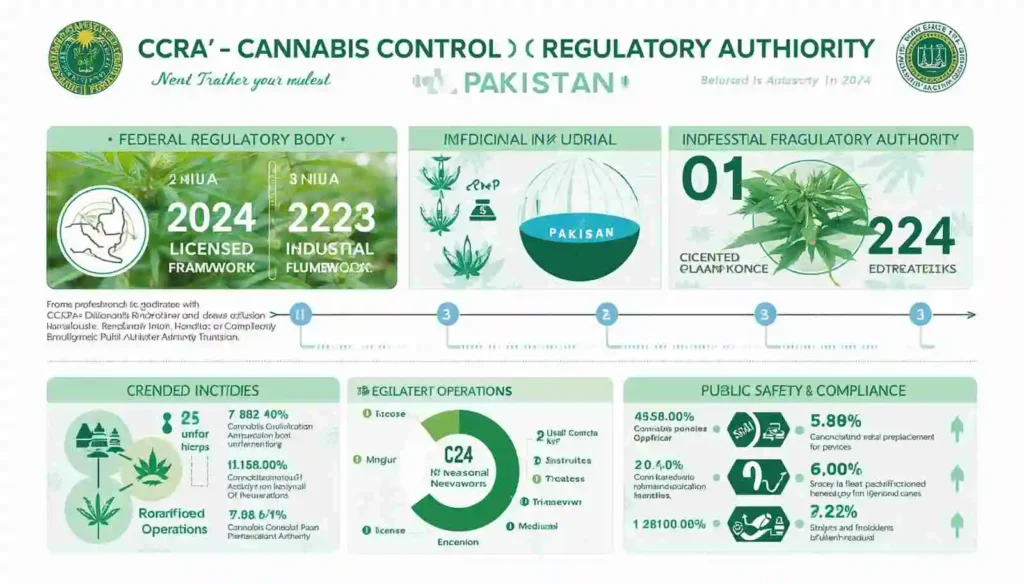
CCRA stands for the Cannabis Control & Regulatory Authority. It is a federal regulatory authority in Pakistan created to regulate the cultivation, extraction, refining, manufacturing, and sale of cannabis and cannabis derivatives for medicinal and industrial purposes, not for open recreational use. The authority appears on the official CCRA website, and the underlying law is the Cannabis Control and Regulatory Authority Act, 2024 listed in the Pakistan Code.
In simple terms, CCRA is the body meant to bring order to a space that used to sit in legal confusion. That matters because without a regulator, you get the usual mess: weak enforcement, vague market claims, poor traceability, and a lot of people pretending they understand the law when they do not.Why Pakistan Created CCRA
Why did Pakistan create CCRA?
Pakistan did not create CCRA for symbolism. It created CCRA to build a formal framework for a sector tied to industrial hemp, medicinal cannabis, controlled processing, research, licensing, and commercial oversight. The legislative and policy language around CCRA repeatedly points to public safety, regulation, structured commercialisation, and the development of medicinal and industrial cannabis products under official control.
There is also an economic angle, and pretending otherwise is naive. Pakistan’s cannabis policy push has been framed around reducing misuse and market manipulation while creating a lawful supply chain that can support domestic development, exports, and investment under state supervision.
When was CCRA established?
The legal framework moved in stages, which is where many articles get lazy and confused.
CCRA first appeared through a 2024 ordinance, and the authority was later placed on a firmer legislative footing through the Cannabis Control and Regulatory Authority Act, 2024, which appears in Pakistan’s official law record. A Cabinet Division memorandum dated March 20, 2024 states that the CCRA was placed under the administrative control of the Cabinet Division. The Senate records also show that the Cannabis Control and Regulatory Authority (Amendment) Act, 2026 exists, which means the framework is still evolving.
That last point matters. Anyone speaking about this sector as if the law froze in 2024 is already behind.
What does CCRA regulate?
CCRA’s official mandate is broad. Search results from the authority’s own site describe it as regulating the cultivation of the cannabis plant, extraction, refining, manufacturing, and sale of derivatives for medicinal and industrial purposes. The official site also describes its role as regulating, supervising, and controlling the sector with a focus on traceability, accountability, and compliance.
Industrial hemp
CCRA licensing materials and policy excerpts show that industrial hemp cultivation is part of the regulated space. The authority’s public licensing pages list industrial hemp cultivation among the formal license categories.
Medicinal cannabis
The official license list also includes medicinal cannabis cultivation, including controlled and open-field categories. That tells you the framework is not limited to hemp alone. It covers medicinal cannabis as a regulated category under state oversight.
Extraction, manufacturing, and sale of derivatives
This is where CBD businesses should pay attention. The official mandate does not stop at farming. It extends into extraction, refining, manufacturing, and sale of derivatives, which is why CCRA matters to processors, manufacturers, and brands, not just growers.
What licenses does CCRA issue?
CCRA’s own licensing materials show multiple license classes. The public license list includes at least:
- A-1: Industrial Hemp Cultivation
- A-2: Medicinal Cannabis Cultivation (Controlled)
- A-3: Medicinal Cannabis Cultivation (Open Field)
The public search snippets do not show every class in full, but they make one thing clear: Pakistan is not treating this as an informal activity. It is a licensed, categorised, monitored sector. That is exactly what serious operators want and exactly what shortcut merchants hate.
Who can apply for a CCRA license?
According to the CCRA licensing prerequisites page as reflected in search results, an applicant must be a Pakistani citizen or an entity incorporated in Pakistan under relevant laws. The same result also notes that foreign investors are contemplated within the framework, but under defined conditions rather than casual entry.
That means the authority is not designed for random social-media sellers who bottle something in the dark and call it wellness. It is designed for traceable, licensable operators.
Is CBD legal in Pakistan under CCRA?
This is where weak content usually lies to the reader.
The careful answer is: CCRA creates the regulatory framework for cannabis activities for medicinal and industrial purposes, but that does not mean every CBD product on the market is automatically lawful, approved, or compliant. CCRA regulates the supply chain through licensing and oversight. Whether a product is compliant depends on how it is sourced, processed, labelled, and handled within the applicable regulatory framework. Official materials point to regulation of derivatives and licensing, not a blanket “everything CBD is freely legal” message.
That distinction matters for consumers in Lahore, Karachi, Islamabad, and everywhere else. A product being sold online does not prove it is compliant. A clean-looking label proves even less.
How CCRA affects farmers, processors, exporters, and CBD brands
CCRA changes the conversation for several groups.
Farmers
For cultivators, the key issue is whether they fall inside the formal licensing route for industrial hemp or medicinal cannabis. The license categories show that cultivation is no longer something to treat casually.
Processors and manufacturers
For extraction and manufacturing businesses, CCRA matters because the authority’s mandate reaches beyond cultivation into processing and derivatives. That is the part many small operators ignore until paperwork, inspections, or licensing questions hit them.
Export-focused businesses
Pakistan’s policy direction clearly includes structured commercialisation and export potential. Coverage of the 2026 policy approval highlights the government’s intent to curb misuse while creating a more formal economic framework.
CBD brands and retailers
For brands like CBD Pakistan, this creates both pressure and opportunity. Pressure, because the market cannot rely forever on vague claims and half-baked compliance. Opportunity, because brands that educate buyers, explain product sourcing clearly, and act like serious businesses stand out faster when the legal environment gets more structured.
What changed with Pakistan’s National Cannabis Control and Regulatory Policy, 2025?
This is the part most outdated blog posts miss.
Pakistan’s National Cannabis Control and Regulatory Policy, 2025 was later approved by the federal cabinet in January 2026, according to current reporting and CCRA-linked policy material. Official CCRA search snippets describe the policy as the legal roadmap for control and regularisation of the cannabis industry in Pakistan. Recent coverage says the policy was approved to prevent misuse, stop market manipulation, and establish a more structured framework for controlled cultivation, processing, and commercialisation.
So no, the 2024 Act was not the end of the story. The framework is still being operationalised.
CCRA vs recreational cannabis: what is still not allowed?
Here is where people either play dumb or genuinely do not understand the law.
CCRA is tied to medicinal and industrial regulation. That is not the same as an open recreational cannabis market. The authority’s mandate, licensing material, and policy direction all point toward controlled, licensed activity. They do not announce a free-for-all consumer recreational system.
So if someone tells you “Pakistan legalized weed,” they are compressing a regulated industrial-medical framework into a lazy slogan. That is not legal analysis. That is noise.
How to stay compliant if you want to work in Pakistan’s cannabis sector
If you are a founder, investor, or operator, the practical questions matter more than the hype.
1. Understand your category
Figure out whether you are dealing with:
- industrial hemp
- medicinal cannabis
- extraction or refining
- manufacturing
- sale of derivatives
2. Check whether licensing applies
Do not assume you can import, cultivate, extract, bottle, or sell because someone on WhatsApp said so. CCRA’s public materials make clear that licensing is central to the framework.
3. Watch policy updates
The 2026 amendment activity and 2026 policy approval show this area is still moving. What was “roughly right” a year ago may already be incomplete.
4. Prioritise traceability and documentation
CCRA’s own public messaging stresses traceability, accountability, and regulatory sophistication. If a business cannot document what it grows, extracts, processes, or sells, it is building on sand.
5. Educate customers honestly
For CBD brands, honesty is not optional. Buyers need plain-language guidance on what the product is, what it is not, and how it fits into Pakistan’s regulated environment. That is one place where CBD Pakistan can win trust without sounding salesy: explain the rules better than the market does.
Final takeaway
CCRA is Pakistan’s federal Cannabis Control & Regulatory Authority, created to regulate the cultivation, processing, manufacturing, and sale of cannabis and its derivatives for medicinal and industrial purposes under a structured licensing and oversight framework. The authority sits under the Cabinet Division, the legal framework was formalised through the Cannabis Control and Regulatory Authority Act, 2024, and the regulatory picture continued developing with the National Cannabis Control and Regulatory Policy, 2025 approved in January 2026 and later amendment activity in 2026.