CBD oil gets talked about constantly, but very little of that talk explains what it actually does inside the body. For readers in Pakistan, the confusion gets worse when CBD, THC, legality, and medical claims are all thrown together as if they mean the same thing. CBD Pakistan helps readers make sense of that by breaking down how hemp-derived CBD may work, what effects people are usually referring to, and what should be understood before making a purchase or wellness decision.
Here’s the problem: most articles on CBD either oversimplify it or oversell it.
One side says CBD does everything. The other says it is just cannabis in a nicer bottle. Neither is good enough.
What does CBD oil actually do in the body?
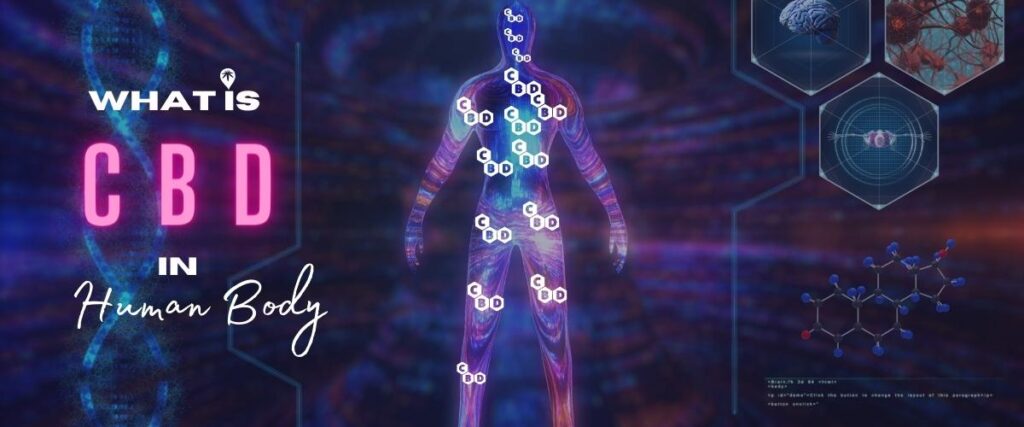
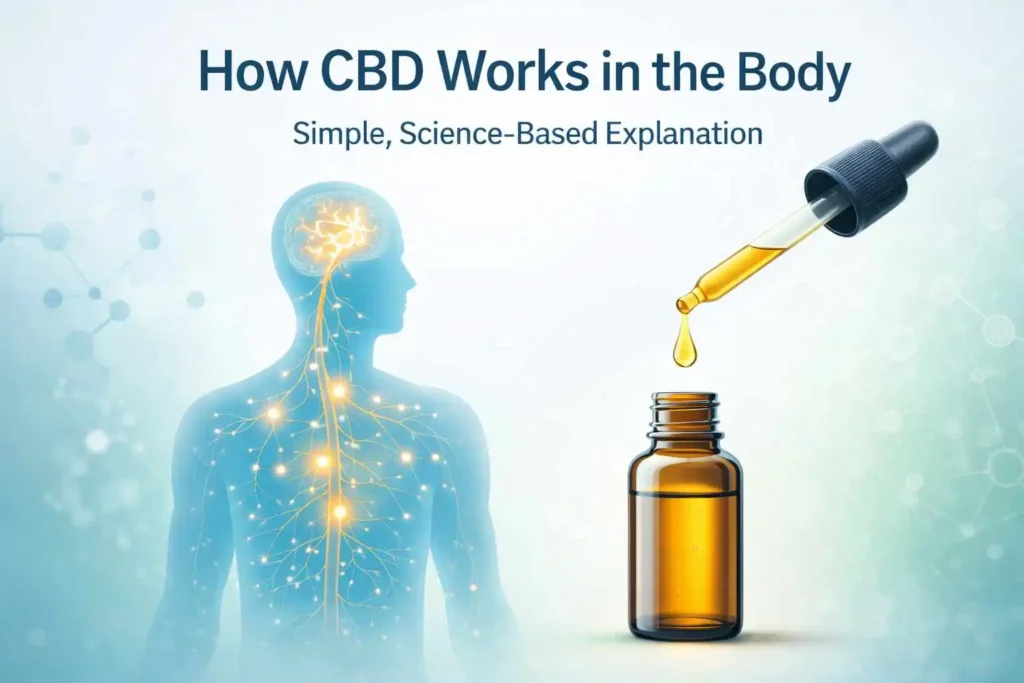
CBD, or cannabidiol, works by interacting with the body’s endocannabinoid system (ECS) and also influencing other signaling pathways involved in things like mood, pain perception, inflammation, and sleep. Researchers describe the ECS as a broad cell-signaling system that helps regulate many day-to-day functions in the body.
That does not mean CBD “fixes” everything. It means CBD may influence systems already involved in balance and regulation.
That difference matters.
The endocannabinoid system explained simply
If the term endocannabinoid system sounds technical, here is the plain-English version:
Your body already has its own signaling network that helps regulate internal balance. This system is involved in functions like sleep, stress response, appetite, pain signaling, memory, and immune activity. Scientists call this the endocannabinoid system.
Think of it as a communication system. Not magic. Not a cure-all. A system.
What are endocannabinoids?
Endocannabinoids are compounds your body makes naturally. They help carry messages within the ECS. One of the better-known examples is anandamide, which is associated with functions including mood and pain regulation. Some research suggests CBD may affect how quickly certain endocannabinoids are broken down, which may influence how strongly they act in the body.
What are CB1 and CB2 receptors?
The ECS includes receptors, commonly referred to as CB1 and CB2.
- CB1 receptors are found largely in the brain and central nervous system.
- CB2 receptors are more associated with immune tissues and peripheral systems.
This is one reason CBD conversations often touch on mood, pain, inflammation, and stress. Those topics overlap with systems the ECS helps regulate.
How CBD interacts with the body
This is where people usually get lost.
CBD does not appear to work exactly like THC. THC is known for binding more directly to cannabinoid receptors in ways that are linked to intoxication. CBD is often described as working more indirectly and more broadly, including through effects on enzymes, receptors, and signaling pathways beyond just CB1 and CB2.
CBD does not work exactly like THC
That is why CBD and THC should never be treated as the same thing.
THC is the cannabinoid most strongly associated with the classic cannabis high. CBD is generally described as non-intoxicating, even though it can still influence how certain systems in the body behave.
If your readers need that comparison, this is a natural internal link:
CBD vs THC
Why CBD is often described as indirect
One commonly cited explanation is that CBD may inhibit FAAH, an enzyme involved in breaking down anandamide. If anandamide stays around longer, its effects may last longer too. Researchers also discuss CBD’s interactions with serotonin-related and other receptor systems, which may help explain why CBD is often discussed in relation to stress, mood, and discomfort.
So when people ask, “How does CBD work in the body?” the honest answer is:
It seems to support and modulate signaling systems rather than acting like a blunt on-off switch.
That is less catchy than the marketing version. It is also more accurate.
What body functions may CBD influence?
Based on current research and common medical summaries, CBD is often discussed in connection with:
- stress response
- sleep
- pain perception
- inflammation
- mood regulation
- appetite
- immune signaling
That does not mean CBD is proven to treat every issue in those categories. It means these are the systems most often mentioned when experts describe how CBD may work in the body. Mayo Clinic and WebMD both note that CBD may have effects but can also cause side effects and drug interactions, so readers should not treat it like harmless flavored oil.
For readers asking what it may be used for, this is another useful supporting article:
CBD Pakistan FAQs
How long does CBD take to work?
This depends on how it is taken, the person’s metabolism, the serving size, and the formulation.
That is the part casual buyers underestimate. Someone in Karachi taking an oil sublingually may describe the experience differently from someone swallowing capsules after a heavy dinner. Same compound, different timing.
In general, the onset and duration can vary depending on the route of use and metabolism. That is why people should avoid expecting the exact same timing from every product or every person.
Can CBD oil make you feel high?
Usually, no.
CBD itself is generally described as non-intoxicating, unlike THC. That is one of the clearest distinctions in both medical summaries and consumer health guidance.
Still, some products may contain trace THC or be poorly labeled, which is where confusion starts.
If you want to address that directly, link here:
Will CBD Oil Get You High?
and
Can CBD Oil Make You Hallucinate?
What is CBD oil useful for?
This is one of the most common follow-up questions in search results.
CBD is often discussed for general wellness support, especially around stress, sleep, inflammation, and discomfort. There is also one major point people miss: a prescription form of cannabidiol exists for certain seizure disorders, which shows CBD has recognized medical relevance in some narrow contexts. But that does not mean every CBD oil on the market is an approved medicine.
So the balanced answer is:
CBD oil may be useful in wellness or medical contexts depending on the product and the purpose, but readers should be skeptical of broad cure-all claims.
Is CBD oil considered a drug?
It depends on the context.
CBD is a compound. A CBD oil can be sold as a wellness product, researched as a therapeutic substance, or formulated as a prescription medicine in specific approved cases. Mayo Clinic and FDA-linked guidance make this distinction important: some forms of cannabidiol are used medically, but many consumer CBD products are not approved medicines.
That means your article should avoid saying:
- “CBD is just a drug”
or - “CBD is definitely not a drug”
Both are lazy.
Is CBD oil legal in Pakistan?
This needs careful wording.
Pakistan has a formal cannabis regulatory structure in place, including the Cannabis Control and Regulatory Authority and the National Cannabis Control and Regulatory Policy – 2025. That means the topic is regulated, not something you should summarize with a one-line claim copied from an outdated blog.
The safer wording for readers is:
The legal status of CBD-related products in Pakistan is regulated and evolving. People should check current rules, product source, formulation, and THC content before assuming a product is compliant.
This is a natural internal link opportunity:
CBD Pakistan FAQs
How to approach CBD more carefully in Pakistan
Too many buyers jump from curiosity to checkout without doing the boring part first.
That is how people end up confused, disappointed, or relying on shaky seller claims.
Use this approach instead:
1. Understand the CBD-THC difference
Do not treat all cannabis-derived products as the same.
Read: CBD vs THC
2. Look at what the product claims to do
If a product promises to cure everything from anxiety to joint pain to sleep in one sentence, that is a red flag.
3. Check the formulation
The body may respond differently depending on dose, delivery method, and whether THC is present.
4. Pay attention to side effects and interactions
CBD may cause side effects such as drowsiness, fatigue, diarrhea, and appetite changes, and it may interact with medications.
5. Start with education, not impulse
This is where CBD Pakistan is useful. The site works best when readers use it the right way: to understand what CBD is, how it differs from THC, and what questions to ask before buying or using anything.
Final takeaway
CBD oil works in the body mainly by interacting with the endocannabinoid system and influencing signaling pathways related to balance, stress, pain, sleep, and inflammation. But it does not work like THC, and it is better understood as a modulator than a magic fix.